| Major Groups > Polypores > Spongipellis unicolor |

|
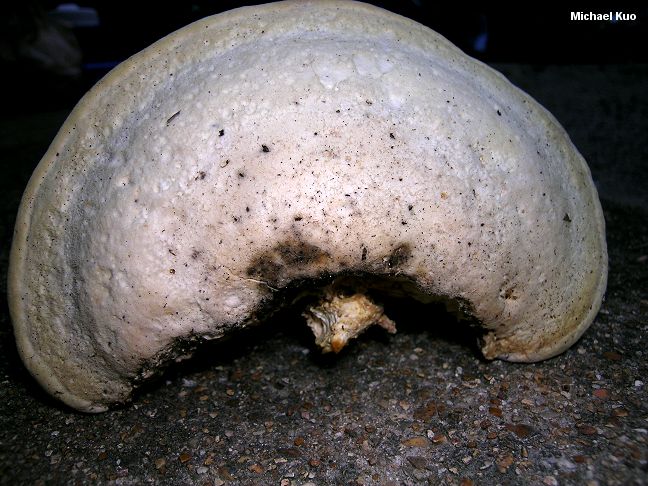
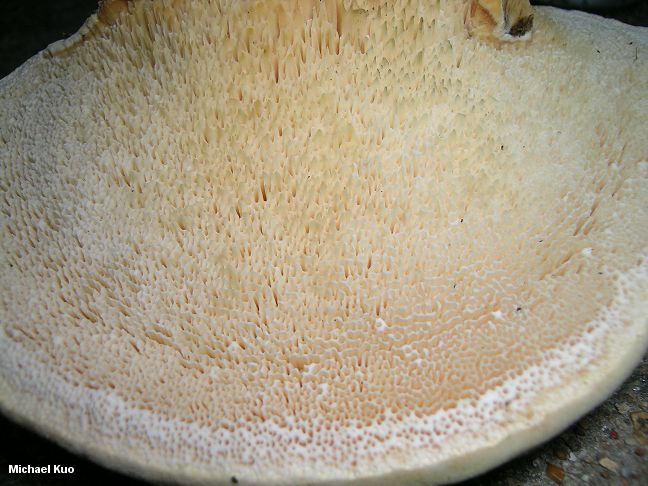
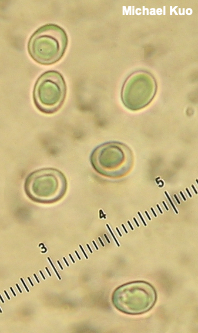
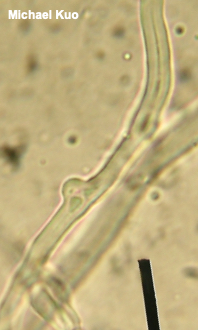
Spongipellis unicolor [ Basidiomycota > Polyporales > Cerrenaceae > "Spongipellis" . . . ] by Michael Kuo Spongipellis unicolor is kind of a big, doinky doofus among the polypores. Its large, spongy, buff-colored cap usually appears alone, on the side of an oak tree. Its pore surface is composed of large, angular pores that can become slot-like or even tooth-like in old age. It causes a white trunkrot, and while it is not often mentioned in field guides (perhaps because it's too much of a doofus?), it can be found wherever oaks occur on our continent. The genus Spongipellis, in theory, holds polypores that feature thick-walled spores that turn blue when mounted in cotton blue, along with two-layered, zoned flesh—but recent studies (Tomsovsky 2012, Justo and collaborators, 2017) have not upheld the idea that mushrooms sharing this combination of features belong together. In fact Spongipellis unicolor's days as a Spongipellis are numbered, since it (along with Spongipellis pachyodon) is not very closely related to the official "type species" of the genus Spongipellis (Spongipellis spumea). Justo and collaborators (2017) place Spongipellis in a new family, the Cerrenaceae, which also contains Cerrena unicolor, but the authors do not create a new genus for Spongipellis pachyodon and Spongipellis unicolor. Tyromyces unicolor and Polyporus obtusus are former names. Thanks to Chris Crabtree for collecting, documenting, and preserving Spongipellis unicolor for study; his collection is deposited in The Herbarium of Michael Kuo. Description: Ecology: Parasitic on living oaks—primarily those in the "red oak" subgenus, Lobatae; appearing on the side of the tree, above ground; causing a dark trunkrot; annual; usually growing alone; widely distributed in North America where oak species occur. The illustrated and described collections are from Missouri. Cap: 10–20 cm across; 5–15 cm deep; semicircular to kidney-shaped; convex; dry; finely hairy to velvety, becoming finely velvety, matted, or bald; buff to pale brownish; without zones; the margin thick and rounded. Pore Surface: Creamy, sometimes becoming dull yellowish with age; not bruising; with large, angular pores that measure 1–2 mm across and often become slot-like or tooth-like with age, especially near the point of attachment; tubes 1.5–3 cm deep. Stem: Absent. Flesh: Whitish; faintly zoned; spongy above and corky below. Microscopic Features: Spores 5–7 x 4–5 µm; broadly ellipsoid; smooth; walls about 0.5 µm thick; hyaline and often uniguttulate in KOH; inamyloid. Cystidia, setae not found. Hyphal system monomitic; hyphae 2–5 µm wide, walls 0.5–1.5 µm thick, smooth, hyaline in KOH, with conspicuous clamps and frequent branching. REFERENCES: (Schweinitz, 1822) Murrill, 1907. (Saccardo, 1888; Spaulding, 1905; Overholts, 1953; Smith, Smith & Weber, 1981; Gilbertson & Ryvarden, 1987; Tomsovsky 2012; Justo et al., 2017.) Herb. Kuo 09261701. This site contains no information about the edibility or toxicity of mushrooms. |
© MushroomExpert.Com |
|
Cite this page as: Kuo, M. (2018, November). Spongipellis unicolor. Retrieved from the MushroomExpert.Com Web site: http://www.mushroomexpert.com/spongipellis_unicolor.html |