| Major Groups > Polypores > Cerrena unicolor |

|
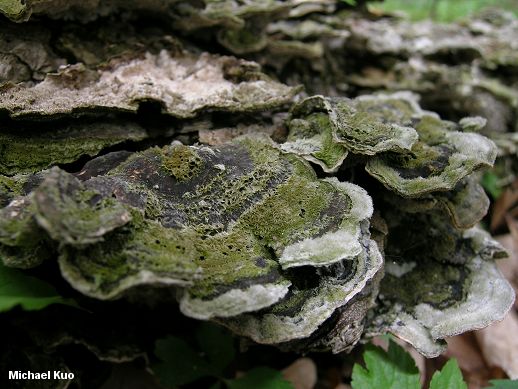
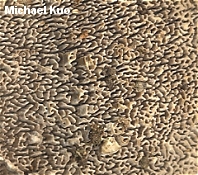
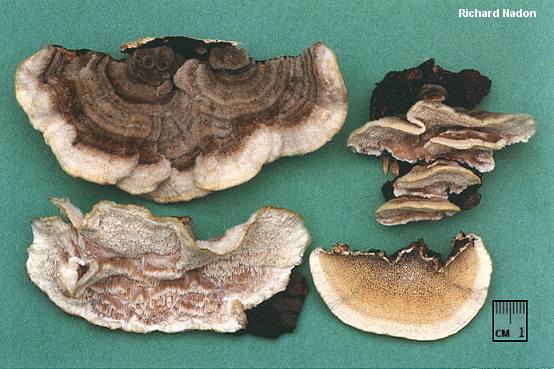
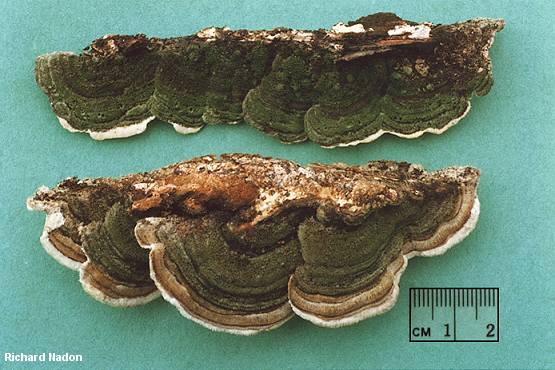
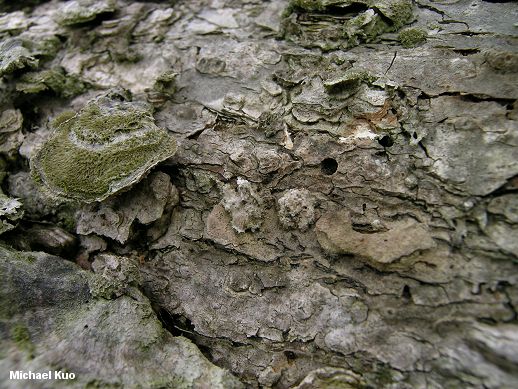
Cerrena unicolor [ Basidiomycota > Polyporales > Cerrenaceae > Cerrena . . . ] by Michael Kuo One of many turkey-tail-ish little polypores that are often ignored by mushroom hunters, Cerrena unicolor is actually fairly easy to identify if you take the time to examine it closely. The underside features a whitish to gray, maze-like surface that becomes tooth-like as the mushroom matures--and the fuzzy upper surface is whitish to grayish but often appears green from algae. But identifying Cerrena unicolor isn't nearly as thrilling as discovering the fascinating relationship it has with the horntail wasp (Tremex columba) and the ichneumonid wasp (Megarhyssa spp.). It's a complicated story, and I admit I have not done exhaustive research, but the broad strokes are as follows: Cerrena unicolor spores get into the ovipositor of the wood-boring wasp (the horntail) when she drills into hardwood logs (often logs of beech). The spores get carried around with the wasp's eggs, and wind up germinating when eggs are laid; mycelium grows quickly and serves as the food source for larvae. But since horntail populations would get out of control without a predator on horntail larvae, the ichneumon wasp enters the picture; it is parasitic on horntail larvae. Cerrena unicolor apparently helps the ichneumon wasp find the horntail larvae buried in the wood by emitting a pheromone. Description: Ecology: Saprobic on the deadwood of hardwoods (very rarely reported on conifers); causing a white rot; annual; growing in overlapping clusters; found year-round; widely distributed in North America but rare or absent in the Southwest. Fruiting Body: Sometimes lacking a cap (especially when growing on the undersides of logs), appearing like a pore surface that lost its mushroom, but more commonly with a kidney-shaped to fan-shaped cap 3-10 cm across; upper surface velvety to hairy, whitish to brownish but often appearing green from algae; usually with concentric zones of texture and/or color. Pore Surface: Whitish when young, becoming gray; pores maze-like or slot-like, becoming tooth-like with age; tubes to 4 mm deep. Flesh: Whitish; with a dark line just beneath the cap surface; leathery. Spore Print: White. Microscopic Features: Spores 5-7 x 2.5-4 µ; smooth; long-elliptical; inamyloid; hyaline in KOH. Hyphal system trimitic. REFERENCES: (Bulliard, 1785) Murrill, 1903. (Persoon, 1801 [D. cinerea]; Fries, 1821 [D. cinerea]; Saccardo, 1888 [D. cinerea]; Overholts, 1953; Smith, Smith & Weber, 1981; Gilbertson & Ryvarden, 1986; Phillips, 1991/2005; Lincoff, 1992; Barron, 1999; Roody, 2003; McNeil, 2006; Binion et al., 2008; Kuo & Methven, 2010.) Herb. Kuo 04270706, 04100903. This site contains no information about the edibility or toxicity of mushrooms. |
© MushroomExpert.Com |

|
Cite this page as: Kuo, M. (2007, March). Cerrena unicolor. Retrieved from the MushroomExpert.Com Web site: http://www.mushroomexpert.com/cerrena_unicolor.html |