| Major Groups > Gilled Mushrooms > Pale-Spored > Cystoderma & Cystodermella > Cystodermella cinnabarina |

|
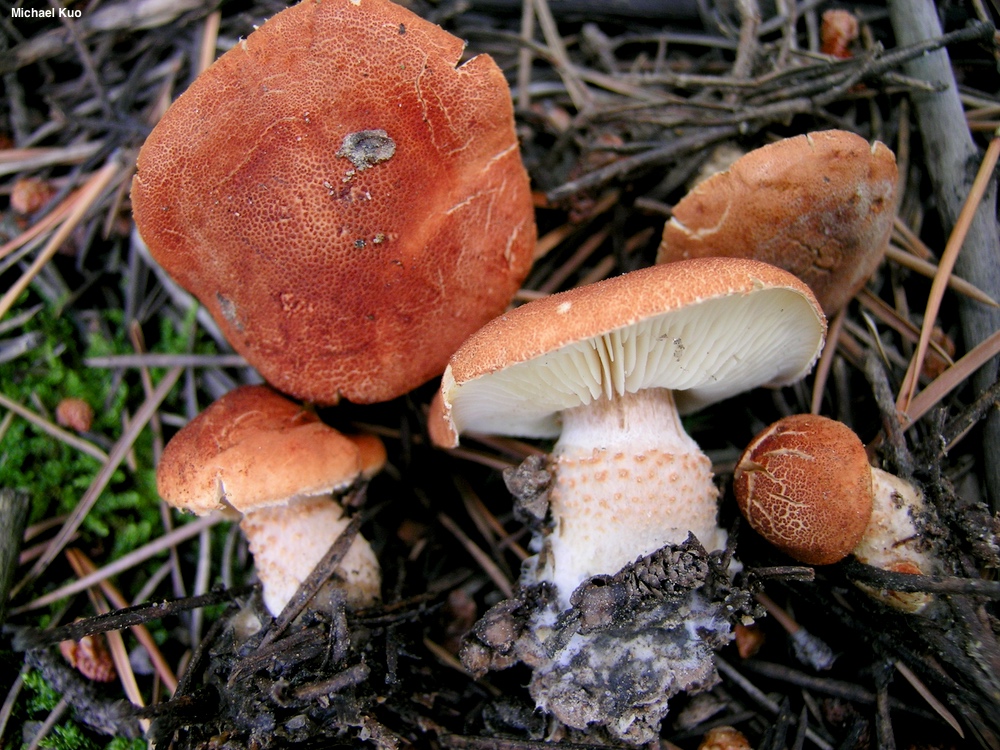
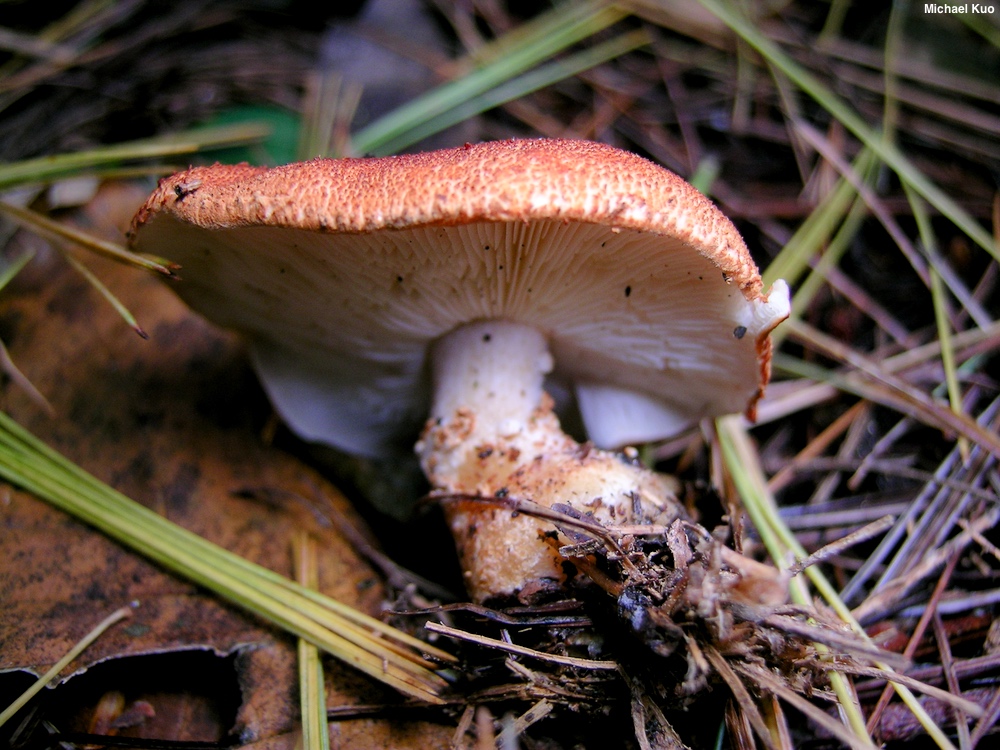
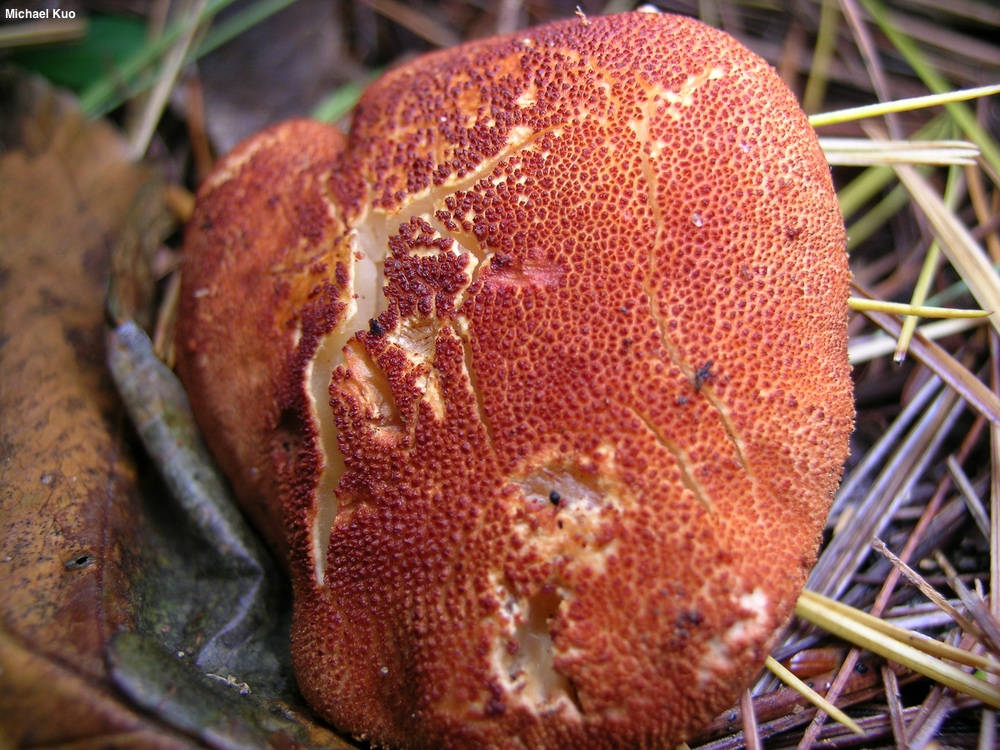
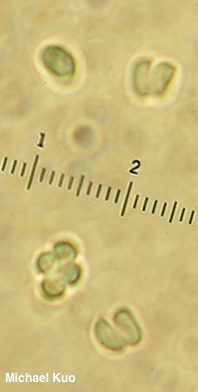
[Basidiomycota > Agaricales > Agaricaceae > Cystodermella . . . ] Cystodermella cinnabarina by Michael Kuo, 21 December 2025 This attractive mushroom has a reddish orange cap that is covered with mealy granules, and a stem that lacks a sturdy ring, but is distinctively sheathed. It is a saprobe under conifers, helping to decompose needle duff and forest debris. The color of the cap and the habitat under conifers, together with its fairly large size, will separate Cystodermella cinnabarina from many other cystodermas—but a microscope is required to separate it from Cystodermella adnatifolia, which is virtually identical to the naked eye but lacks the distinctive cystidia found on the gills of Cystodermella cinnabarina. Cystoderma terreii (variously spelled terreyi and terrei) is a synonym, as is Cystoderma cinnabarinum. Description: Ecology: Saprobic; growing alone or gregariously under conifers (sometimes fruiting from well rotted wood); summer and fall, or over winter in warm climates; originally described from Portugal (Albertini & Schweinitz 1805) and neotypified from Estonia (Saar et al. 2024b); widely distributed in Europe and North America. The illustrated and described collections are from Colorado and Kentucky. Cap: 3–6 cm; dry; convex at first, becoming broadly convex or nearly flat; covered with mealy, granular scales; orange-red to reddish orange or rusty cinnamon. Gills: Attached to the stem but pulling away from it by maturity; close or crowded; short-gills frequent; white to creamy. Stem 2–4 cm long; 1–1.5 cm thick; more or less club-shaped; dry; bald and whitish to pale cinnamon near the apex, but sheathed with reddish orange granular scales from the base upwards, with the sheath sometimes terminating in a flimsy ring zone; the granules often wearing away as the mushroom matures, exposing a coarse, whitish surface below; basal mycelium white. Flesh: Whitish; unchanging when sliced. Odor and Taste: Odor slightly fruity, or not distinctive. Chemical Reactions: KOH purple to black on cap surface. Spore Print: White. Microscopic Features: Spores 3–5 x 2–3 µm; ellipsoid to subcylindric; smooth; inamyloid; hyaline in KOH. Basidia 16–18 x 3–4 µm; subclavate; 4-sterigmate. Cheilocystidia 30–55 x 2–5 µm; cylindric-aciculate to narrowly fusiform; smooth below, but often developing an encrusted, harpoonlike apex; hyaline in KOH. Pleurocystidia scattered or often absent; when present similar to cheilocystidia. Pileipellis a trichoderm of chained, subglobose, smooth or slightly roughened elements 8–40 µm wide, with orangish brown walls in KOH. Clamp connections present. REFERENCES: (J. B. von Albertini & L. D. von Schweinitz, 1805) H. Harmaja, 2002. (Graham, 1944; Smith & Singer, 1945; Smith & Singer, 1948; Smith, 1949; Harmaja, 1979; Smith, Smith & Weber, 1979; Phillips, 1991/2005; Schalkwijk-Barendsen, 1991; Breitenbach & Kränzlin, 1995; Barron, 1999; Nonis, 2001; Saar, 2003; Sesli, 2005; McNeil, 2006; Miller & Miller, 2006; Boccardo et al., 2008; Saar et al., 2009; Trudell & Ammirati, 2009; Kuo & Methven, 2010; Buczacki et al., 2012; Saar, 2012; Saar & Voitk, 2013; Kuo & Methven, 2014; Siegel & Schwarz, 2016; Cripps, Evenson & Kuo, 2016; Baroni, 2017; Læssøe & Petersen, 2019; Kibby, 2020; McKnight et al., 2021.) Herb. Kuo 10160404, 08130705, 08130706. This site contains no information about the edibility or toxicity of mushrooms. |
© MushroomExpert.Com |


|
Cite this page as: Kuo, M. (2025, December). Cystodermella cinnabarina. Retrieved from the MushroomExpert.Com Web site: http://www.mushroomexpert.com/cystodermella_cinnabarina.html |