[ Basidiomycota > Agaricales > Squamanitaceae / Agaricaceae . . . ]
Cystoderma and Cystodermella
by Michael Kuo, 23 December 2025
Unfortunately, cystodermas are not frequently encountered. While they're not rare, most mushroom collectors don't see them very often. In 30 years of mushrooming I've only seen them about 10 times in the woods, and even when I add another one or two collections per year I've "found" on specimen tables at mycological society forays, I still can't say I've seen them often.
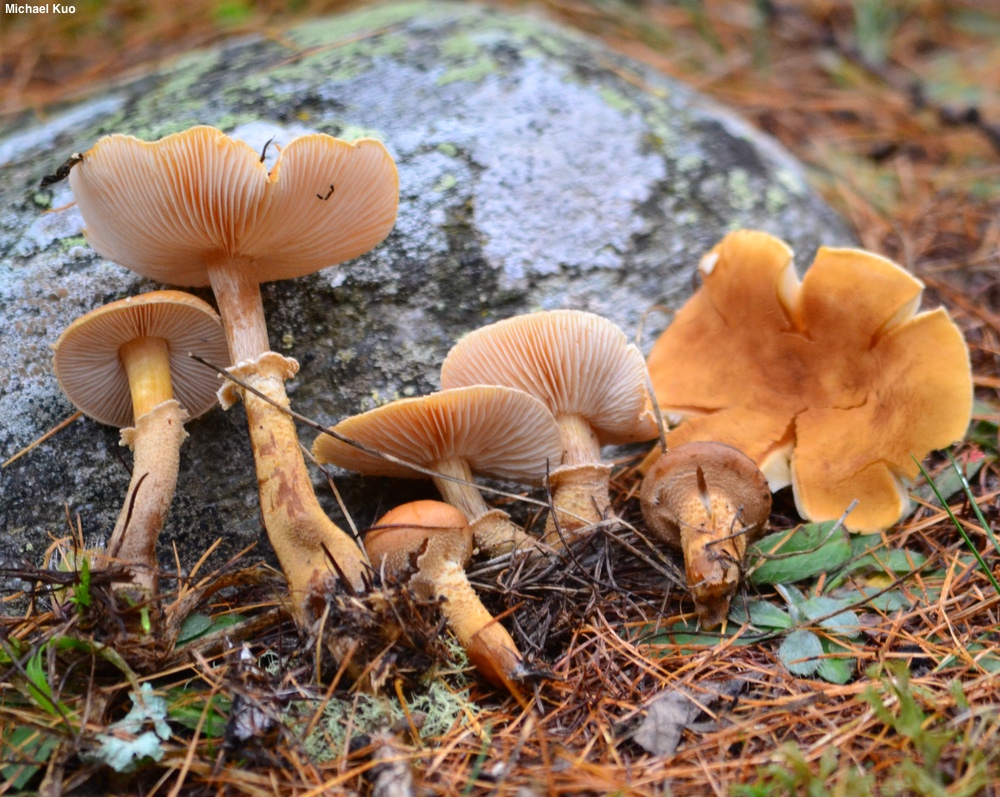
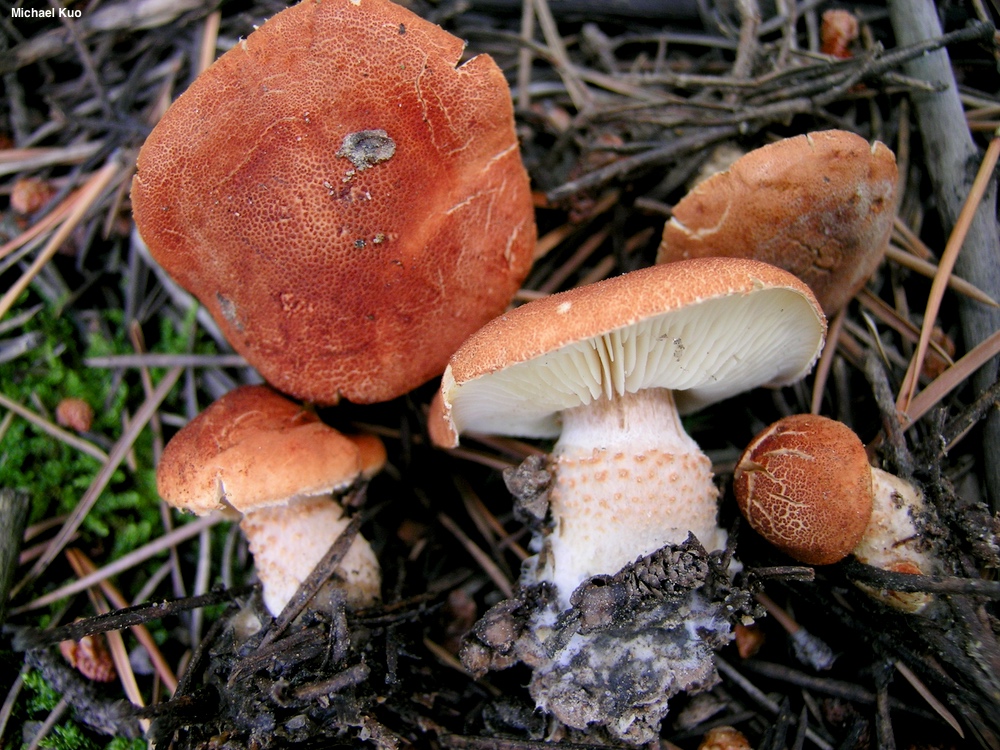
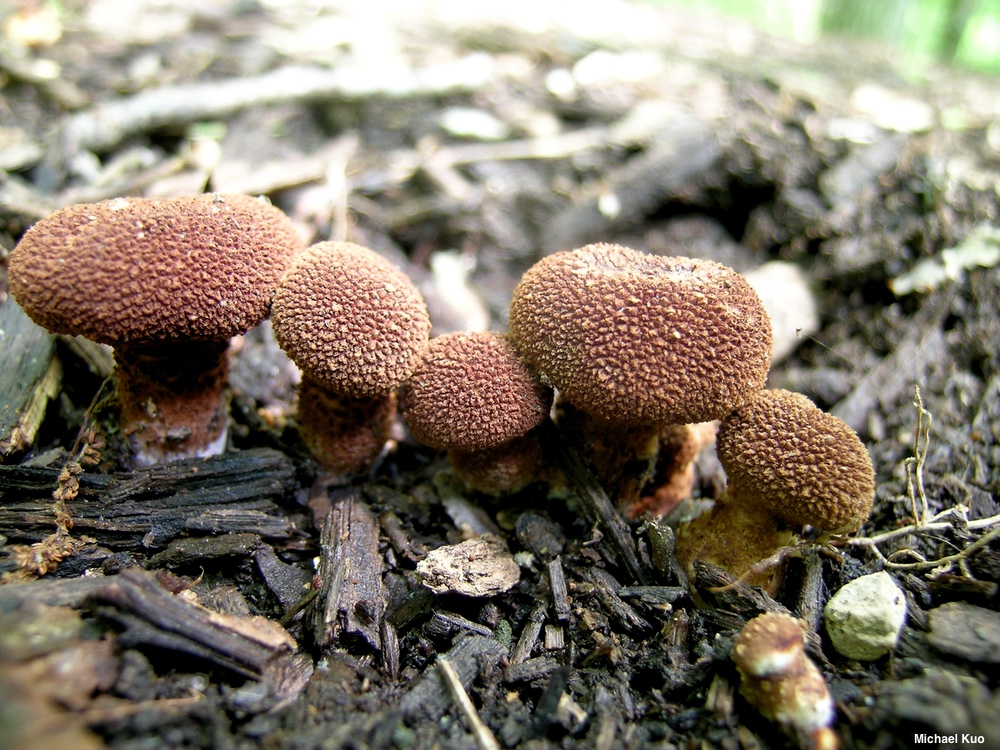
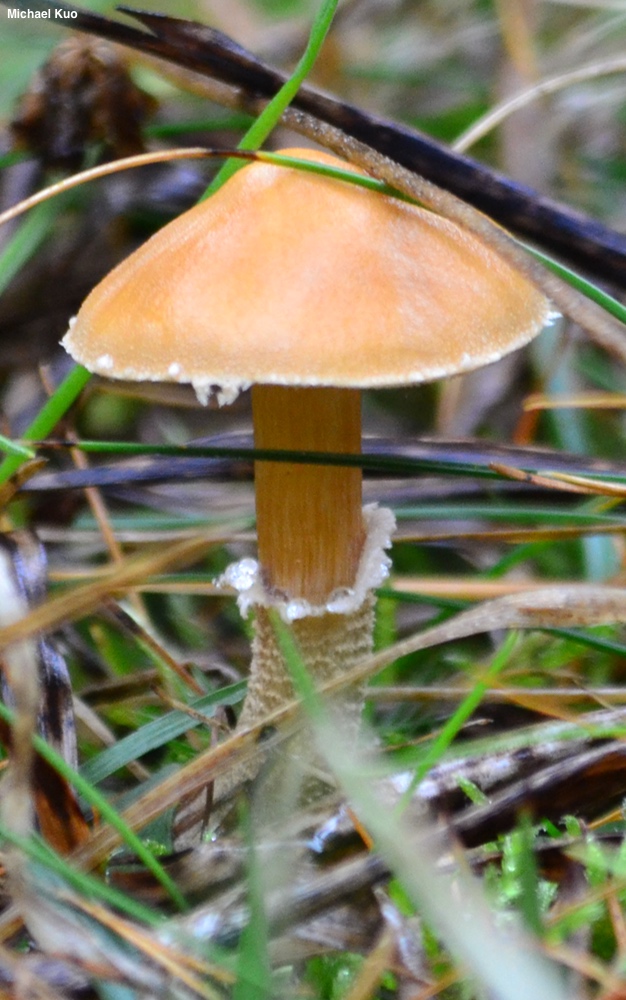
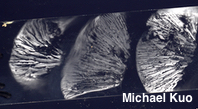
I'm using the term "cystodermas" for mushrooms in the genera Cystoderma and Cystodermella, which form a relatively small number of saprobic gilled mushrooms, fairly easily recognized by a combination of features:
- A white spore print;
- Gills that are attached to the stem;
- A cap and stem that are densely covered (at least when young) with powdery granules that are easily rubbed off;
- A pileipellis with inflated, chained-together terminal elements;
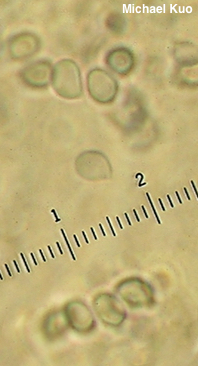
- Ellipsoid, smooth spores that are either amyloid or inamyloid, but never dextrinoid.
Your field guide may treat species of Cystoderma and Cystodermella together as species of Cystoderma, since the two genera were split apart fairly recently (Harmaja 2002). But while Cystoderma and Cystodermella contain similar-looking mushrooms, they are actually not very closely related; Cystodermella is more closely related to the brown-spored species of Agaricus (and many other genera) than it is to Cystoderma (see Saar et al. 2009).
Identification of American and Canadian cystodermas is sometimes a relatively easy matter of close observation of fresh specimens, but microscopic analysis is occasionally required. And it must be said that cystoderma features in nature are not as consistent as cystoderma features in the literature, especially when it comes to colors. Another easy identification balloon burster is the fact that North American cystodermas have not been studied with anything approaching a thorough sampling of collections using contemporary, DNA-informed methods; there could be many unnamed and potentially cryptic species.
Key to 15 Cystodermas in the United States and Canada 
| 1. | Stem with a persistent, flaring ring. | 2 |
| 1. | Stem without a ring—or with a flimsy an ephemeral ring, or a ring zone. | 4 |
| 2. | Fresh cap and stem golden yellow; spore print yellowish to yellow-brown; spores inamyloid; often found in grassy areas and landscaping areas in urban settings; distributed from the Pacific Northwest to Alaska. | Phaeolepiota aurea |
| 2. | Fresh cap rusty orange to rusty brown or brown; spore print white; spores amyloid; found in woods; northern and montane. | 3 |
| 3. | Spores 4–6 µm long; northern and montane. | |
| 3. | Spores 5–10 µm long; boreal. | Cystoderma tuomikoskii
= arcticum |
| 4. | Fresh cap usually orange to red. | 5 |
| 4. | Fresh cap brown to purplish brown, yellowish, or whitish. | 7 |
| 5. | Growing from wood or woody debris of hardwoods; distributed from the Great Plains eastward; spores amyloid. | Cystoderma granosum |
| 5. | Growing terrestrially; widely distributed in North America; spores inamyloid. | 6 |
| 7. | Fresh cap brown to purple brown. | 8 |
| 7. | Fresh cap yellowish to whitish. | 14 |
| 8. | Growing from wood or woody debris. | 9 |
| 8. | Growing terrestrially. | 11 |
| 9. | Found in the Pacific Northwest on deadwood and woody debris of Douglas-fir; spores 9–11 µm long, subfusiform, amyloid. | Cystoderma gruberianum |
| 9. | Found east of the Rocky Mountains; spores smaller than above, ellipsoid, amyloid or inamyloid. | 10 |
| 10. | Described from Florida in 1945 and not reliably documented since; cheilocystidia present; spores inamyloid; cap rusty brown. | Cystodermella australis |
| 10. | Distributed in the Great Lakes region; cheilocystidia absent; spores inamyloid or weakly amyloid; cap wine brown. | Cystoderma subvinaceum |
| 11. | Distributed in the Pacific Northwest; fresh cap purplish brown. | Cystodermella subpurpurea |
| 11. | Variously distributed; fresh cap without purple shades. | 12 |
| 12. | Fairly widely distributed in North America; fresh cap brown, medium sized at maturity; spores inamyloid. | |
| 12. | Distributed in northern and montane areas; fresh cap yellow-brown, fairly small; spores amyloid. | 13 |
| 13. | Stem usually 1–2 times longer than the width of the cap; spores 5–6 µm long. | |
| 13. | Stem usually more than twice as long as the width of the cap; spores 6–8 µm long. | Cystoderma jasonis |
| 14. | Fresh cap usually yellowish (occasionally brownish or whitish); odor often unpleasant. | 15 |
| 14. | Fresh cap usually whitish; odor not distinctive. | 16 |
| 15. | Stem usually 1–2 times longer than the width of the cap; spores 5–6 µm long. | |
| 15. | Stem usually more than twice as long as the width of the cap; spores 6–8 µm long. | Cystoderma jasonis |
| 16. | Growing from wood; distribution uncertain (originally described from New York and Michigan); spores amyloid. | Cystoderma pulveraceum |
| 16. | Growing terrestrially under pines; originally described from Texas in 1957 and possibly not documented since; spores inamyloid. | Cystodermella texense |
References
Harmaja, H. (1979). Studies in the genus Cystoderma. Karstenia 19: 25–29.
Harmaja, H. (2002). Amylolepiota, Clavicybe and Cystodermella, new genera of the Agaricales. Karstenia 42: 39–48.
Matheny, P. B. & G. W. Griffith (2010). Mycoparasitism between Squamanita paradoxa and Cystoderma amianthinum (Cystodermateae, Agaricales). Mycoscience 51: 456–461.
Saar, I. (2003). The genera Cystoderma and Cystodermella (Tricholomataceae) in temperate Eurasia. Mycotaxon 86: 455–473.
Saar, I., K. Põldmaa & U. Kõljalg (2009). The phylogeny and taxonomy of genera Cystoderma and Cystodermella (Agaricales) based on nuclear ITS and LSU sequences. Mycological Progress 8: 59–73.
Saar, I. (2012). The taxonomy and phylogeny of the genera Cystoderma and Cystodermella (Agaricales, Fungi). Dissertationes Biologicae Universitatis Tartuensis 210. Tartu University Press. 35 pp.
Saar, I. & A. Voitk (2013). Cystoderma and Cystodermella of Newfoundland and Labrador. Omphalina 4: 6–13.
Saar, I., R. G. Thorn, E. Nagasawa, T. W. Henkel & J. A. Cooper (2022). A phylogenetic overview of Squamanita, with descriptions of nine new species and four new combinations. Mycologia 114: 769–797.
Smith, A. H. & Singer, R. (1945). A monograph on the genus Cystoderma. Papers of the Michigan Academy of Science 30: 71–124.
Smith, A. H. & R. Singer (1948). Notes on the genus Cystoderma. Mycologia 40: 454–460.
Thiers, H. D. (1957). The agaric flora of Texas. I. New species of agarics and boletes. Mycologia 49: 707–722.
This site contains no information about the edibility or toxicity of mushrooms.
Kuo, Michael (2025, December). Cystoderma and Cystodermella. Retrieved from the Mushroomexpert.Com website: www.mushroomexpert.com/cystoderma.html
All text and images © , Mushroomexpert.com