| Major Groups > Gilled Mushrooms > Pale-Spored > Cystoderma & Cystodermella > Cystodermella adnatifolia |

|
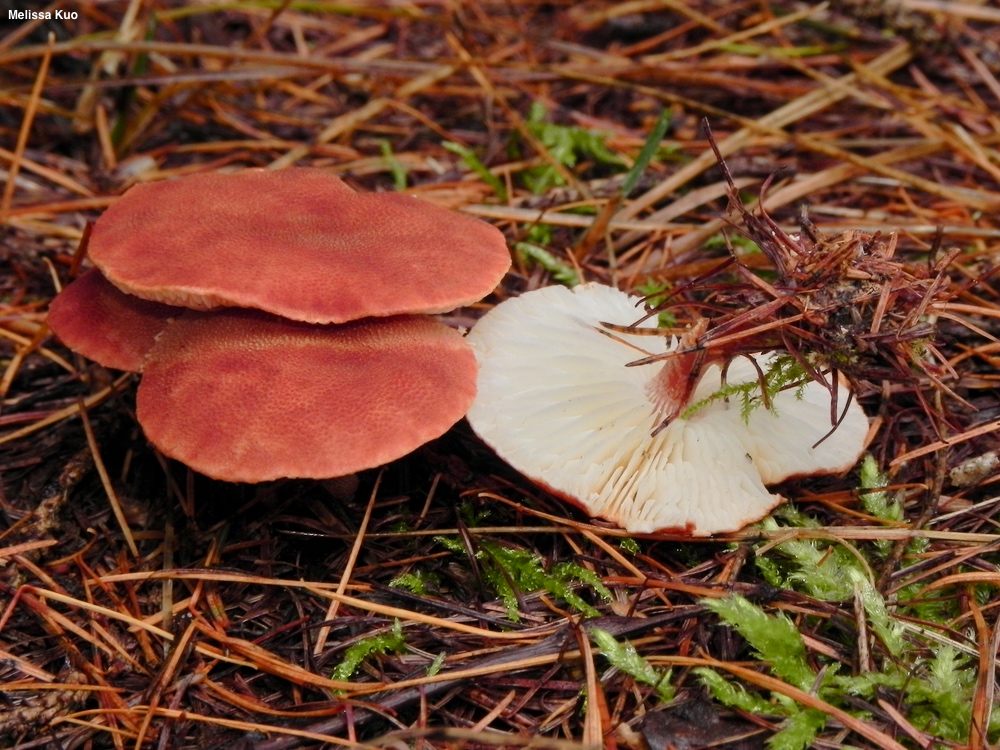
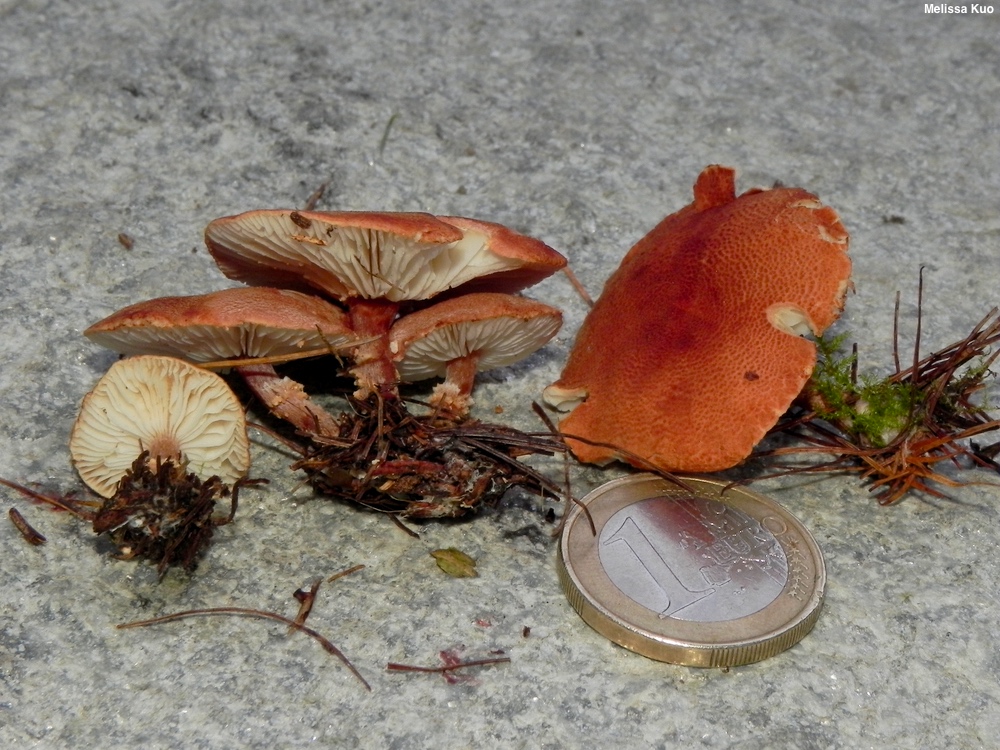
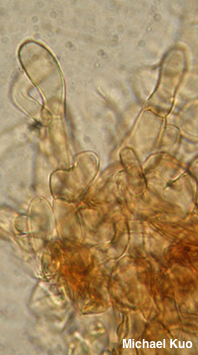
[Basidiomycota > Agaricales > Agaricaceae > Cystodermella . . . ] Cystodermella adnatifolia by Michael Kuo, 22 December 2025 Like other cystodermas, Cystodermella adnatifolia features a white spore print, small powdery scales on the cap and stem, and gills that are attached to the stem. In fact, the epithet adnatifolia refers to the adnate, or attached, gills—because the original author of the species, Charles Peck (1902) thought the species was an outlier within Lepiota, where gills are free from the stem. Peck listed four lepiotas with attached gills: adnatifolia, granosa, rugosoreticulata, and amianthina; all of these are now cystodermas. The orange to red colors of Cystodermella adnatifolia separate it from all other cystodermas except Cystodermella cinnabarina, which is virtually identical in macroscopic features, habitat (on the ground under conifers), and range (Europe and North America). A microscope is required to disentangle this pair; cinnabarina features long, funky-tipped cystidia, while adnatifolia does not. Cystoderma adnatifolia and Cystoderma granulosum var. adnatifolium are synonyms. Description: Ecology: Saprobic; growing alone or gregariously under conifers; summer and fall; originally described from New York (Peck 1901); fairly widely distributed in Europe and North America. The illustrated and described collections are from Illinois and Italy. Cap: 2–4 cm; dry; convex at first, becoming broadly convex or nearly flat; when fresh covered with small, granular scales; orange-red to reddish orange or brownish red. Gills: Attached to the stem; close; short-gills frequent; white. Stem: 2–3 cm long; 3–7 mm thick; equal; dry; sheathed with loose, reddish orange to brownish red granular scales from the base upwards, with the sheath sometimes terminating in a flimsy ring zone; the granules often wearing away as the mushroom matures, exposing a coarse, reddish surface below; basal mycelium whitish. Flesh: Whitish; unchanging when sliced. Odor and Taste: Odor not distinctive. Spore Print: White. Microscopic Features: Spores 4–6 x 2–3 µm; ellipsoid; smooth; inamyloid; hyaline in KOH. Basidia 22–28 x 4–5 µm; subclavate; 4-sterigmate. Hymenial cystidia not found. Pileipellis a trichoderm of chained, subglobose to ellipsoid, smooth elements 6–17 µm wide, with orangish brown walls in KOH. Clamp connections present. REFERENCES: (C. H. Peck, 1902) H. Harmaja, 2002. (Kauffman, 1918; Graham, 1944; Smith & Singer, 1945; Smith & Singer, 1948; Saar, 2003; Saar et al., 2009; Saar, 2012; Saar & Voitk, 2013; Læssøe & Petersen, 2019; Kibby, 2020.) Herb. Kuo 09260902, 10141410. This site contains no information about the edibility or toxicity of mushrooms. |
© MushroomExpert.Com |


|
Cite this page as: Kuo, M. (2025, December). Cystodermella adnatifolia. Retrieved from the MushroomExpert.Com Web site: http://www.mushroomexpert.com/cystodermella_adnatifolia.html |