| Major Groups > Boletes > Suillus > Suillus brevipes |

|
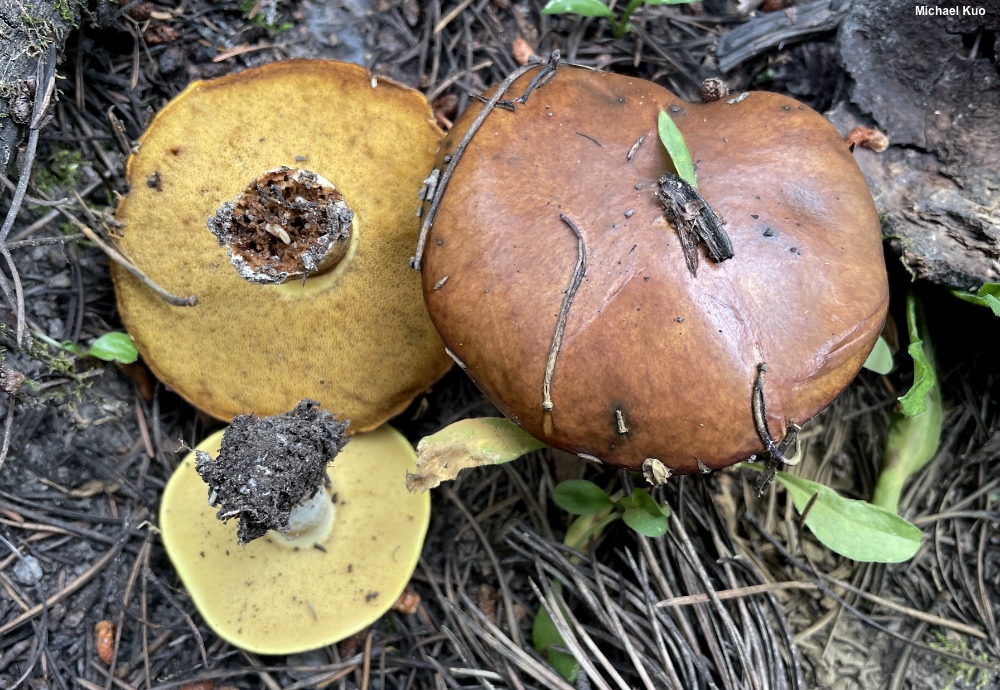
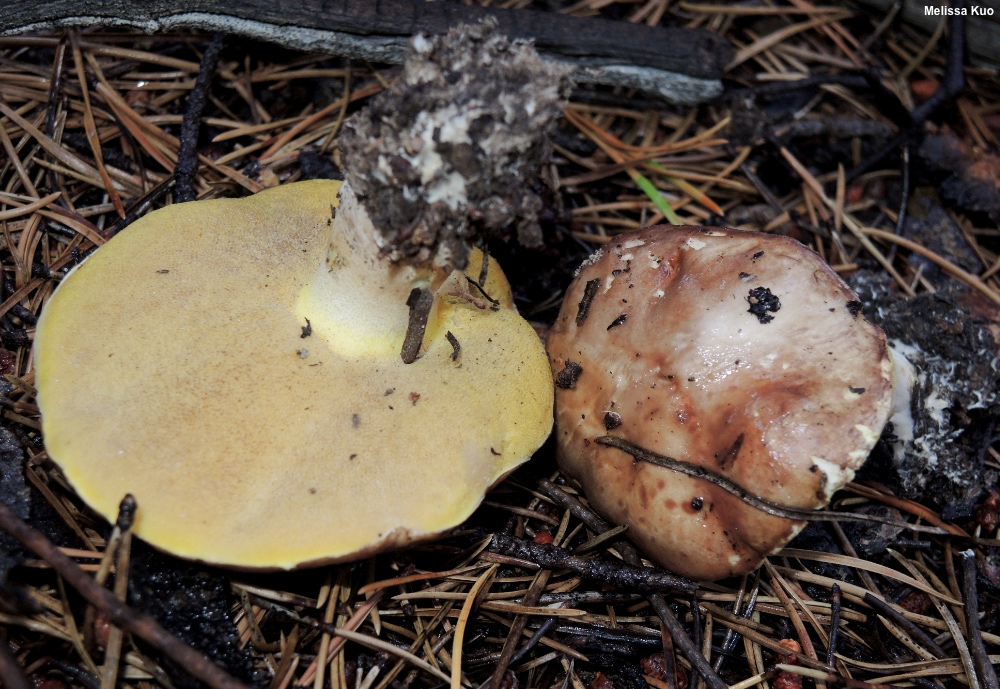
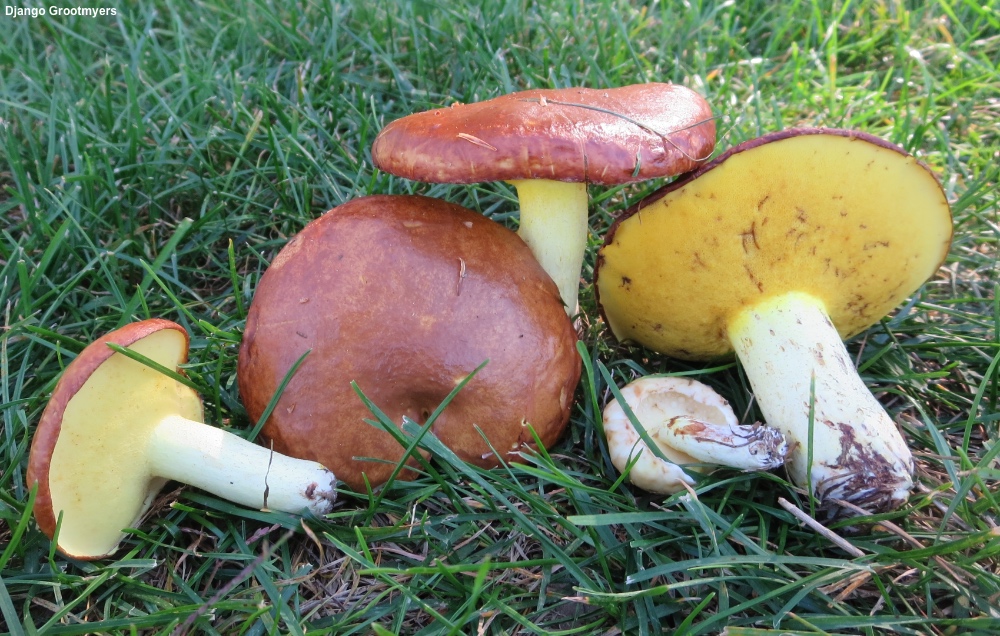
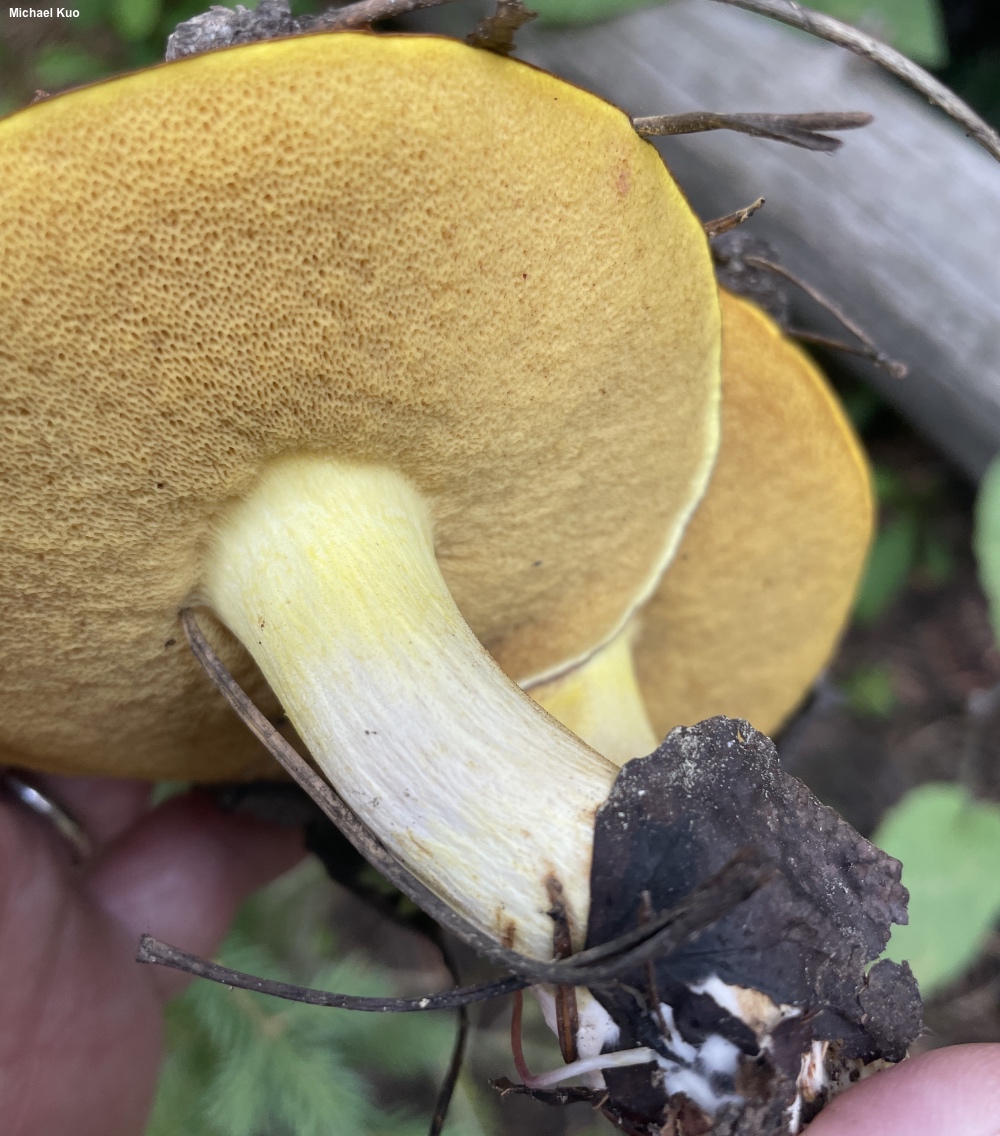
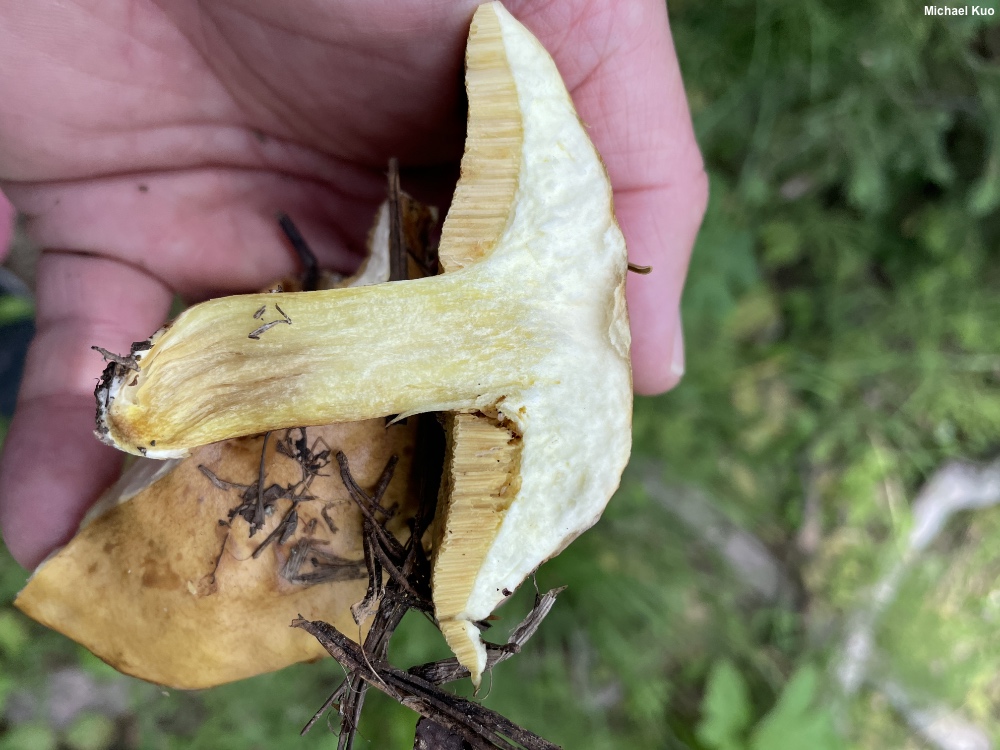
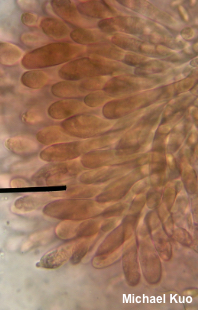
Suillus brevipes [ Basidiomycota > Boletales > Suillaceae > Suillus . . . ] by Michael Kuo Suillus brevipes can be found under hard pines (species of Pinus with needles bundled in twos or threes) throughout much of North America. It is very similar to the better known Suillus weaverae, but differs in its mycorrhizal associations, since Suillus weaverae is a companion of the 5-needled eastern white pine. Additionally, subtle differences in physical features separate the species: Suillus brevipes has a darker, slimier cap when fresh and young, and the stem's glandular dots are nearly invisible to the naked eye. The epithet brevipes reflects the tendency of the stem to be short and squat—but this is not always the case, and "squattiness" should not be the principal means of identifying the species. Western North America's Suillus pseudobrevipes is very similar, and also occurs with 2-needled pines—but it features a veil that leaves remnants on the edge of the cap and a ring on the stem. In the southeastern United States, Suillus pseudogranulatus is similar to Suillus brevipes, and appears with 2- and 3-needled pines like loblolly pine and longleaf pine; it, too, has a veil. Singer (1945) thought this last species was a mere variety of Suillus brevipes, which he believed to be variable in the presence of the veil. Thanks to Django Grootmyers for documenting, collecting, and preserving Suillus brevipes for study; his collections are deposited in The Herbarium of Michael Kuo. Description: Ecology: Mycorrhizal with hard pines (species of Pinus with needles in bundles of two or three)— including lodgepole pine, red pine, and jack pine; growing alone, scattered, or gregariously; late summer and fall; originally described from "New England" (Frost 1874), and later from the Albany, New York area (Peck 1885); widely distributed in North America from the northeast to the Midwest, the Rocky Mountains, the southwestern United States, and the West Coast (but probably absent in the southeastern United States; see discussion above); reported from Mexico and from Oceania. The illustrated and described collections are from Colorado, Illinois, and Indiana. Cap: 4–10 cm; convex becoming broadly convex or nearly flat; very slimy when fresh; bald; dark brown to dark reddish or orangish brown, fading to pinkish brown or yellowish brown, often in streaks; the margin at first incurved and pale, with a tiny sterile edge, but without veil remnants. Pore Surface: Pale yellow, becoming dingy brownish yellow and eventually dark reddish brown; not bruising; 1–2 circular to angular pores per mm; tubes to about 5 mm deep; surface not boletinoid. Stem: 3–7 cm long; 1.5–3 cm thick; swollen and squat when young, straightening out with maturity; often short, even at maturity; white at first, becoming pale to dark yellow, usually from the apex downward; sometimes bruising brownish; glandular dots usually tiny and concolorous with stem surface (nearly invisible without a hand lens); without a ring; basal mycelium white, or bright to dull yellow. Flesh: White at first, especially in the cap; becoming yellow with age; not staining when sliced. Odor and Taste: Not distinctive. Chemical Reactions: Ammonia negative to pinkish on cap surface; pink on flesh. KOH dark gray on cap surface; purplish gray or blue, with a pink ring, on flesh. Iron salts negative or gray on cap; purplish to blue on flesh. Spore Print: Brown to dull cinnamon. Microscopic Features: Spores 5–10 (–12) x 2–3.5 µm; boletoid-fusiform; smooth; yellowish in KOH. Basidia 20–25 x 4–6 µm; clavate; 4-sterigmate. Cystidia in bundles; 30–70 x 4–10 µm; cylindric-flexuous, with subclavate, subcapitate, or merely rounded apices; smooth; thin-walled; purple-brown to brown in KOH. Pileipellis an ixocutis; elements 3–7 µm wide, encrusted with tiny pigment droplets, brownish in KOH. REFERENCES: (C. H. Peck, 1885) C. E. O. Kuntze, 1898. (Coker & Beers, 1943; Singer, 1945; Smith & Thiers, 1964; Snell & Dick, 1970; Smith & Thiers, 1971; Thiers, 1975; Grund & Harrison, 1976; Smith, Smith & Weber, 1981; Weber & Smith, 1985; Arora, 1986; States, 1990; Phillips, 1991/2005; Lincoff, 1992; Both, 1993; Barron, 1999; Bessette, Roody & Bessette, 2000; McNeil, 2006; Miller & Miller, 2006; Ortiz-Santana et al., 2007; Trudell & Ammirati, 2009; Desjardin, Wood & Stevens, 2015; Evenson, 2015; Bessette, Roody & Bessette, 2016; Cripps, Evenson & Kuo, 2016; Nguyen et al., 2016; Siegel & Schwarz, 2016; Baroni, 2017; Sturgeon, 2018; McKnight et al., 2021; MacKinnon & Luther, 2021.) Herb. Kuo 08130708, 09211402, 08121504, 09071501, 09111601, 07292102, 11012101. Herb. DBG RMNP 2008-016, 2008-017, 2008-101, 2008-134, 2008-206, 2008-231; RMNP 2009-001, 2009-002, 2009-045; ROMO 2012 5023-15. This site contains no information about the edibility or toxicity of mushrooms. |
© MushroomExpert.Com |




|
Cite this page as: Kuo, M. (2022, June). Suillus brevipes. Retrieved from the MushroomExpert.Com Web site: http://www.mushroomexpert.com/suillus_brevipes.html |