| Major Groups > Gilled Mushrooms > Pale-Spored > Russula > Russula brevipes |

|
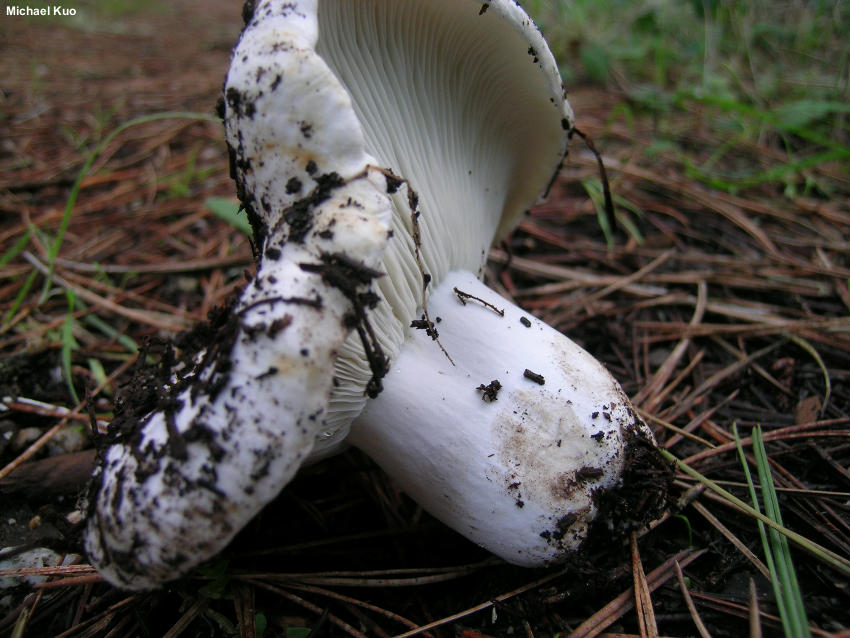
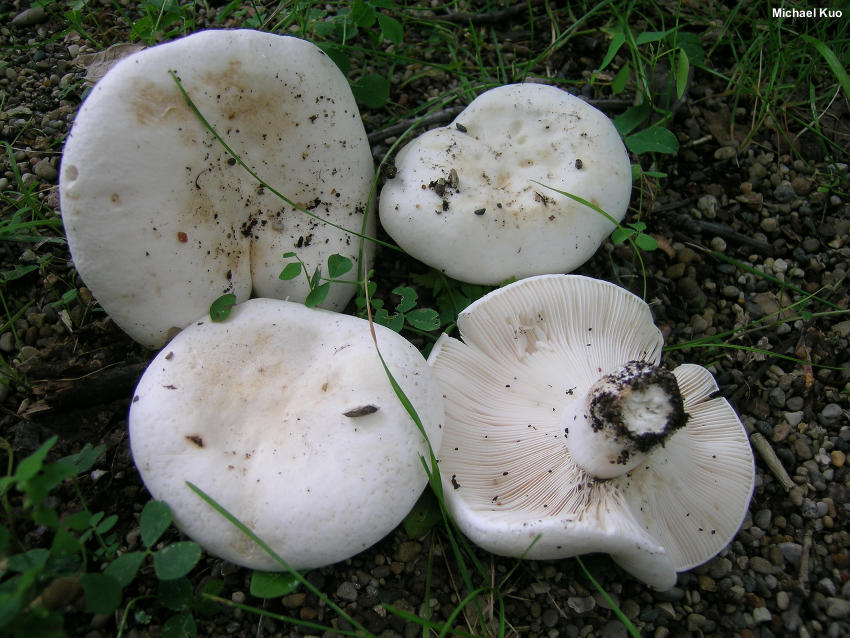
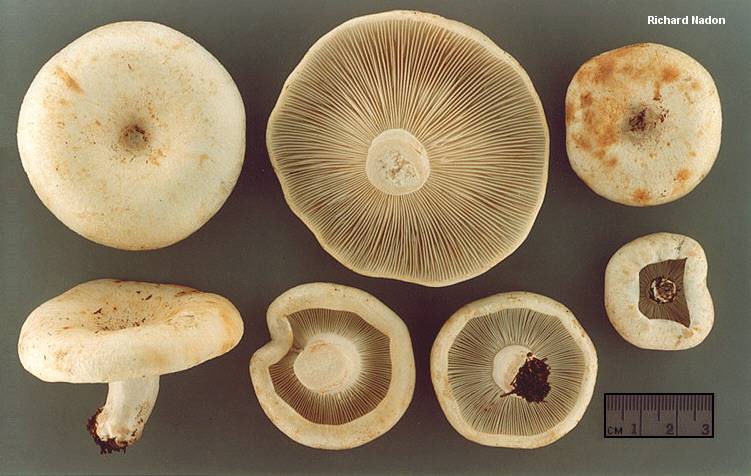
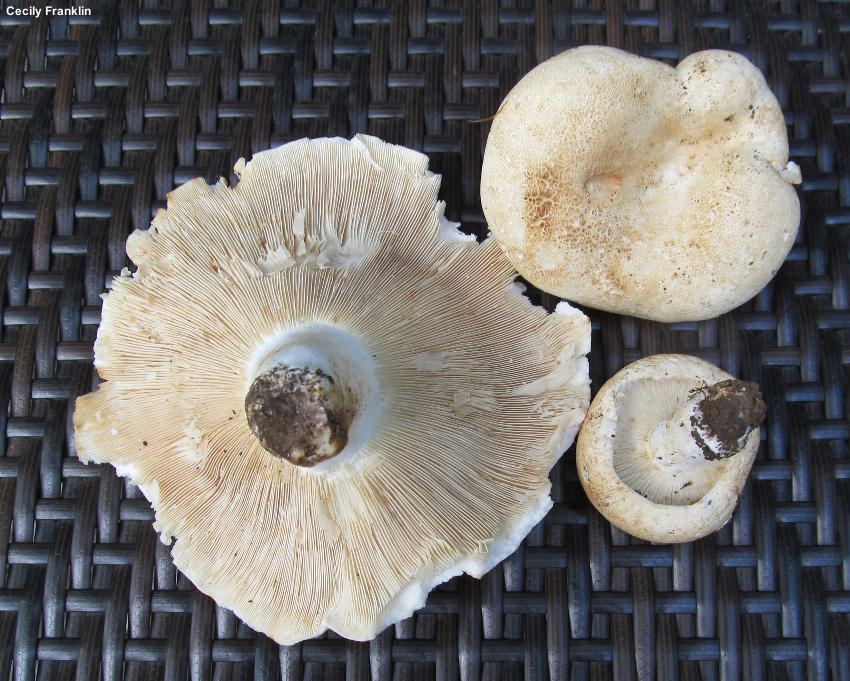
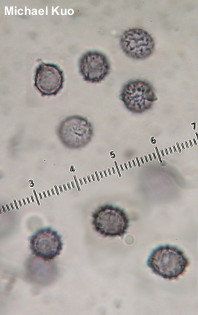
Russula brevipes [ Basidiomycota > Russulales > Russulaceae > Russula . . . ] by Michael Kuo This common russula is initially white, but it soon develops tan, brownish, or flat-out orangish brown colors—though it can also remain fairly pale overall. The gills typically bruise brownish, and the stem is often fairly short in proportion to the cap (brevipes means "short-stemmed"), and often bruises brownish as well. It is a sturdy and compact mushroom, and the "skin" on its cap surface is not easily peeled away. I find Russula brevipes most frequently in mixed woods with sandy soil, in northern Michigan, where I have seen fruitings in the hundreds. Lactarius deceptivus is often growing alongside Russula brevipes, and separating the two species at a glance can be all but impossible. However, Lactarius species produce drops of milk when injured, making it easy to distinguish the two species with a pocket knife. I might add, however, that one tires of this fairly quickly ("That's a Russula, that's a Lactarius, that's a Russula . . ."), especially if there are other, more interesting mushrooms around. "Russula brevipes" as I am treating it here is essentially a fiction—a combination of several, or even many North American species that are in need of thorough study and revision. Mycologists have noted differences in ecology and morphology among the brevipes-like russulas for many years. Some appear to be limited to conifers; others apparently associate with hardwoods. Some are western; some are Midwestern and eastern. Some have a mild taste, while others are weakly to strongly acrid. Some, when fresh, demonstrate a bluish line at the juncture of the stem and gills; others do not. Gill spacing ranges from nearly distant to very crowded. And then there are myriad microscopic differences—in the morphology of spores, cystidia, and the pileipellis. Species or variety names have been applied to some of these mushrooms (including Russula brevipes var. acrior, Russula brevipes var. megaspora, Russula inopina, Russula romagnesiana, Russula vesicatoria, Russula cascadensis, and Russula angustispora), usually with reference to putative micromorphological distinctions—and the European species names Russula delica and Russula chloroides represent very similar species across the Atlantic. For more information see Shaffer (1964), as well as Buyck and Adamčik (2013)—but contemporary, DNA-based study of many collections from this species group is desperately needed before names can be applied with confidence. Thanks to Cecily Franklin for collecting, documenting, and preserving Russula brevipes for study; her collection is deposited in The Herbarium of Michael Kuo. Description: Ecology: Mycorrhizal with a wide variety of trees, from conifers to hardwoods (see the discussion above); growing alone, scattered, or gregariously; common; summer and fall, or over winter in warm climates; fairly widely distributed in North America, at least as a species group. The illustrated and described collections are from Illinois, Québec, Pennsylvania, Michigan, California, and Colorado. Cap: 6–20 cm; convex with a central depression and an inrolled margin when young, later broadly convex with a central depression and eventually shallowly vase-shaped, the margin remaining somewhat inrolled or straightening; dry; bald or suedelike; sometimes becoming cracked in age; white to whitish or creamy at first, developing brownish discolorations and sometimes becoming brownish to orangish brown overall with old age; the margin not lined; the skin fairly tightly adnate, not peeling easily. Gills: Attached to the stem or running down it slightly; crowded or close; short-gills frequent; white at first, becoming creamy; sometimes spotting and discoloring brownish; sometimes bluish to blue, especially near the juncture with the stem. Stem: 3–4 cm long; 1.5–3 cm thick; sturdy and solid; more or less equal; dry; bald; whitish; usually discoloring and bruising brown to brownish; basal mycelium white. Flesh: White; sometimes discoloring brownish when sliced. Odor and Taste: Odor not distinctive, faintly foul, or faintly fragrant; taste mild to slightly, moderately, or strongly acrid. Chemical Reactions: KOH negative to faintly yellowish on cap surface. Iron salts negative on stem surface. Spore Print: White to creamy. Microscopic Features: Spores 7–10 x 5–7 µm (but in some collections much smaller: 4–7 x 4–5 µm); broadly ellipsoid to subglobose; ornamentation usually about 0.5 µm high, as amyloid warts and occasional connectors that may be fairly isolated, or may form subreticulate patterns. Pleuro- and cheilocystidia 35–50 x 7.5–10 µm; fusiform, cylindric, or subclavate, sometimes with one or more apical constrictions or knobs; thin-walled; hyaline. Pileipellis a cutis of hyaline to yellowish elements 2.5–5 µm wide. Oleiferous hyphae present. REFERENCES: Peck, 1890. (Saccardo, 1891; Peck, 1906; Kauffman, 1918; Shaffer, 1964; Smith, Smith & Weber, 1979; Arora, 1986; Kibby & Fatto, 1990; States, 1990; Phillips, 1991/2005; Lincoff, 1992; Barron, 1999; McNeil, 2006; Miller & Miller, 2006; Roberts, 2008; Trudell & Ammirati, 2009; Buyck and Adamčik, 2013; Desjardin, Wood & Stevens, 2015; Evenson, 2015; Siegel & Schwarz, 2016; Cripps, Evenson & Kuo, 2016.) Herb. Kuo 09059507, 01120614, 06221007, 09191401, 07181606, 08151602, 08161601. Herb. DBG ROMO 2012 5026-19. This site contains no information about the edibility or toxicity of mushrooms. |
© MushroomExpert.Com |



|
Cite this page as: Kuo, M. (2017, May). Russula brevipes. Retrieved from the MushroomExpert.Com Web site: http://www.mushroomexpert.com/russula_brevipes.html |