| Major Groups > Gilled Mushrooms > Pale-Spored > Pleurotoid Mushrooms > Pleurotus populinus |

|
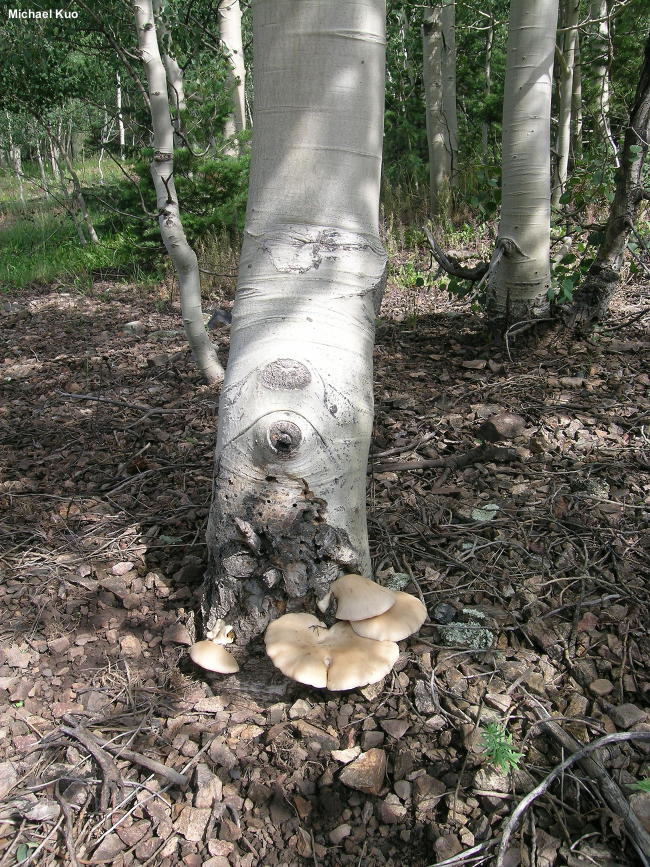
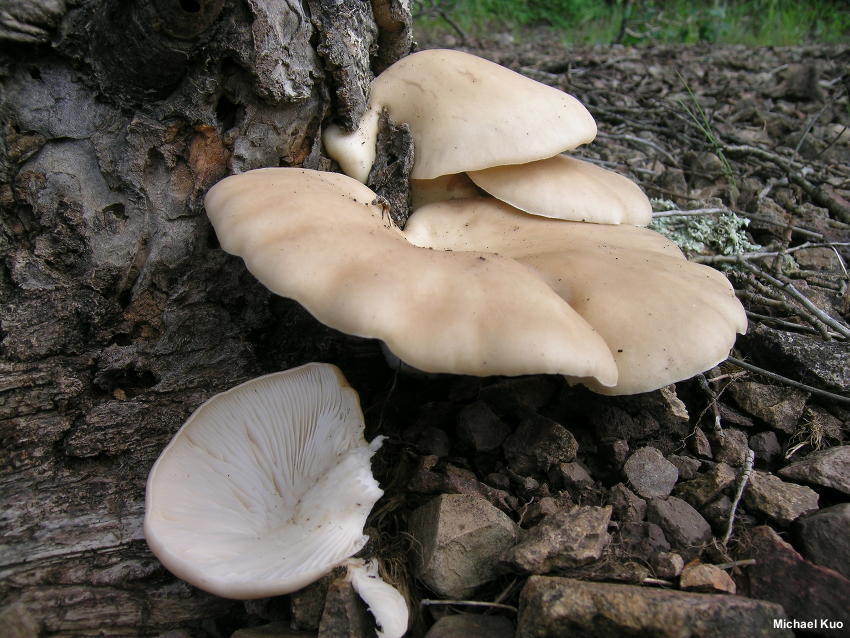
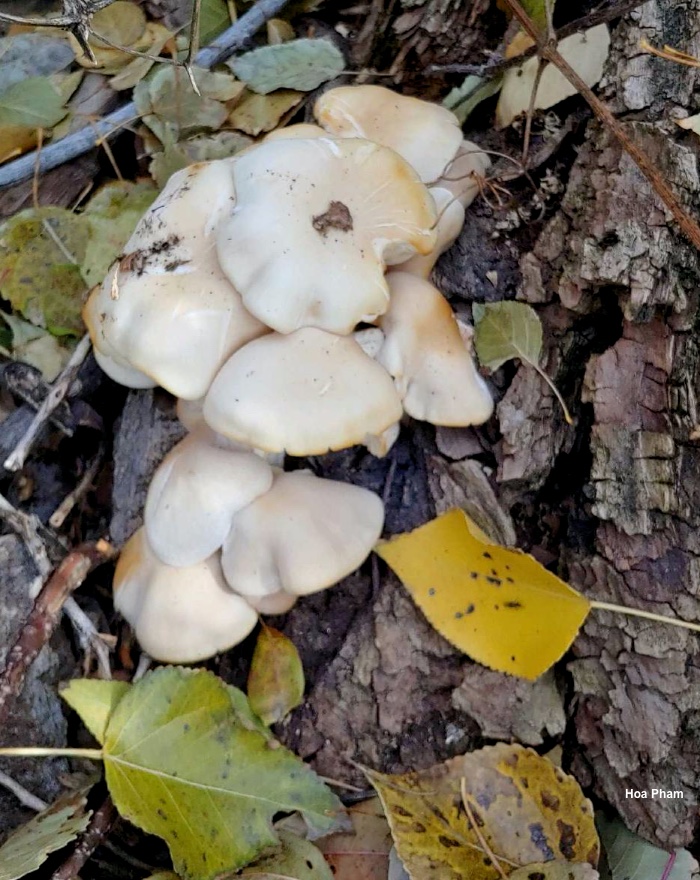
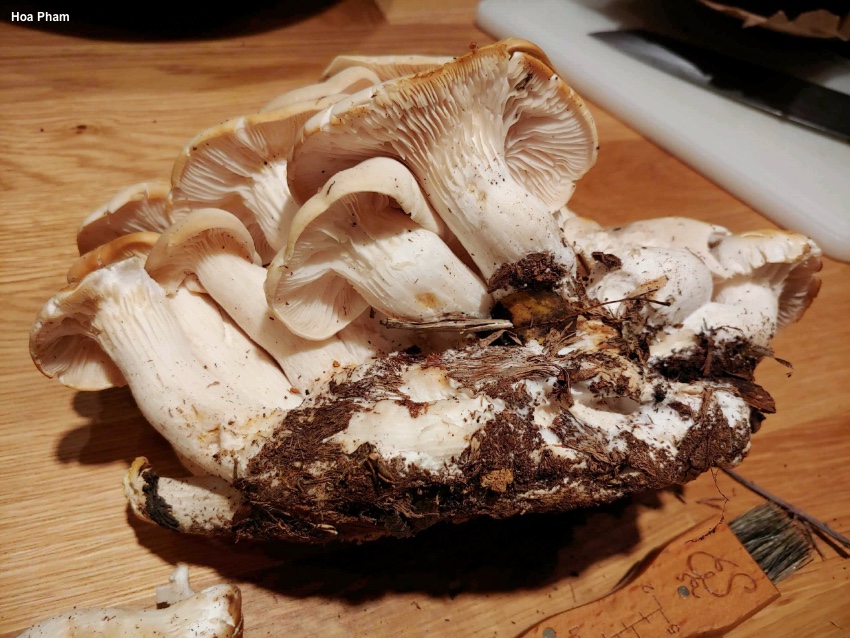
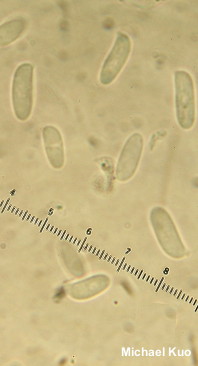
Pleurotus populinus [ Basidiomycota > Agaricales > Pleurotaceae > Pleurotus . . . ] by Michael Kuo Pleurotus populinus is part of the Pleurotus ostreatus species complex; I call it the "aspen oyster," since it appears to be limited to the wood of quaking aspen and closely related trees (aspens and cottonwoods in the genus Populus). It is northern and montane, corresponding to the range of the host trees. Pleurotus populinus is a well established biological species (meaning that it cannot "mate" with the other oysters) that is also a phylogenetic species, supported by DNA evidence. Fortunately for those of us who do not have mycology laboratories at our disposal, its ecology (the relationship to aspen) and even a few morphological features are distinct. The cap is not dark brown, as it sometimes is in Pleurotus ostreatus, and the spore print is always whitish rather than whitish to grayish or lilac. Under the microscope it has longer spores than Pleurotus ostreatus or Pleurotus pulmonarius. Thanks to Hoa Pham for collecting, documenting, and preserving Pleurotus populinus for study; her collection is deposited in The Herbarium of Michael Kuo. Description: Ecology: Saprobic; growing in shelf-like clusters on dead and living wood of Populus species, primarily quaking aspen but also plains cottonwood; causing a white rot; spring, summer, and fall; widely distributed in northern and montane North America, throughout the range of the host trees. The illustrated and described collections are from Colorado. Cap: 4–17 cm; broadly convex, becoming flat or somewhat depressed; kidney-shaped to fan-shaped, or nearly circular if growing on the tops of logs; somewhat greasy when young and fresh; bald; whitish to pinkish gray or pale tan, without dark brown colorations; the margin incurved when young, later wavy. Gills: Running down the stem or pseudostem; close; short-gills frequent; whitish. Stem: Usually absent or rudimentary, when the mushroom is growing from the side of a log or tree. When it grows on the tops of logs or branches, or at an angle, however, it may develop a substantial and thick stem that is dry and slightly hairy near the base. Flesh: Thick; white; unchanging when sliced. Odor and Taste: Odor distinctive but hard to describe ("like oyster mushrooms"); taste mild. Chemical Reactions: KOH negative to yellowish on cap surface. Spore Print: Whitish (never lilac). Microscopic Features: Spores 10–14 x 4–5 µm; cylindric; smooth; hyaline in KOH; inamyloid. Basidia 4-sterigmate. Hymenial cystidia not found. Pileipellis a cutis; elements 2.5–5 µm wide, smooth, hyaline in KOH. REFERENCES: O. Hilber & O. K. Miller, 1993. (Bessette, Miller, Bessette & Miller, 1995; Trudell & Ammirati, 2009; Evenson, 2015; Cripps, Evenson & Kuo, 2016; Petersen et al., no date.) Herb. Kuo 07260602, 10241801. This site contains no information about the edibility or toxicity of mushrooms. |
© MushroomExpert.Com |

|
Cite this page as: Kuo, M. (2019, October). Pleurotus populinus. Retrieved from the MushroomExpert.Com Web site: http://www.mushroomexpert.com/pleurotus_populinus.html |