Major Groups > Gilled Mushrooms > Pale-Spored > Lactarius > Lactarius volemus

MushroomExpert.Com

Lactarius volemus

[ Basidiomycetes > Russulales > Russulaceae > Lactarius . . . ]

by Michael Kuo

For the life of me, I can't figure out why this mushroom is listed as a "choice" edible in field guides. For example, David Arora: "This species . . . rank[s] among the best edible mushrooms of eastern North America" (78). Well, first of all, Lactarius volemus reeks, producing a dead-fish smell that the very same field guides mention as a means of identification. Then there is the brown-staining milk. White when exuded, it stains the mushroom's tissues sordid brown--but it also stains your hands sordid brown, and your clothes, and your kitchen counter. Finally, there's the fact that when cooked up, Lactarius volemus is insipid and slimy, and still smells bad!

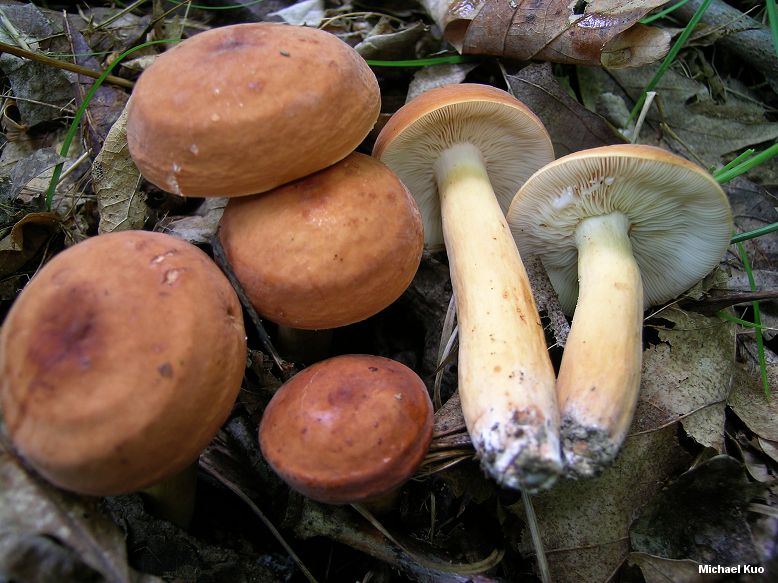
However, if you're not thinking of eating it or handling it, Lactarius volemus is an attractive mushroom, fairly easily recognized by its brownish orange colorations, the above-mentioned white milk that stains everything in sight brown, and its tendency to develop a fishy odor that increases in fishiness over time after the mushroom has been picked. Its cap is smooth or only slightly wrinkled, separating it from the similar Lactarius corrugis (which lacks the fishy odor). Lactarius hygrophoroides is similar in appearance, but has distant gills and non-staining milk (see the linked page for a photo comparison of the two species).

At least one reader disagrees with me on the palatability of Lactarius volemus; see Richard Kramer's comments below, in the right-hand column.

Description:

Ecology: Mycorrhizal with hardwoods and perhaps with conifers; growing alone or scattered; summer and fall; widely distributed in eastern North America.

Cap: 5-13 cm; at first convex, with an inrolled margin; becoming flat, with a central depression, shallowly vase-shaped, or (rarely) with a slight bump over the disc, the margin even; smooth or slightly wrinkled; brownish orange, orangish brown, or sometimes lighter (see note below); typically without distinct zones of color, but often darker towards the center.

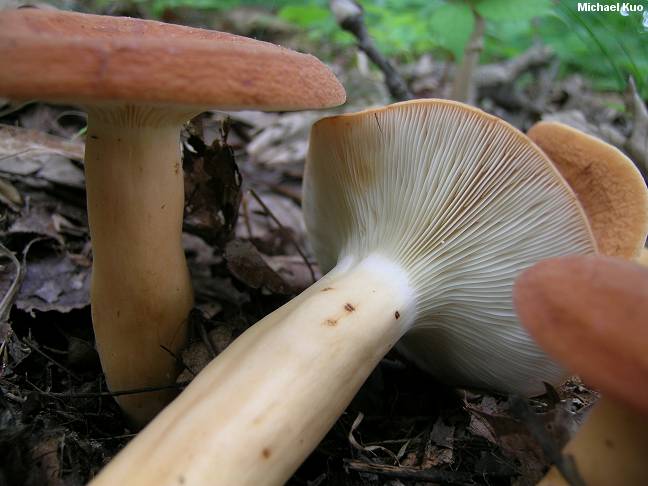
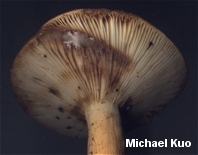
Gills: Attached to the stem or running slightly down it; close; creamy white; discoloring brown when injured; often forking near the margin.

Stem: 5-10 cm long; .5-2 cm thick; colored like the cap or paler; equal or tapering to base; smooth; sometimes vaguely "ribbed" longitudinally; solid or hollowing somewhat.

Flesh: White; eventually staining brown when cut.

Milk: White; copious; sometimes becoming brownish on exposure to air, but always staining tissues brown.

Odor and Taste: Odor rather fishy (like a dead shad, which anglers will tell you is probably the most malodorous freshwater fish); taste mild.

Spore Print: White.

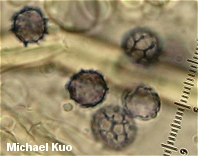
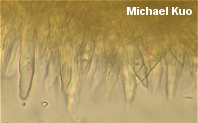
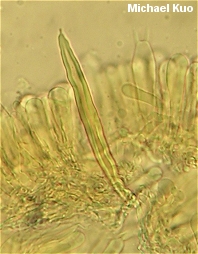
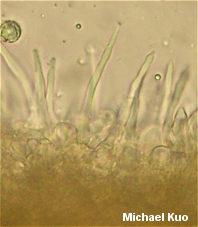
Microscopic Features: Spores 7.5-9.5 x 7.5-8.5 µ; more or less round; reticulate; prominences 0.4-1.0 µ high.

The description above applies to Lactarius volemus var. volemus. Hesler and Smith (1979; links below) describe var. flavus as a southern variety with a yellow cap and slightly smaller spores. They also indicate the likelihood that Lactarius volemus intergrades with Lactarius corrugis; mushrooms may be collected that combine the features of these two species.

REFERENCES: (Fries, 1821) Fries, 1838. (Saccardo, 1887; Coker, 1918; Kauffman, 1918; Hesler & Smith, 1979; Smith, Smith & Weber, 1979; Weber & Smith, 1985; Arora, 1986; Heilmann-Clausen et al., 1998; Phillips, 1991/2005; Lincoff, 1992; Metzler & Metzler, 1992; Roody, 2003; McNeil, 2006; Miller & Miller, 2006; Kuo, 2007.) Herb. Kuo 06239510, 08240203, 07180707.

Further Online Information:

Lactarius volemus var. volemus in Hesler & Smith (1979)
Lactarius volemus var. flavus in Hesler & Smith (1979)
Lactarius volemus at Roger's Mushrooms
Lactarius volemus var. flavus at Roger's Mushrooms
Lactarius volemus at Russulales News
Lactarius volemus at Fungi of Poland


Lactarius volemus

Lactarius volemus

Lactarius volemus

Lactarius volemus

Richard Kramer, member of the Boston Mycological Club, writes:

"It's sad that you are missing out on L. volemus. If you don't agree with David Arora that it is one of the best wild mushrooms in the northeast US, you must be cooking it wrong. Saute in olive oil with onions, black pepper, some tamari sauce, and some lemon juice. Give the onions a brief head start in the pan and add the lemon juice before the mushrooms. That way the onions pick up most of the lemon juice and you can enjoy the lemony brightness without overwhelming the subtler notes of the lactarius. Give this method a try and you'll be converted to a volemus lover. With the right amount of lemon, volemus doesn't smell at all. And I don't know why you would consider them insipid and slimy, mine always come out firm and crisp, almost crunchy.

"I'm afraid that I don't know of any remedy for the stains except being careful how you handle the mushrooms and learning to appreciate the mellow brown colors. I have a shirt that is pretty thoroughly stained by a chance volemus windfall I encountered one day on a walk. My wife has tried to throw the shirt away, but it has become one of my favorites BECAUSE OF the stains. We've never had any trouble with counter tops or cutting boards. The latex washes off our counters and it doesn't hurt the cutting boards one bit."


© MushroomExpert.Com


Cite this page as:

Kuo, M. (2002, August). Lactarius volemus. Retrieved from the MushroomExpert.Com Web site: http://www.mushroomexpert.com/lactarius_volemus.html