| Major Groups > Polypores > Ischnoderma resinosum |

|
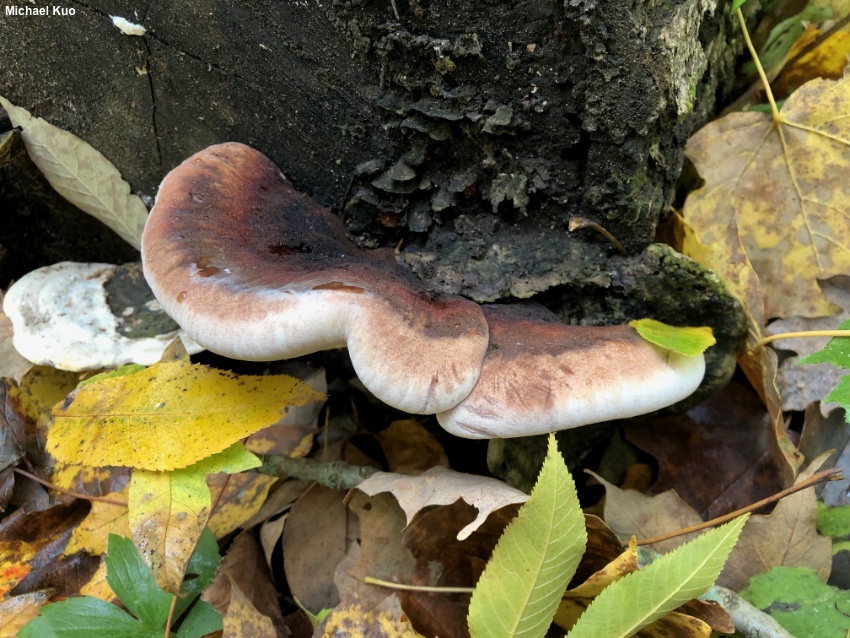
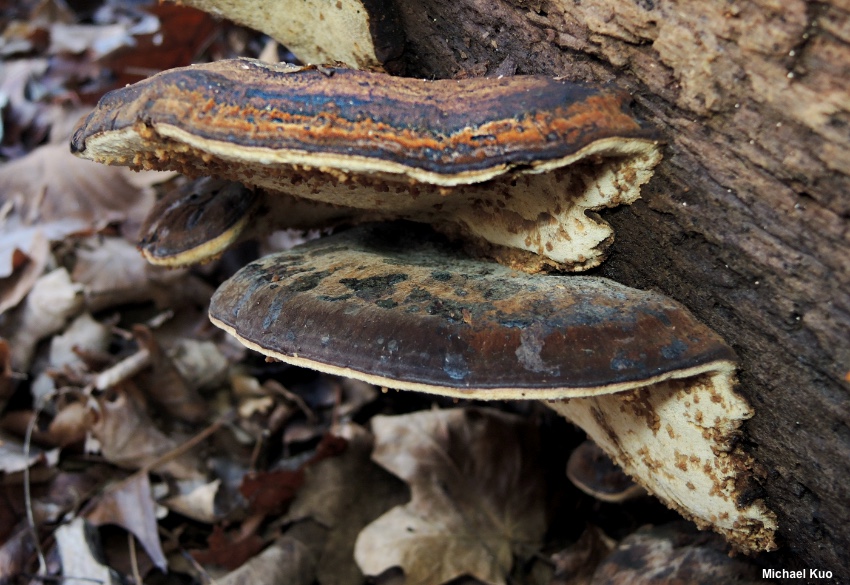
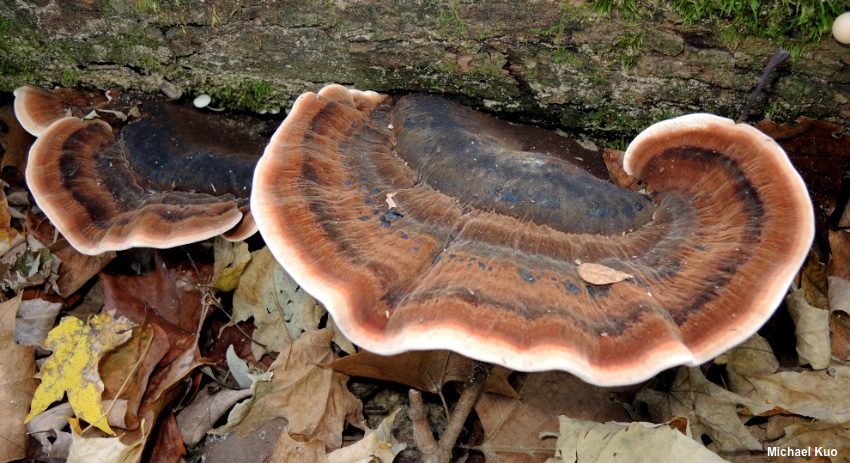
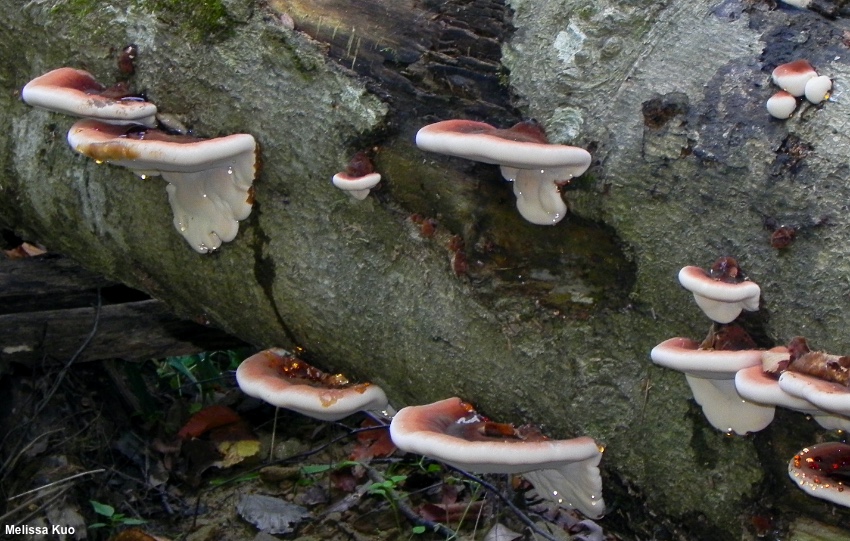
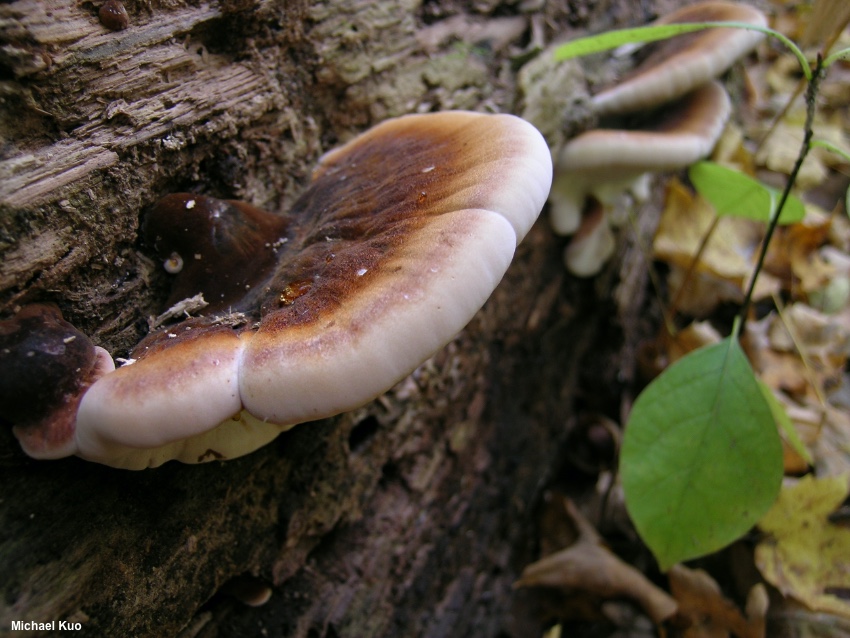
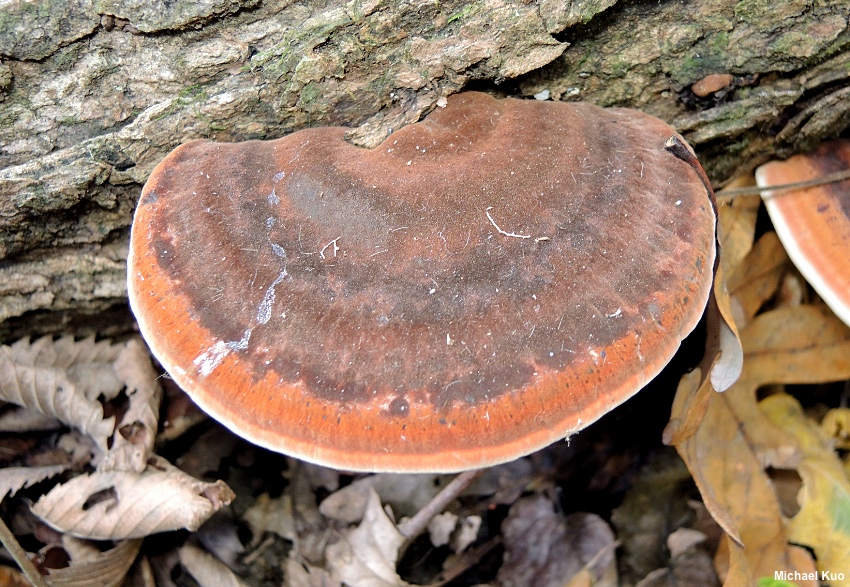
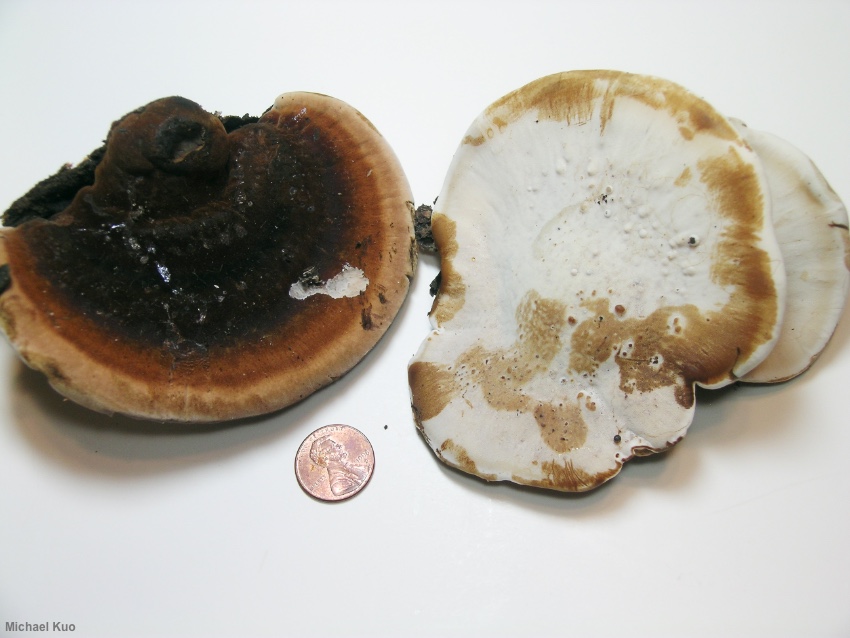
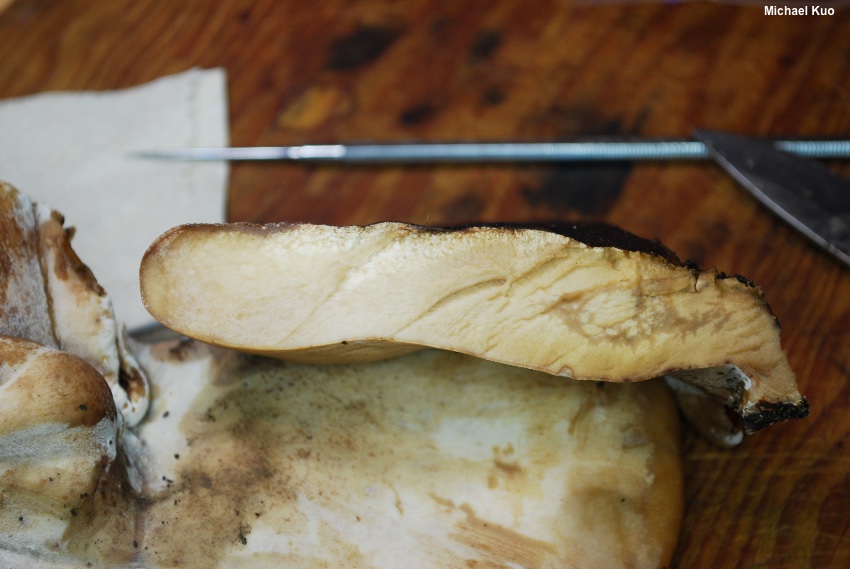
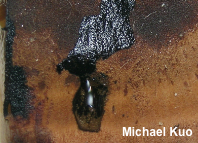
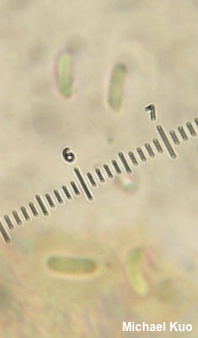
Ischnoderma resinosum [ Basidiomycota > Polyporales > Fomitopsidaceae > Ischnoderma . . . ] by Michael Kuo This attractive and widely distributed polypore is fairly easy to recognize, with close inspection. It grows on the wood of hardwoods, and young specimens are thick, soft, and fleshy—much softer than you might expect in a polypore, especially if, from a distance, you thought you were looking at Ganoderma applanatum or another hard, woody species. The young pore surface is whitish, but it turns brown very quickly when bruised. Ischnoderma resinosum has a tendency to grow not only on the sides of dead logs, but also on their undersides, where it produces a capless version (or extension) of itself that consists primarily of a pore surface (see illustrations). As Ischnoderma resinosum matures, it becomes very tough and leathery, and much more "polyporeish." Ischnoderma benzoinum is very similar (so similar that some mycologists treat it as a synonym of Ischnoderma resinosum), but grows on the wood of conifers. It tends to have skinnier, flatter fruiting bodies with slightly darker flesh. Description: Ecology: Saprobic on the deadwood of hardwoods; annual; causing a white rot that separates the annual rings in the wood and often smells of anise; appearing on recently fallen wood and on wood that has been down for several years, but not typically on well-rotted wood; growing alone, gregariously, or in overlapping clusters; usually appearing in fall; widely distributed in North America but more common in the Midwest and eastern United States. The illustrated and described collections are from Illinois and Wisconsin. Fruiting Body: Usually presenting a well-developed cap, but sometimes appearing effused-reflexed or even resupinate. Cap: 5–19 cm across; 3–9 cm deep; irregularly bracket-shaped, kidney-shaped, or nearly semicircular; broadly convex; when young quite thick and fleshy, with a finely velvety surface with zones of pinkish brown and brown, and a thick whitish margin; in maturity dark brown, sometimes with zones of blackish brown, fairly bald, dry, and tough. Pore Surface: When young whitish, soft, promptly bruising brown; in maturity pale brown and hard; with 4–6 angular or round pores per mm; tubes 2–8 mm deep. Stem: Absent. Flesh: Whitish to dull pinkish brown and soft at first; darkening to brown and becoming tougher with maturity. Odor and Taste: Not distinctive. Chemical Reactions: KOH on cap surface black; on flesh negative to brownish or grayish. Spore Print: White. Microscopic Features: Spores 5–7 x 1–1.5 µm; allantoid; smooth; hyaline in KOH; inamyloid. Cystidia not found. Hyphal system dimitic; generative hyphae of tube trama 2–4 µm wide, smooth, thin-walled, hyaline in KOH, with clamp connections at septa; skeletal hyphae 4–6 µm wide, with walls 1–1.5 µm thick. REFERENCES: (Schrader, 1794) Karsten, 1879. (Fries, 1821; Saccardo, 1888; Overholts, 1953; Smith, Smith & Weber, 1981; Gilbertson & Ryvarden, 1986; Arora, 1986; Pouzar, 1990; Phillips, 1991/2005; Lincoff, 1992; Horn, Kay & Abel, 1993; Barron, 1999; Roody, 2003; McNeil, 2006; Kuo, 2007; Binion et al., 2008; Trudell & Ammirati, 2009; Palacios-Pacheco et al., 2010; Kuo & Methven, 2014; Woehrel & Light, 2017; Baroni, 2017; Sturgeon, 2018; Læssøe & Petersen, 2019.) Herb. Kuo 09220407, 10070401, 10281903. Herb. EIU 005. This website contains no information about the edibility or toxicity of mushrooms. |
© MushroomExpert.Com |
|
Cite this page as: Kuo, M. (2019, December). Ischnoderma resinosum. Retrieved from the MushroomExpert.Com Web site: http://www.mushroomexpert.com/ischnoderma_resinosum.html |