| Major Groups > Polypores > Ganoderma > Ganoderma applanatum |

|
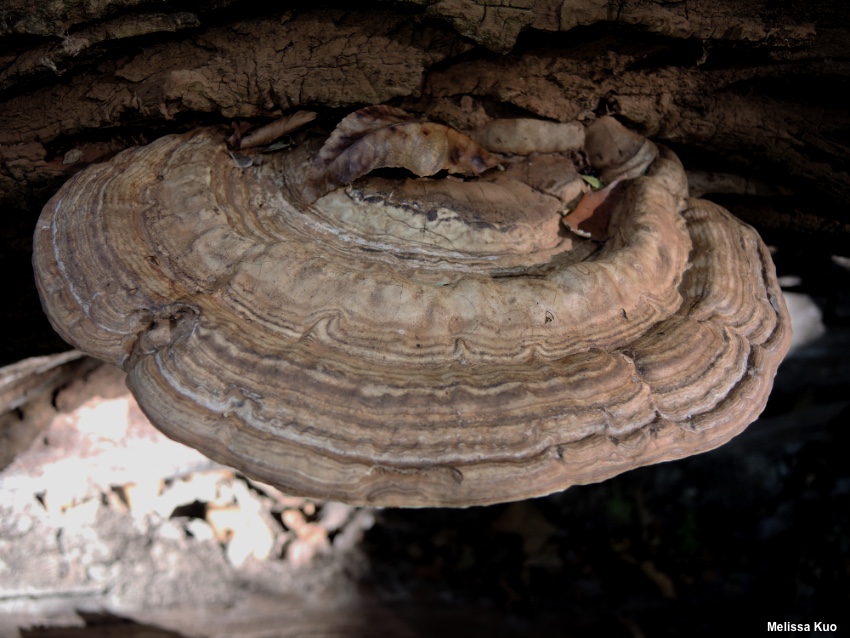
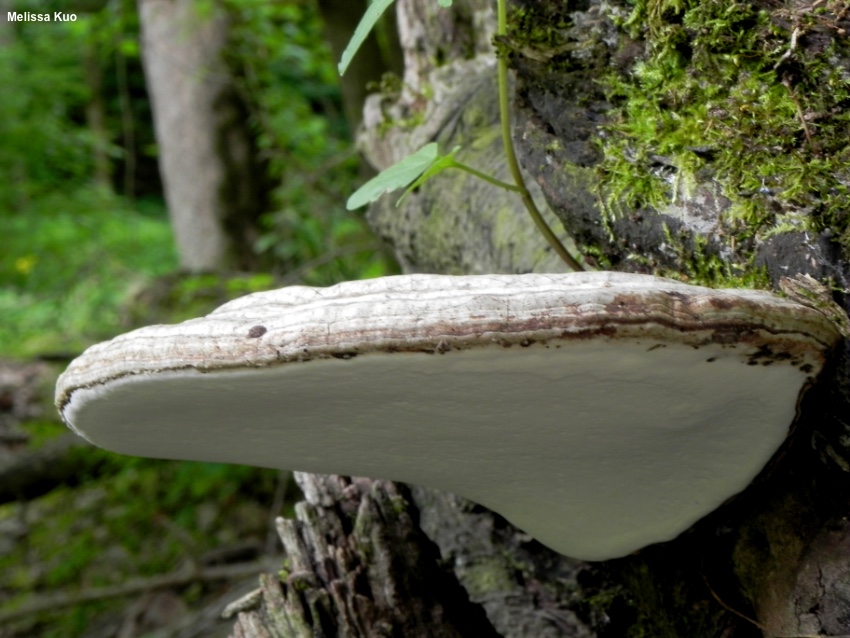
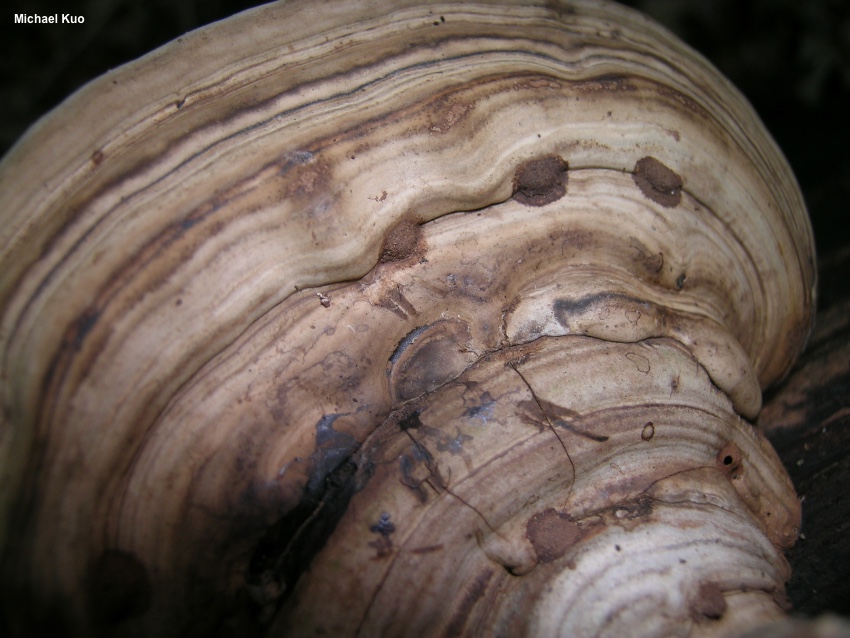
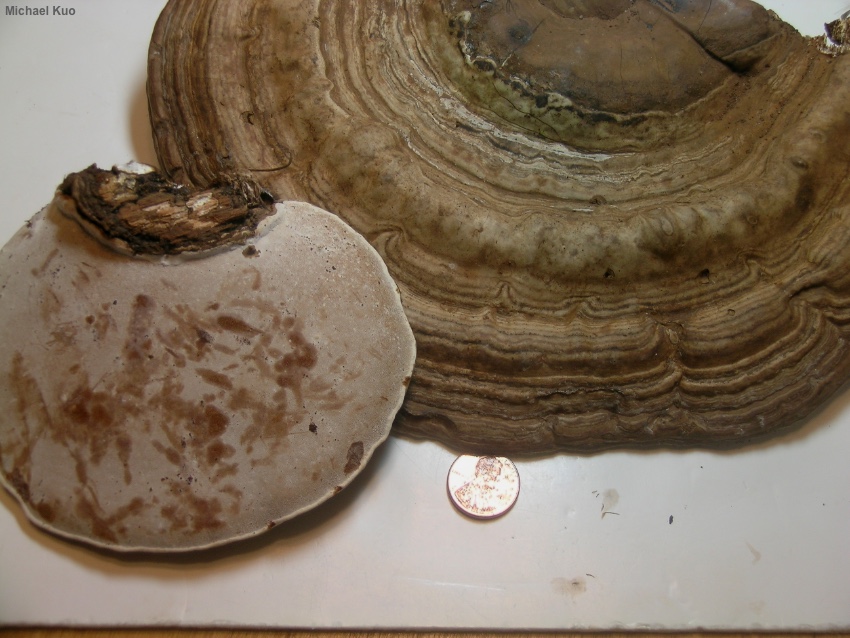
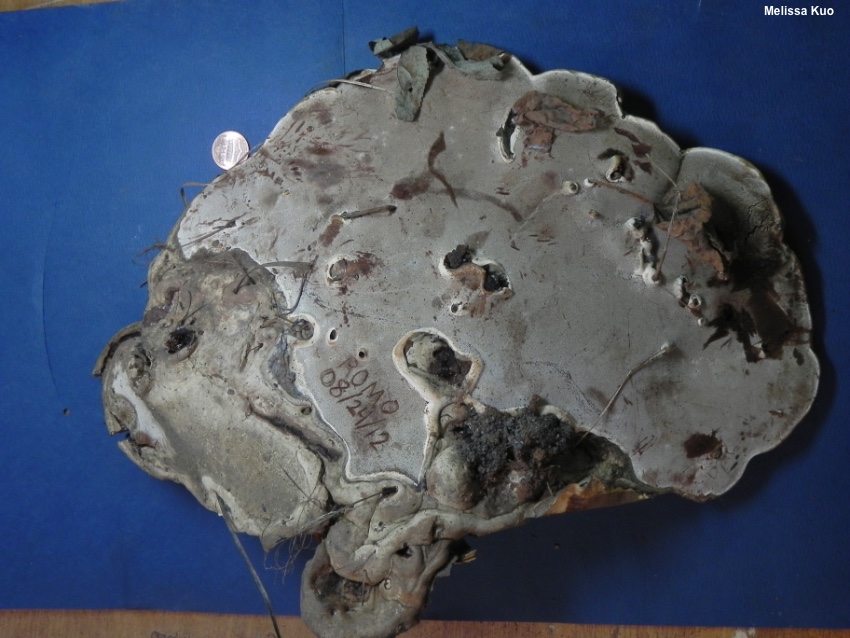
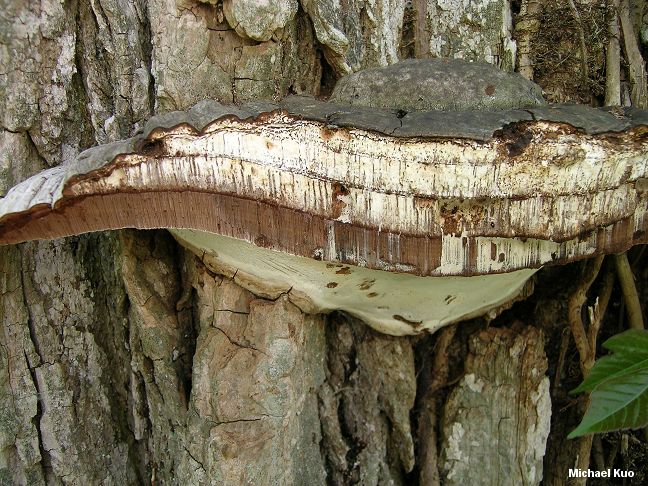
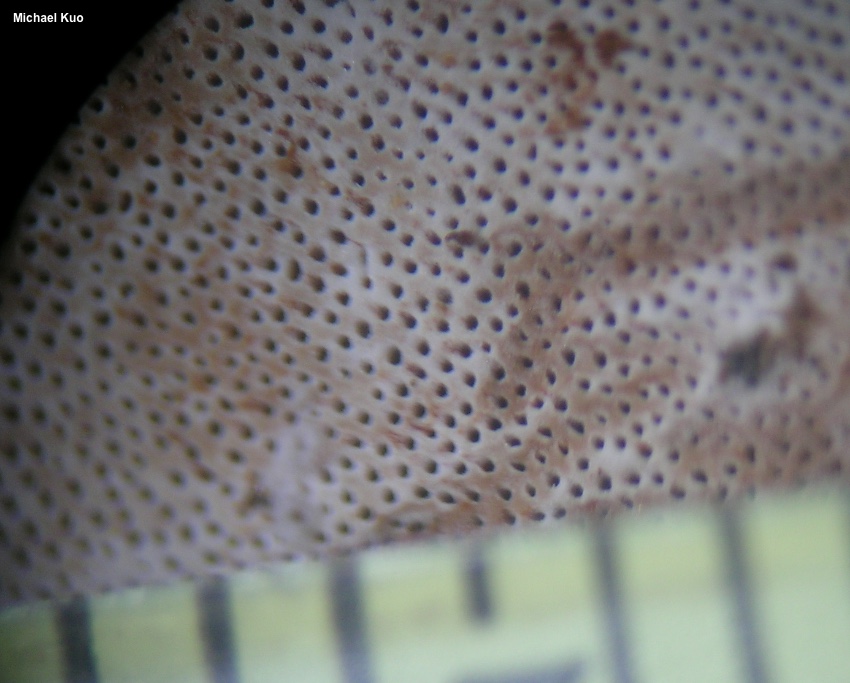
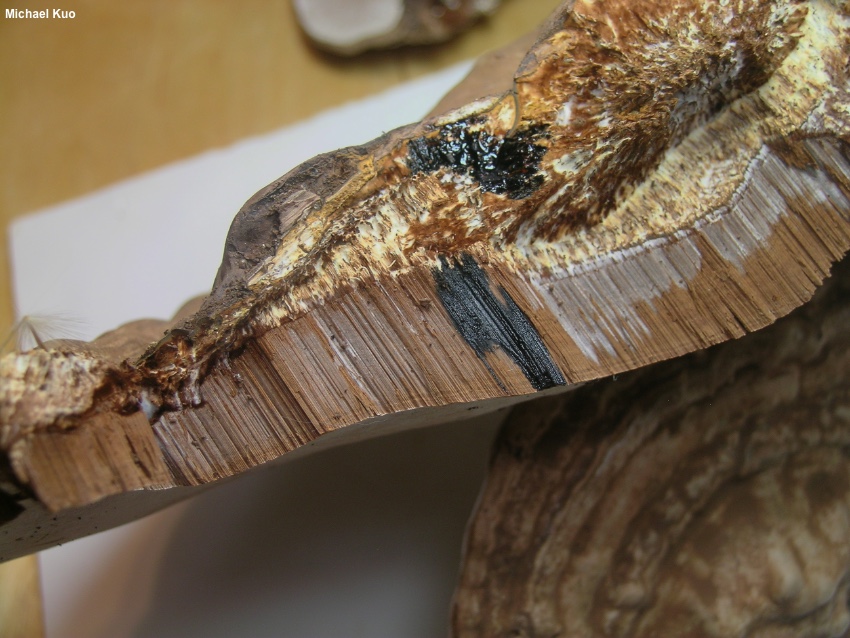
Ganoderma applanatum [ Basidiomycota > Polyporales > Polyporaceae > Ganoderma . . . ] by Michael Kuo Many people have seen Ganoderma applanatum at one time or another; it is widely distributed and fairly common—typically seen at the bases of hardwood stumps or on hardwood logs. It is sometimes known as the "artist's fungus," since its white to gray pore surface bruises brown and retains the bruising for years if the mushroom is picked and brought inside. I have seen very intricate and beautiful etchings on Ganoderma applanatum, in craft stores and yard sales. My own attempts at Ganoderma art, however, have not been very beautiful—unless you call abusive woodland notes for my mushrooming buddies "beautiful." Distinguishing features for Ganoderma applanatum include its unvarnished, furrowed and lumpy, dull brown cap surface; its white to grayish pore surface, which bruises brown; and its woody, brownish or cinnamon flesh. It is perennial, and individuals can develop for many years by producing a new spore-producing tube layer beneath the previous year's layer (see the sixth illustration). Ganoderma lobatum is similar, but features a comparatively thin cap with an upper surface that is somewhat softer (it can be punctured with one's thumb); additionally it grows a new cap-like structure beneath the previous year's growth, rather than adding a tube layer beneath the previous year's layer. Ganoderma brownii is a similar mushroom found on California hardwoods (especially laurel); it has a hoof-shaped fruiting body and larger spores. "Ganoderma megaloma" is a name sometimes applied to North American collections of Ganoderma applanatum in online resources, but no published, peer-reviewed study supports use of this name in place of Ganoderma applanatum. Description: Ecology: Saprobic and sometimes parasitic; growing alone or in groups on decaying hardwood logs and stumps, or from the wounds of injured, living (for a while, anyway) trees; producing a white to straw-colored rot of sapwood and heartwood; found on most species of hardwoods; perennial; common and widely distributed in North America. The illustrated and described collections are from Illinois, Indiana, and Colorado. Cap: 10–30 cm across; 8–14 cm deep; more or less semicircular in outline, or irregular; surface with a dull, unvarnished outer crust, often furrowed in "zones," brownish to grayish brown; bald. Pore Surface: White to grayish or pale brownish; bruising yellow to brownish, then dark brown; becoming dirty brown in age; with 4–6 tiny, circular pores per mm; tubes in annual layers, separated by brown tissue, each layer 0.5–2 cm deep, with older layers often stuffed with white mycelial material. Stem: Usually absent; if present, lateral and very stubby. Flesh: Thin; brown to cinnamon brown (rarely whitish); woody. Odor and Taste: Not distinctive. Chemical Reactions: KOH instantly black on cap surface, flesh, and tubes. Spore Print: Brown to orangish brown. Microscopic Features: Spores 6–9 x 4–5 µm after the collapse of the hyaline vesicular appendix; more or less ellipsoid, with a truncated end; appearing double-walled, with a series of "pillars" between the walls; finely stippled; inamyloid; brown in KOH. Cystidia and setae not found. Hyphal system trimitic. Clamp connections present. REFERENCES: (Persoon, 1799) Patouillard, 1887. (Saccardo, 1888; Overholts, 1953; Smith, Smith & Weber, 1981; Arora, 1986; Breitenbach & Kränzlin, 1986; Gilbertson & Ryvarden, 1986; States, 1990; Lincoff, 1992; Horn, Kay & Abel, 1993; Barron, 1999; Roody, 2003; McNeil, 2006; Miller & Miller, 2006; Binion et al, 2008; Niemelä & Miettinen, 2008; Kuo & Methven, 2014; Evenson, 2016; López-Peña et al., 2016; Siegel & Schwarz, 2016; Justo et al., 2017.) Herb. Kuo 02191001, 10201808. Herb. DBG RMNP 2009-084; ROMO 2012 5026-32, 5028-24. This site contains no information about the edibility or toxicity of mushrooms. |
© MushroomExpert.Com |

|
Cite this page as: Kuo, M. (2018, October). Ganoderma applanatum. Retrieved from the MushroomExpert.Com Web site: http://www.mushroomexpert.com/ganoderma_applanatum.html |