| Major Groups > Chanterelles and Trumpets > Cantharellus subalbidus |

|
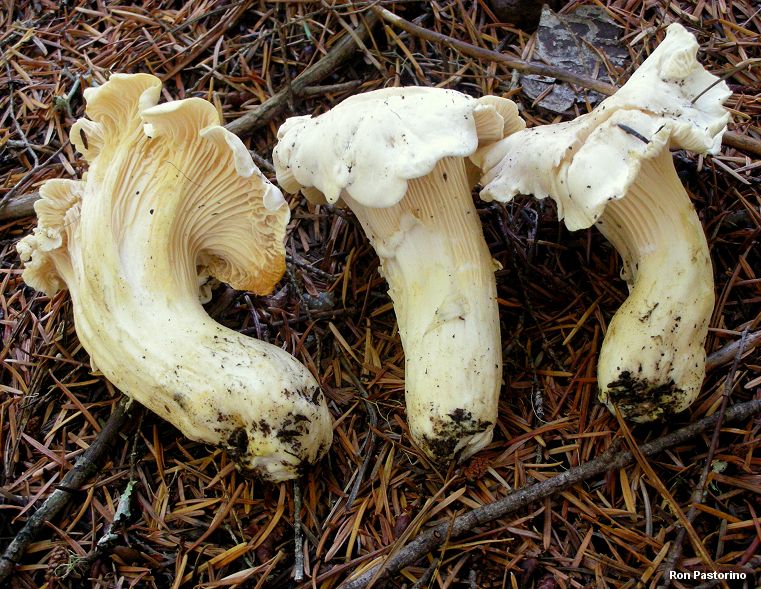
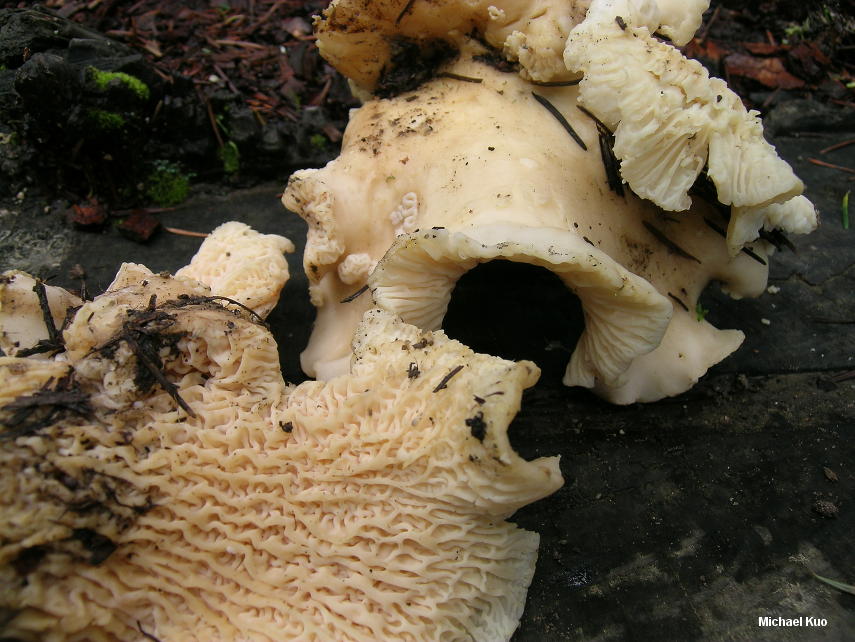
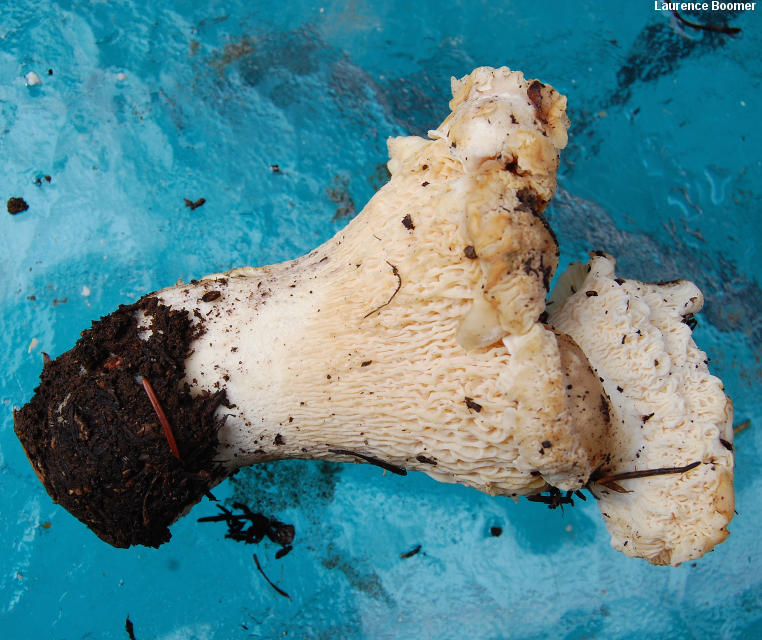
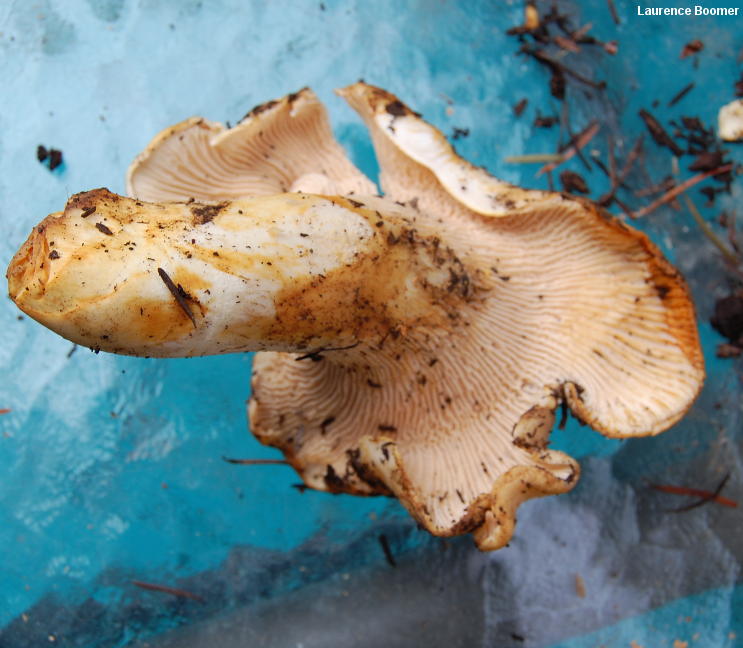
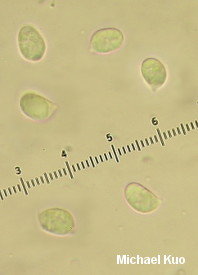
Cantharellus subalbidus [ Basidiomycota > Cantharellales > Cantharellaceae > Cantharellus . . . ] by Michael Kuo Cantharellus subalbidus is a large, white to whitish chanterelle found in the conifer forests of northern California and the Pacific Northwest. Its surfaces often bruise yellowish to orangish when handled, or with age--and its odor is usually fragrant and sweet. Specimens that have well-developed false gills can appear almost like clitocyboid mushrooms--but the latter possess true gills that are readily separable from the caps. A study by Dunham and collaborators (2006) revealed that Cantharellus subalbidus is much more likely to appear in old-growth forests that have stood for hundreds of years, and less likely to appear in second-growth forests (about 40-60 years old) that represent regeneration after clear cutting. The authors offer two possible explanations: "The reduced odds of finding C. subalbidus in SG [second-growth forests] indicate that they did not persist following logging and that the biological, physical or chemical characteristics of the soil or competition from other newly establishing species are limiting its re-establishment in young stands. Alternatively, C. subalbidus may be able to establish mycelia in young stands, but subsequently experience suppressed fruiting until OG [old-growth] characteristics begin to develop" (1436). Thanks to Laurence Boomer for collecting, documenting, and preserving some of the illustrated and described specimens; they are deposited in The Herbarium of Michael Kuo. Thanks to Ron Pastorino for his photo of Cantharellus subalbidus in nature. Description: Ecology: Mycorrhizal with conifers--especially Douglas-fir; growing alone or scattered; fall and winter; Pacific Northwest and northern California. The illustrated and described collections are from California and Oregon. Cap: 5-10 cm; broadly convex to flat, developing a central depression and becoming irregularly shaped in age; the margin becoming uplifted and wavy to lobed; bald or nearly felty when when young, sometimes becoming cracked or finely scaly with age; dry; white to whitish, bruising and discoloring yellowish to orangish. Undersurface: With false gills that run down the stem; often with forking or cross-veins or, in some specimens, elaborately corrugated and irregular; white, bruising and discoloring yellowish to orangish. Stem: 2-5 cm long; 1-2.5 cm thick; tapering to base; solid; white, bruising and discoloring yellowish to orangish. Flesh: White; sometimes discoloring yellowish where exposed. Odor and Taste: Odor fragrant; taste not distinctive, or peppery. Spore Print: White. Microscopic Features: Spores 6-8.5 x 4-5 µ; ellipsoid; smooth; hyaline to faintly ochraceous in KOH; inamyloid. Basidia 45-65 µ long; 4-sterigmate. Elements from cap surface 5-10 µ wide; smooth; hyaline to yellowish; clamped; terminal cells cylindric, with rounded apices. REFERENCES: Smith & Morse, 1947. (Corner, 1966; Smith, Smith & Weber, 1981; Thiers, 1985; Arora, 1986; Phillips, 1991/2005; Lincoff, 1992; Pilz et al., 2003; Miller & Miller, 2006; Kuo, 2007; Trudell & Ammirati, 2009.) Herb. Kuo 10171304. This site contains no information about the edibility or toxicity of mushrooms. |
© MushroomExpert.Com |
|
Cite this page as: Kuo, M. (2015, February). Cantharellus subalbidus. Retrieved from the MushroomExpert.Com Web site: http://www.mushroomexpert.com/cantharellus_subalbidus.html |