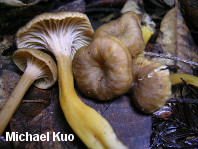
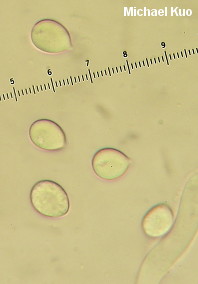
Key to 46 Chanterelles and Trumpets in North America
| 1. | Mature mushroom medium-sized to large; fairly tough and fleshy; often with a central depression that is coarsely scaly; some species growing in clusters with shared stem bases; spores somewhat wrinkled or warted (not smooth); distributed on the West Coast, in the Rocky Mountains, in the southern Appalachians, and in northern and northeastern North America. | |
| 1. | Mature mushroom variously sized; fleshy or thin-fleshed; without a coarsely scaly central depression (or, if so, then thin-fleshed); growing alone, gregariously, or in clusters but not sharing stems (with two exceptions); spores smooth; variously distributed. | 2 |
| 2. | Fresh mushroom with dark colors (black, gray, dark blue, purplish black, blackish brown) overall. | 3 |
| 2. | Fresh mushroom not dark overall, though perhaps with a dark brown cap. | 14 |
| 3. | Growing in dense clusters with shared stem bases; found in northern and montane North America; blue to purple shades usually present on cap surface and undersurface; spores nodulose. | |
| 3. | Not growing in clusters--or, if loosely clustered, stem bases not fused; variously distributed; blue shades absent or very faint; spores not nodulose. | 4 |
| 4. | Mature cap tiny (usually under 2 cm across); stem under 3 mm thick; cap fairly easily distinguished from stem. | 5 |
| 4. | Mature fruiting body more than 2 cm across; stem or pseudostem more than 3 mm thick; cap and stem clearly separated or not. | 8 |
| 5. | Cap margin fringed with tiny hairs; spores 8-10.5 x 5-7 µ; known from North Carolina and Tennessee. | Craterellus carolinensis |
| 5. | Cap margin not fringed; spores variously sized; probably widely distributed east of the Great Plains. | 6 |
| 6. | Spores under 10 µ long. | 7 |
| 7. | Fresh cap brownish with a yellowish margin; basidia 6-spored. | Craterellus hesleri |
| 7. | Fresh cap black to gray; basidia 4-spored. | Craterellus subundulatus |
| 8. | Undersurface smooth at maturity, or slightly wrinkled to sparsely veined. | 9 |
| 8. | Undersurface at maturity more prominently wrinkled, veined, or with false gills. | 11 |
| 9. | Found in northern California and Oregon; spore print white to creamy; spores 8-12 µ long; basidia 2-spored. | |
| 9. | Variously distributed; spore print varying; spores 6.5-8.5 µ long or 10-15 µ long; basidia 2- or 4-spored. | 10 |
| 10. | Associated with spruces; spore print color unknown; basidia 4-spored; spores 6.5-8.5 µ long. | Craterellus dubius |
| 10. | Associated with oaks and other hardwoods; spore print orangish yellow to pinkish orange; basidia 2-spored; spores 10-15 µ long. | |
| 11. | Associated with oaks; pseudostem 1-3 cm thick at apex at maturity; odor strong and sweet. | |
| 11. | Associated with beech, paper birch, or conifers; mature stem or pseudostem under 1.5 cm thick at apex; odor sweet or not distinctive. | 12 |
| 12. | Undersurface smooth to wrinkled, often notably paler than cap surface; spores mostly longer than 10 µm. | Craterellus undulatus |
| 12. | Undersurface with prominent veins or false gills; spores mostly shorter than 10 µm. | |
| 14. | Found from the Rocky Mountains westward. | 15 |
| 14. | Found from the Great Plains eastward. | 21 |
| 15. | Mushroom very thin-fleshed, trumpet-shaped, and yellow; stem and cap not clearly separated. | |
| 15. | Mushroom not thin-fleshed and trumpet-shaped, yellow or not; stem and cap more or less clearly separated. | 16 |
| 16. | Fresh cap, false gills, and stem white to whitish or creamy, bruising orangish brown; associated with conifers. | |
| 16. | Fresh cap, false gills, and stem not all white to whitish; associated with conifers or hardwoods. | 17 |
| 17. | Cap brown, developing a central perforation; stem yellow, with a waxy feel, hollowing. | |
| 17. | Cap not brown, not developing a perforation; stem variously colored, not waxy, not hollowing. | 18 |
| 18. | Associated with spruces (especially Engelmann spruce); cap surface dull yellow, with a pinkish bloom when very young; false gills brilliant orange, frequently contrasting markedly with the cap; surfaces not bruising brownish to brownish orange when handled. | |
| 18. | Associated with various trees; cap surface without a pinkish bloom; false gills usually not contrasting markedly with cap surface; surfaces bruising or not. | 19 |
| 19. | Associated with coast live oak in northern California; cap bald and egg-yolk yellow; false gills usually yellow; stem more or less equal. | |
| 19. | Associated with hemlock, Douglas-fir, spruce, or lodgepole pine in the coastal Pacific Northwest; cap surface often developing fine scales or tiny appressed fibers, orangish yellow; false gills yellow or, often, pinkish; stem variously shaped. Note: The subsequent two species are DNA-defined and morphologically cryptic. | 20 |
| 20. | Stem usually tapered to base; cap usually orangish yellow. | |
| 20. | Stem usually club-shaped or swollen in the middle; cap usually bright, pure yellow. | Cantharellus cascadensis |
| 21. | Found in northern areas under jack pine; cap surface dull yellow, with a pinkish bloom when very young; false gills brilliant orange, frequently contrasting markedly with the cap; surfaces not bruising brownish to brownish orange when handled. | |
| 21. | Associated with various hardwoods and conifers; variously distributed; cap surface without a pinkish bloom; false gills if brilliant orange not contrasting markedly with the cap; surfaces bruising or not. | 22 |
| 22. | Cap and false gills pinkish red, pinkish orange, orangish pink, "cinnabar red" (about e44235), or peach colored (occasionally bright orange, without a red component, but if so, cap center not becoming perforated). | 23 |
| 22. | Cap and false gills without red, pink, peach, or "cinnabar" shades; if bright orange, cap becoming perforated. | 26 |
| 23. | Associated with seagrapes (plants in the genus Coccoloba) in coastal areas in the Caribbean and in Florida. | |
| 23. | Not found in coastal areas in the Caribbean—or, if so, then associated with hardwood trees. | 24 |
| 24. | Cap and false gills peach colored; stem bruising and discoloring brownish yellow to yellowish brown; mushroom fairly fleshy and compact (stature cibarius-like); distributed in the Appalachians. | |
| 24. | Cap and false gills pinkish red, pinkish orange, orangish pink, or "cinnabar red"; stem not bruising; mushroom thin-fleshed and graceful (stature not cibarius-like); variously distributed. | 25 |
| 25. | Known from eastern Texas; spores long-ellipsoid to nearly cylindric, 8–9 µm long; terminal cells on cap surface thin-walled and cylindric. | Cantharellus texensis |
| 25. | Variously distributed; spores ellipsoid, 7–8 µm long; terminal cells on cap surface thin- and thick-walled, cylindric to clavate. | |
| 26. | Surfaces bruising purple to lilac; southeastern in distribution. | Gloeocantharellus purpurascens |
| 26. | Surfaces not bruising purple; variously distributed. | 27 |
| 27. | Cap brown or with a brown center at some point in its development. | 28 |
| 28. | Cap surface with fine brown fibrils; undersurface smooth, wrinkled, veined, or rarely sub-lamellate--but almost always without well-developed false gills. | |
| 28. | Cap without brown fibrils; undersurface with well-developed false gills. | 29 |
| 29. | Associated with hardwoods or with slash pine; generally distributed below the Great Lakes and in the Appalachians; stem surface not waxy. | 30 |
| 29. | Associated with conifers; northern and Appalachian; stem surface often with a waxy feel. | 32 |
| 30. | Distributed from the southern Appalachians to Missouri and Québec; surfaces red with iron salts. | |
| 30. | Distributed in the Gulf states; surfaces negative with iron salts. | 31 |
| 31. | Mushroom compact (mature stem about the width of the cap); flesh yellowing when sliced, then turning rusty brown; known from east-central Texas in association with post oak in savannahs. | Cantharellus quercophilus |
| 31. | Mushroom slender (mature stem longer than width of cap); flesh not yellowing when sliced; associated with slash pine and possibly with hardwoods; common throughout the Gulf States. | Cantharellus tabernensis |
| 32. | Undersurface smooth or, at maturity, wrinkled to veined or, near the margin, nearly gill-like. | |
| 32. | Undersurface by maturity with well-developed false gills. | 33 |
| 33. | Spores round or nearly so. | |
| 34. | Cap yellow when young, only becoming brown at maturity. | Craterellus flavobrunneus |
| 34. | Cap brown from the beginning. | 35 |
| 35. | Stem long and pale, "always very long before the pileus expansion begins, giving the general appearance of 'pin-heads' in the population" (Petersen, 1979); cap and stem fading quickly. | Craterellus pallidipes |
| 35. | Stem not as above; cap and stem not fading quickly. | |
| 36. | Undersurface smooth or, at maturity, wrinkled to veined or, near the margin, nearly gill-like. | 37 |
| 36. | Undersurface by maturity with well-developed false gills. | 40 |
| 37. | Mushroom small (mature cap to about 2 cm across, stem to about 6 mm thick); found in low, wet woods. | |
| 37. | Mushroom medium-sized to large (mature cap 2-10 cm across, stem 0.5-2.5 cm thick); found under hardwoods in upland woods. | 38 |
| 38. | Mushrooms thin-fleshed, with truly vase-shaped caps (the depression of the "vase" extends all the way down into the stem); distributed in the southern Appalachians and reported (accuracy not certain due to confusion with other species) from Florida and Mexico. | |
| 38. | Mushrooms thick-fleshed, with convex to flat or shallowly vase-shaped caps; distributed from the Great Plains eastward and southward. | 39 |
| 39. | Mushrooms often confluent (stems give rise to more than one cap); distributed in the southeastern United States and Mexico. | |
| 39. | Mushrooms rarely confluent; widely distributed east of the Great plains. | |
| 40. | Mature mushroom tiny to small; stem 1-10 mm thick, often becoming hollow; center of cap becoming perforated or not. | 41 |
| 40. | Mature mushroom usually medium-sized to large (for a chanterelle); stem 10-30 thick, fleshy; center of cap not becoming perforated. | 44 |
| 41. | Distributed in the Gulf States; associated with slash pine; cap dull orangish yellow to brownish, often appearing nearly zonate near the margin with maturity. | Cantharellus tabernensis |
| 41. | Variously distributed; associated with various trees; cap variously colored, not becoming zonate. | 42 |
| 42. | Associated with hemlock; cap and stem bright orange. | Cantharellus minor f. intensissima(see C. minor) |
| 42. | Associated with hardwoods; cap and stem variously colored. | 43 |
| 43. | Center of cap becoming perforated with maturity; undersurface with pinkish to grayish, blunt, false gills; mature cap 1.5-5 cm across. | |
| 43. | Center of cap not becoming perforated; undersurface yellow to orangish yellow, with well-developed, gill-like false gills; mature cap 0.5-3 cm across. | |
| 44. | Odor strong, reminiscent of camphor or curry (like that of Lactarius camphoratus); false gills shallow; young cap finely scaly; known from Nova Scotia. | Cantharellus camphoratus |
| 44. | Odor sweet and fragrant, reminiscent of apricots--or not distinctive; false gills shallow to deep; cap finely scaly or not; variously distributed. | 45 |
| 45. | Cap with lilac to purple shades, at least when young; surfaces bruising yellowish to brownish readily; spores under 9 µ long; found in the Gulf Coast states. | Cantharellus lewisii |
| 45. | Cap without purple shades; surfaces bruising readily, slowly, or not bruising; spore length varying; variously distributed. | 46 |
| 46. | So here's the deal. Up until very recently, you could have called your mushroom "Cantharellus cibarius" if you had reached this point in the key, and you would have been in line with North American literature from field guides to websites (including this one) to scientific treatments. But thanks to recent research we are now in a transition. A few cibarius-like species have been described from our continent with contemporary (meaning: DNA-informed) concepts. Many more species are likely to ensue--and you can help mycology figure out what the species are. Please read the page for "Cantharellus cibarius," linked to the right, to find out how. | |
| 46. | Mushroom identifier is willing to accept that there is a good probability that his or her cibarius-like collection from eastern North America is unnamed. | 47 |
| 47. | Species recently described from pine-oak woods in eastern Texas, with precise distribution limits yet to be established. | 48 |
| 47. | Species recently described from oak-hickory woods in Wisconsin, with precise distribution limits yet to be established. | 49 |
| 48. | Stem, particularly in immature specimens, often longer than the cap is wide; spores 8.5-12 µ long; elements from cap surface with thick (0.5-1 µ) walls. | Cantharellus altipes |
| 48. | Stem not usually longer than the cap is wide; spores 7-8.5 µ long; elements from cap surface both thin- and thick-walled. | Cantharellus tenuithrix |
| 49. | False gills with a deep pink tinge; cap orange; stem orange with a white base; spore print deep pinkish orange; spores 10-12 µ long. | Cantharellus spectaculus |
| 49. | False gills white, yellow, or pinkish; cap yellow; stem white or yellow; spore print whitish to yellow or pinkish; spores 7.5-10 µ long. | 50 |
| 50. | False gills white to whitish when young, developing pink hues with maturity (tilt the undersurface at several angles in good lighting before deciding); spore print whitish to pinkish or pink; stem white to whitish. | Cantharellus phasmatis |
| 50. | False gills, spore print, and stem yellow. | Cantharellus flavus |
References
Arora, D. & S. M. Dunham (2008). A new, commercially valuable chanterelle species, Cantharellus californicus sp. nov., associated with live oak in California, USA. Economic Botany 62: 376–391.
Bigelow, H. E. (1978). Cantharelloid fungi of New England and adjacent areas. Mycologia 70: 707–756.
Burt, E. A. (1914). The Thelephoraceae of North America. II. Craterellus. Annals of the Missouri Botanical Garden 1: 327–350.
Buyck, B., D. P. Lewis, G. Eyssartier & V. Hofstetter (2010). Cantharellus quercophilus sp. nov. and its comparison to other small, yellow or brown American chanterelles. Cryptogamie, Mycologie 31: 17–33.
Buyck, B., C. Cruaud, A. Couloux & V. Hofstetter (2011). Cantharellus texensis sp. nov. from Texas, a southern lookalike of C. cinnabarinus revealed by tef-1 sequence data. Mycologia 103: 1037–1046.
Buyck, B. & V. Hofstetter (2011). The contribution of tef-1 sequences to species delimitation in the Cantharellus cibarius complex in the southeastern USA. Fungal Diversity 49: 35–46.
Buyck, B. (2014). Exploring the diversity of "smooth chanterelles" (Cantharellus, Cantharellales). Cryptogamie, Mycologie 35: 23–40.
Buyck, B., F. Kauff, G. Eyssartier, A. Couloux & V. Hofstetter (2014). A multilocus phylogeny for worldwide Cantharellus (Cantharellales, Agaricomycetidae). Fungal Diversity 64: 101–121.
Buyck, B., P. -A. Moreau, R. Courtecuisse, A. Kong, M. Roy & V. Hofstetter (2016). Cantharellus coccolobae sp. nov. and Cantharellus garnieri, two tropical members of Cantharellus subg. Cinnabarinus. Cryptogamie, Mycolgie 37: 391–403.
Coker, W. C. (1919). Craterellus, Cantharellus and related genera in North Carolina; with a key to the genera of gill fungi. Journal of the Elisha Mitchell Scientific Society 35: 24–48.
Contu, M., A. Vizzini, M. Carbone & L. Setti (2009). Identity and neotypification of Craterellus cinereus and description of Cantharellus atrofuscus sp. nov. Mycotaxon 110: 139–149.
Corner, E. J. H. (1966). A monograph of cantharelloid fungi. Oxford: Oxford UP. 255 pp.
Cuesta, J. C., J. F. Portal, D. M. Alcántara, F. P. Maza, M. A. R. Ripoli & N. S. Rodríguez (2009). Cantharellales en el Pirineo 1. Micobotánica-Jaén 4: 134–162.
Dahlman, M., E. Danell & J. W. Spatafora (2000). Molecular systematics of Craterellus: Cladistic analysis of nuclear LSU rDNA sequence data. Mycological Research 104: 388–394.
Danell, E. (1994). Cantharellus cibarius: Mycorrhiza formation and ecology. Ph. D. thesis. Acta Universitatis Upsaliensis: Comprehensive summaries of Uppsala dissertations from the Faculty of Science and Technology 35. 75 pp.
Donk, M. A. (1969). Notes on Cantharellus Sect. Leptocantharellus. Persoonia 5: 265–284.
Dunham, S. M., T. E. O'Dell & R. Molina (2003). Analysis of nrDNA sequences and microsatellite allele frequencies reveals a cryptic chanterelle species Cantharellus cascadensis sp. nov. from the American Pacific Northwest. Mycological Research 107: 1163–1177.
Dunham, S. M., T. E. O'Dell & R. Molina (2006). Forest stand age and the occurrence of chanterelle (Cantharellus) species in Oregon's central Cascade Mountains. Mycological Research 110: 1433–1440.
Dunham, S. M., T. E. O'Dell & R. Molina (2006). Spatial analysis of within-population microsatellite variability reveals restricted gene flow in the Pacific golden chanterelle (Cantharellus formosus). Mycologia 98: 250–259.
Feibelman, T. P., J. W. Bennett & W. G. Cibula (1996). Cantharellus tabernensis: A new species from the southeastern United States. Mycologia 88: 295–301.
Feibelman, T. P., R. L. Doudrick, W. G. Cinbula & J. W. Bennett. (1997). Phylogenetic relationships within the Cantharellaceae inferred from sequence analysis of the nuclear large subunit rDNA. Mycological Research 101: 1423–1430.
Foltz, M. J., K. E. Perez & T. J. Volk (2013). Molecular phylogeny and morphology reveal three new species of Cantharellus within 20 m of one another in western Wisconsin, USA. Mycologia 105: 447–461.
Guerrero, G. G. & F. G. Ocanas (2005). Estudio de la subunidad mayor del ADN ribosomal nuclear de algunas especies del genero Cantharellus en Mexico. Revista Mexicana de Micologia 20: 21–26.
Guo-ying, Z., G. Liang, L. Lin & L. He (2011). rDNA internal transcribed spacer sequence analysis of Craterellus tubaeformis from North America and Europe. Canadian Journal of Microbiology 57: 29–32.
Matheny, P. B., E. A. Austin, J. M. Birkebak & A. D. Wolfenbarger (2010). Craterellus fallax, a Black Trumpet mushroom from eastern North America with a broad host range. Mycorrhiza 20: 569–575.
Moncalvo, J. M. & 15 coauthors (2006). The cantharelloid clade: dealing with incongruent gene trees and phylogenetic reconstruction methods. Mycologia 98: 937–948.
Olariaga, I., I. Salcedo & L. A. Parra (2009). Proposal to conserve the name Craterellus cinereus (Pers.: Fr.) Donk with a conserved type against Craterellus cinereus Pers. (Basidiomycota). Taxon 58: 294–295.
Petersen, R. H. (1969). Notes on cantharelloid fungi. II. Some new taxa, and notes on Pseudocraterellus. Persoonia 5: 211–223.
Petersen, R. H. (1975). Notes on cantharelloid fungi. V. A new species of Cantharellus. Nova Hedwigia 51: 183–189.
Petersen, R. H. (1975). Notes on cantharelloid fungi. VI. New species of Craterellus and infrageneric rearrangement. Česká Mycologie 29: 199–204.
Petersen, R. H. (1976). Notes on cantharelloid fungi. VII. The taxa described by Charles H. Peck. Mycologia 68: 304–326.
Petersen, R. H. (1979a). Notes on cantharelloid fungi. IX. Illustrations of new or poorly understood taxa. Nova Hedwigia 31: 1–23.
Petersen, R. H. (1979b). Notes on cantharelloid fungi. X. Cantharellus confluens and C. lateritius, Craterellus odoratus and C. aureus. Sydowia 32: 198–208.
Petersen, R. H. (1985). Notes on clavarioid fungi. XIX. Colored illustrations of selected taxa, with comments on Cantharellus. Nova Hedwigia 42: 151–160.
Pilz, D., L. Norvell, E. Dannell & R. Molina (2003). Ecology and management of commercially harvested chanterelle mushrooms. Portland, Oregon: USDA General Technical Report. 83 pp. Available online at http://www.fs.fed.us/pnw/pubs/gtr576.pdf
Pine, E. M., D. S. Hibbett & M. J. Donoghue (1999). Phylogenetic relationships of cantharelloid and clavarioid Homobasidiomycetes based on mitochondrial and nuclear rDNA sequences. Mycologia 91: 944–963.
Redhead, S. A., L. L. Norvell & E. Danell (1997). Cantharellus formosus and the Pacific Golden Chanterelle harvest in western North America. Mycotaxon 65: 285–322.
Redhead, S. A., L. L. Norvell, E. Danell & S. Ryman (2002). Proposals to conserve the names Cantharellus lutescens Fr.: Fr. and C. tubaeformis Fr.: Fr. (Basidiomycota) with conserved types. Taxon 51: 559–562.
Redman, R. S., J. Ranson & R. J. Rodriguez (2006). Genetic structure of Cantharellus formosus populations in a second-growth temperate rain forest of the Pacific Northwest. Pacific Northwest Fungi 1: 1–13.
Rochon, C., D. Pare, N. Pelardy, D. P. Khasa & J. A. Fortin (2011). Ecology and productivity of Cantharellus cibarius var. roseocanus in two eastern Canadian jack pine stands. Botany 89: 663–675.
Smith, A. H. & Morse, E. E. (1947). The genus Cantharellus in the western United States. Mycologia 39: 497–534.
Smith, A. H. (1968). The Cantharellaceae of Michigan. Michigan Botanist 7: 143–183.
Thiers, H. D. (1985). The Agaricales of California. 2. Cantharellaceae. Eureka, CA: Mad River Press. 34 pp.
Trappe, M. J. (2004). Habitat and host associations of Craterellus tubaeformis in northwestern Oregon. Mycologia 96: 498–509.
Vila, J. (2006). Notas sobre el género Craterellus Pers. Errotari 3: 57–62.
Zhang, Y. -Z. & 10 coauthors (2022). A contribution to knowledge of Craterellus (Hydnaceae, Cantharellales) in China: Three new taxa and amended descriptions of two previous species. Frontiers in Microbiology 13: 906296.
This site contains no information about the edibility or toxicity of mushrooms.
Cite This Page As:
Kuo, M. (2015, March). Chanterelles and trumpets: Cantharellus and Craterellus. Retrieved from the MushroomExpert.Com Web site: http://www.mushroomexpert.com/cantharellaceae.html
© MushroomExpert.Com