| Major Groups > Chanterelles and Trumpets > Cantharellus "cibarius" |

|
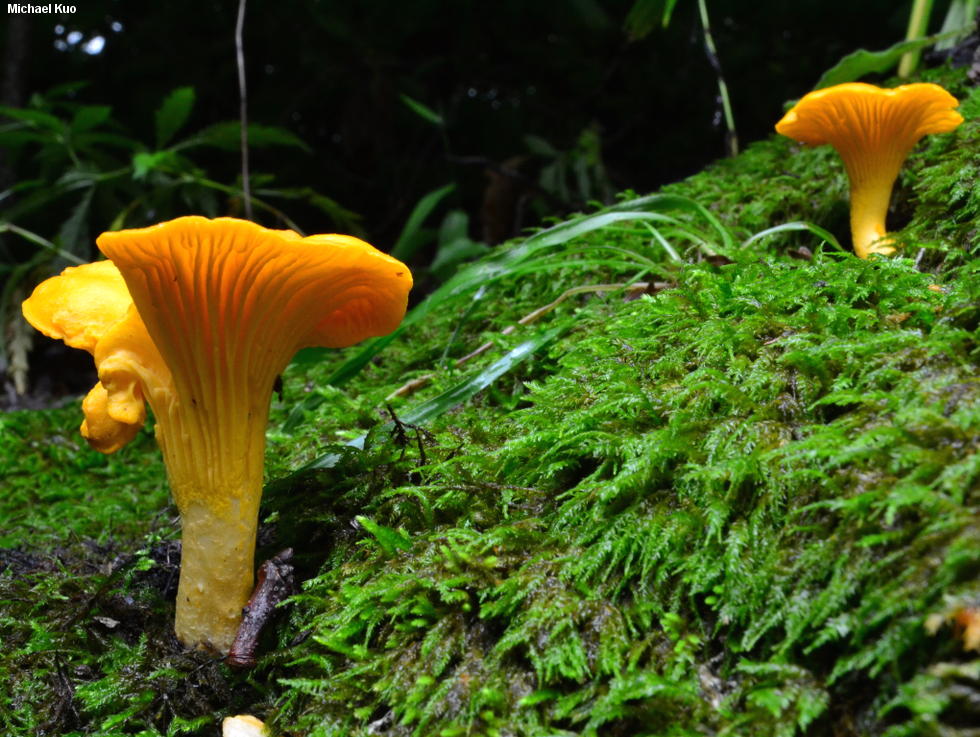
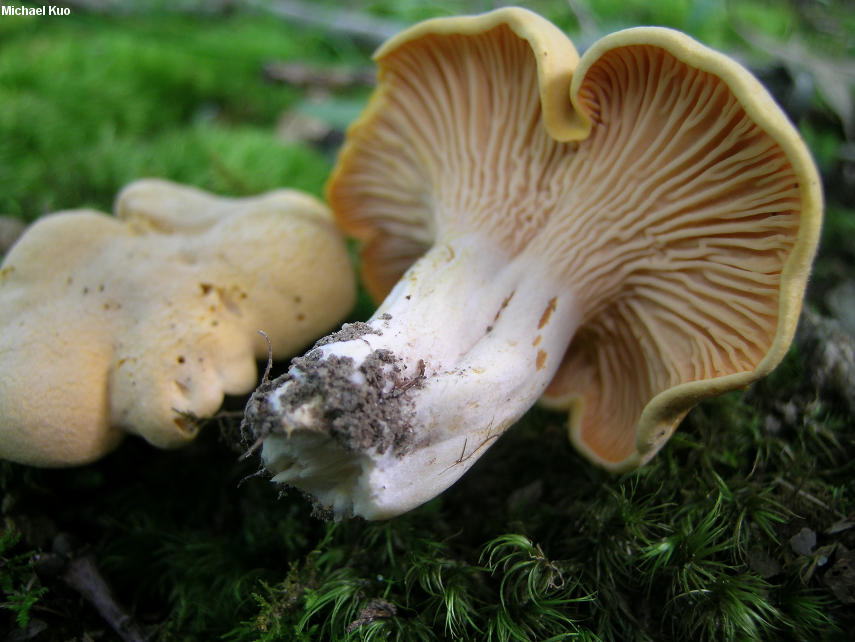
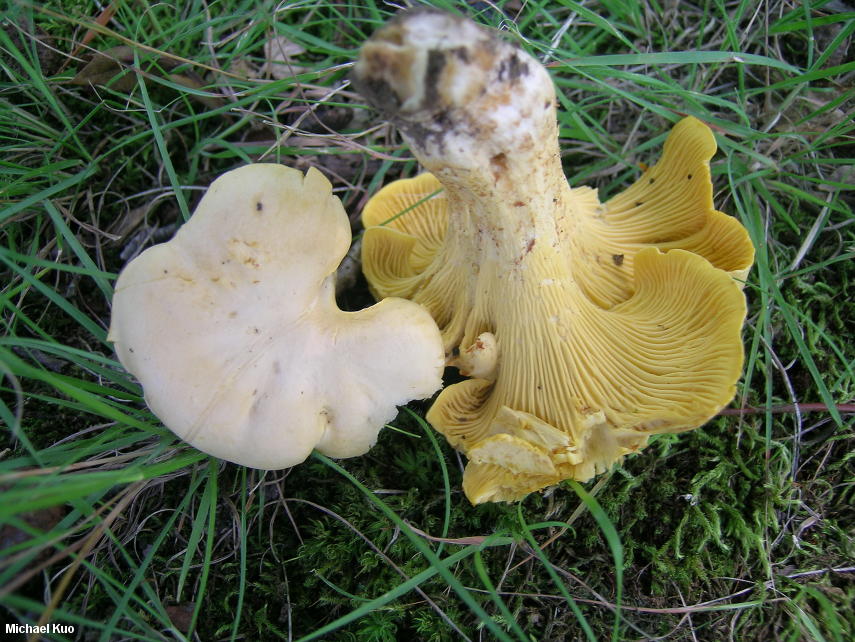
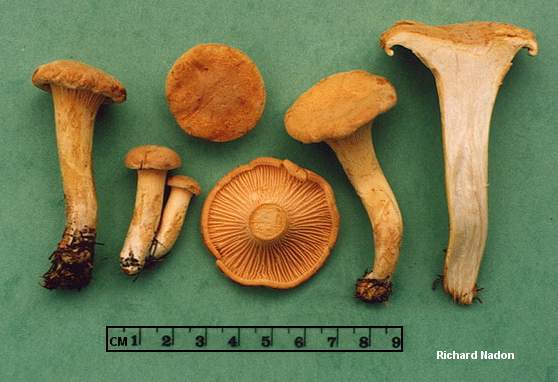
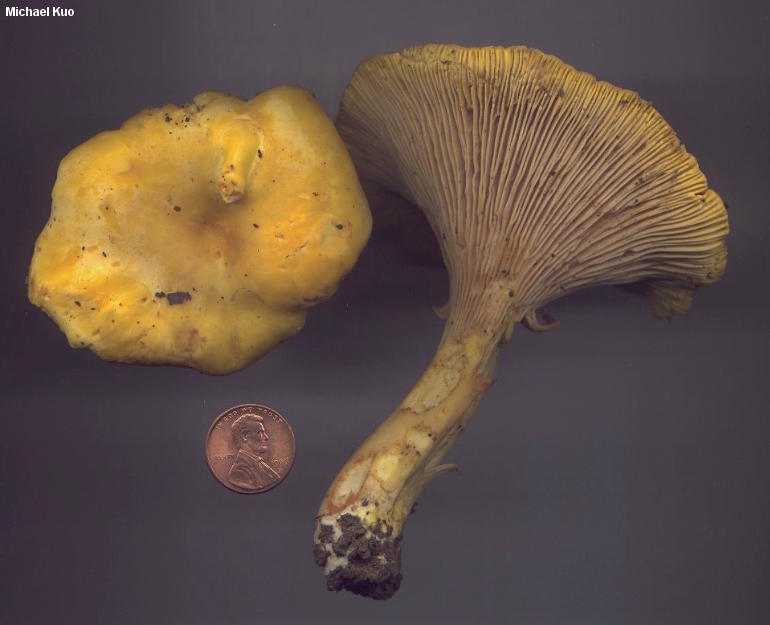
Cantharellus "cibarius" [ Basidiomycota > Cantharellales > Cantharellaceae > Cantharellus . . . ] by Michael Kuo The chanterelles grouped together here are usually fairly easy to spot; they are medium-sized or large, yellow to orange-yellow or orange mushrooms found in hardwood forests, featuring a broadly convex, flat, or shallowly depressed cap, a central and fleshy stem, and false gills on the underside of the cap. The mushrooms are also known for their fruity, apricot-like odor, best detected when you have several of them together in your collection bag or basket. It is currently unclear how many species of Cantharellus in North America match the general description above. Until recently they were all lumped together in treatments of "Cantharellus cibarius," but recent research has made it clear that Cantharellus cibarius is a strictly European species. In western North America (that is, from the Rocky Mountains westward) there appears to be less diversity among the cibarius-like species; so far, anyway, only four species have been delineated with contemporary species concepts; see the key to chanterelles and trumpets, beginning with couplet #17. But in eastern North America, we may well be in for some changes. At the time of this writing (early 2015), two papers have begun to describe cibarius-like species from Texas (Buyck & Hofstetter, 2011) and from Wisconsin (Foltz and collaborators, 2013). These new eastern species can be found in the key to chanterelles and trumpets, beginning with couplet #44. You Can Help! Many more species are likely to be discovered--perhaps in the west, but almost certainly in the east. Mycology needs your help in the effort to document, describe, and name the cibarius-like chanterelles on our continent. If you are like me, your chanterelle collections over the years have not exactly been made with science in mind. But I am turning over a new leaf, and I hope you'll join me. Please see the pages on collecting mushrooms for study, making spore prints, and describing mushrooms, along with the page for preserving specimens. These pages provide the basics for documenting collections. But the recently published Cantharellus papers have made it clear that, if we want to be able to tell our chanterelle species apart, we are going to need to pay attention to some features we are not used to observing for chanterelles, so I am drawing your attention to them here: Spore Print Color. The Foltz paper used DNA sequencing to identify three separate cibarius-like species growing within 65 feet of one another in Wisconsin. The authors determined that each species had a different spore print color. The authors of the Texas paper, however, did not document spore print color for one species, and for the other they only managed to obtain very thin spore prints that looked more or less whitish--but any chanterelle spore print can look whitish if it is not thick. When recording the color of a chanterelle spore print, be sure to hold the print in good light, and view it from an oblique angle. The colors recorded for North American cibarius-like species, so far, include white, creamy, yellow, pinkish, and deep pinkish (salmon). Color of False Gills. The Foltz paper also used the color of the false gills to help separate species. This color is subject to potential change over the course of the chanterelle's development; for example, the whitish young false gills of Cantharellus phasmatis develop pink shades as the spores mature. The color of the false gills can be difficult to assess, and even more difficult to photograph. "Pink" in mushroom mycology is not always as, well, pink as one might think. I recommend making the observation in good, natural light, and holding the mushroom at various angles before deciding. Mycorrhizal Association. The precise extent to which chanterelles are mycorrhizal specialists is not yet known. For this reason it would be a good idea to document any tree within "toppling range" (the distance from which, if the tree were to fall over, it could potentially hit the mushroom) with as much precision as possible. It is entirely possible that some species of cibarius-like chanterelles are associated with a limited number of hosts, which might help in their identification. Reaction to Iron Salts. Although neither the Foltz paper nor the Buyck paper documents the reaction of the various newly named species to iron salts, at least two North American Cantharellus species have distinctive reactions (red for Cantharellus appalachiensis and olive for Cantharellus roseocanus). And, over the years, I have found the cibarius-like collections I've made to vary in reaction from negative to dark gray--but this was while I was conceiving of them as a single species. Perhaps the difference between negative and gray will turn out to be informative in some situations. (Iron salts can be purchased easily at Amazon or elsewhere; search "feso4.") Basic Morphology. Aside from the special details above, of course, the basic proportions, colors, measurements (width of the cap, length and width of the stem), and so on should all be recorded and photographed. Good photos are especially important with chanterelles, because the features that separate them are likely to be easily assessed only when the mushrooms are fresh; microscopic features, which can be observed from dried specimens, are only occasionally useful with this group of species. Robust, well-documented, well-dried collections of cibarius-like chanterelles are essential to figuring out what our chanterelle species are. If you (or your mycological society) are interested in helping, I urge you to make such collections and donate them, along with supporting documentation and photgraphs, to a public herbarium. If you would like help figuring out the process, or selecting a herbarium, feel free to contact me! REFERENCES: Fries, 1821; Coker, 1919; Smith, 1968; Bigelow, 1978; Petersen, 1979; Smith, Smith & Weber, 1981; Weber & Smith, 1985; Lincoff, 1992; Metzler & Metzler, 1992; Horn, Kay & Abel, 1993; Barron, 1999; Roody, 2003; McNeil, 2006; Kuo, 2007; Binion et al., 2008; Buyck & Hofstetter, 2011; Foltz et al., 2013; Kuo & Methven, 2014. Herb. Kuo 06249402, 06130206, 07220303, 07220305, 07180702, 07011101, 07121101, 07141102. This site contains no information about the edibility or toxicity of mushrooms. |
© MushroomExpert.Com |
|
Cite this page as: Kuo, M. (2015, March). Cantharellus "cibarius." Retrieved from the MushroomExpert.Com Web site: http://www.mushroomexpert.com/cantharellus_cibarius.html |