| Major Groups > Toothed Mushrooms |

|
Toothed Mushrooms [ Basidiomycota . . . ] by Michael Kuo Mushrooms with spines or "teeth" do not form a natural taxonomic group, but putting them together simplifies identification; while the toothed mushrooms range widely in their appearance, the presence of the spines helps separate them from the thousands of other mushrooms that lack spines. Some of these mushrooms, like Auriscalpium vulgare, are fairly easy to identify—but others can make for a frustrating experience. I find many species of Hydnellum to be very difficult to separate (figuratively and literally, since their flesh is so tough). The key below will lead you to a species in a few instances, but is primarily designed to sort out the various genera of toothed mushrooms. Toothed Mushroom Pages
Auriscalpium vulgare |
|

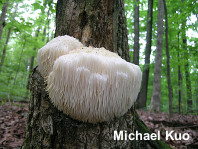
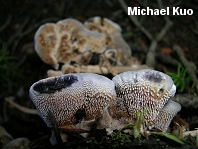
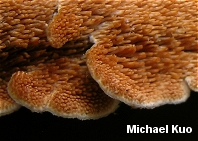
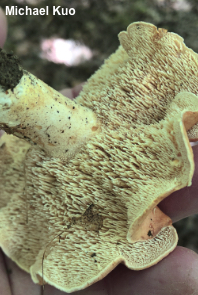
|
Key to Genera (and a Few Species) of Toothed Mushrooms
|
|
References Baird, R. E. (1986a). Type studies of North American and other related taxa of stipitate hydnums: Genera Bankera, Hydnellum, Phellodon, Sarcodon. Berlin: J. Cramer. 89 pp. Baird, R. E. (1986b). Study of the stipitate hydnums from the southern Appalachian Mountains—Genera: Bankera, Hydnellum, Phellodon, Sarcodon. Berlin: J. Cramer. 156 pp. Baird, R. E. & S. R. Khan (1986). The stipitate hydnums (Thelephoraceae) of Florida. Brittonia 38: 171–184. Baltazar, J. M., L. Trierveiler-Pereira, S. P. Gorjón & R. M. B. da Dilveira (2022). A synopsis of stipitate corticioid fungi (Basidiomycota) from southern Brazil. Lilloa 59 (Suplemento): 125–136. Banker, H. J. (1906). A contribution to a revision of the North American Hydnaceae. Memoirs of the Torrey Botanical Club 12: 99–194. Baroni, T. J., R. A. Swenie, L. Lacey, C. L. Ovrebo, J. Cifuentes, A. Corrales, M. E. Smith & D. Jean Lodge (2025). Hydnum (Cantharellales) of the neotropics: four new species and new reports from Belize, Costa Rica, Dominican Republic, Mexico, and Panama. Mycological Progress: 24: 13. Cao, T., J. -R. Yu, T. T. T. Nguyen & H. -S. Yuan (2021). Multiple-marker phylogeny and morphological evidence reveal two new species in Steccherinaceae (Polyporales, Basidiomycota) from Asia. MycoKeys 78: 169–186. Coker, W. C. (1919). The hydnums of North Carolina. Journal of the Elisha Mitchell Scientific Society 34: 163–197. Coker, W. C. & A. H. Beers (1951). The stipitate hydnums of the eastern United States. Chapel Hill: University of North Carolina Press. 211 pp. Conde, L. F. & Wolf, F. A. (1972). A large sporophore of Hericium erinaceus. Mycologia 64: 1187–1189. Gilbertson, R. L. & K. K. Nakasone (2003). New taxa of Hawaiian corticoid fungi are described with keys to Crustoderma, Radulomyces, and Scopuloides. Mycologia 95: 467–473. Ginns, J. (1985). Hericium in North America: Cultural characteristics and mating behavior. Canadian Journal of Botany 63: 1551–1563. Ginns, J. & L. Millman (2011). Mysterious Asian beauty conquers eastern Massachusetts. Fungi 4: 61-63. Hall, D. & D. E. Stuntz (1971). Pileate Hydnaceae of the Puget Sound area. I. White-spored genera: Auriscalpium, Hericium, Dentinum and Phellodon. Mycologia 63: 1099–1128. Hall, D. & D. E. Stuntz (1972). Pileate Hydnaceae of the Puget Sound Area III. Brown-Spored Genus: Hydnellum. Mycologia 64: 560–590. Harrison, K. A. (1973). The genus Hericium in North America. The Michigan Botanist 12:177–194. Harrison, K. A. & D. W. Grund (1984a). A new stipitate Hydnum of Nova Scotia. Mycotaxon 20: 95–99. Harrison, K. A. (1984b). Creolophus in North America. Mycologia 76: 1121–1123. Harrison, K. A. & D. W. Grund (1987a). Preliminary keys to the terrestrial stipitate hydnums of North America. Mycotaxon 28: 419–426. Harrison, K. A. & D. W. Grund (1987b). Differences in European and North American stipitate hydnums. Mycotaxon 28: 427–435. Hjortstam, B., B. M. Spooner & S. G. Oldridge (1990). Some Aphyllophorales and Heterobasidiomycetes from Sabah, Malaysia. Kew Bulletin 45: 303–322. Johannesson, H., S. Ryman, H. Lundmark & E. Danell (1999). Sarcodon imbricatus and S. squamosus—two confused species. Mycological Research 103: 1447–1452. Leal-Dutra, C., G. W. Griffith, M. A. Neves, D. J. McLaughlin, E. G. McLaughlin, L. A. Clasen & B. T. M. Dentinger (2020). Reclassification of Pterulaceae Corner (Basidiomycota: Agaricales) introducing the ant-associated genus Myrmecopterula gen. nov., Phaeopterula Henn. and the corticoid Radulomycetaceae fam. nov. IMA Fungus 11: 2. Maas Geesteranus, R. A. (1967). Notes on hydnums—VII. Persoonia 5: 1–13. Maas Geesteranus, R. A. & J. A. Nannfeldt (1969). The genus Sarcodon in Sweden in the light of recent investigations. Svensk Botanisk Tidskrift 63: 401–440. Maas Geesteranus, R. A. (1974). Studies in the genera Irpex and Steccherinum. Persoonia 7: 443–581. Moreno, G., M. N. Blanco, I. Olariaga & J. Checa (2007). Climacodon pulcherrimus a badly known tropical species, present in Europe. Cryptogamie, Mycologie 28: 3–11. Nakasone, K. K. (2001). Taxonomy of the genus Radulon. Harvard Papers in Botany 6: 163–177. Nakasone, K. K., B. Ortiz-Santana & S. -H. He (2021). Taxonomic studies of crust fungi with spines in Radulomyces, Sarcodontia, and the new genus Noblesia. Mycological Progress 20: 1479–1501. Niskanen, T., K. Liimatainen, J. Nuytinck, P. Kirk, I. O. Ibarguren, R. Garibay-Orijel, L. Norvell, S. Huhtinen, I. Kytövuori, J. Ruotsalainen, T. Niemelä, J. F. Ammirati & L. Tedersoo (2018). Identifying and naming the currently known diversity of the genus Hydnum, with an emphasis on European and North American taxa. Mycologia 110: 890–918. Parfitt, D., J. Hynes, H. J. Rogers & L. Boddy (2005). New PCR assay detects rare tooth fungi in wood where traditional approaches fail. Mycological Research 109: 1187–1194. Ryvarden, L. (2001). The genus Auriscalpium. Harvard Papers in Botany 6: 193–198. Swenie, R., Baroni, T. J. & P. B. Matheny (2018). Six new species and reports of Hydnum (Cantharellales) from eastern North America. MycoKeys 42: 35–72. Tervonen, K., V. Spirin & P. Halme (2015). Redescription of Mycorrhaphium pusillum, a poorly known hydnoid fungus. Mycotaxon 130: 549–554. Wald, P., S. Pitkanen & L. Boddy (2004). Interspecific interactions between the rare tooth fungi Creolophus cirrhatus, Hericium erinaceus and H. coralloides and other wood decay species in agar and wood. Mycological Research 108: 1447–1457. This site contains no information about the edibility or toxicity of mushrooms. Cite this page as: Kuo, M. (2010, May). Toothed mushrooms. Retrieved from the MushroomExpert.Com Web site: http://www.mushroomexpert.com/toothed.html © MushroomExpert.Com |