| Major Groups > Gilled Mushrooms > Pale-Spored > Russula > Foetid Russulas > Russula pulverulenta |

|
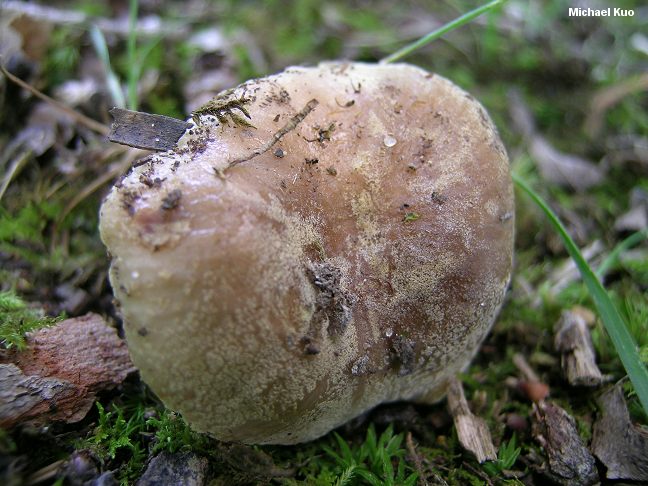
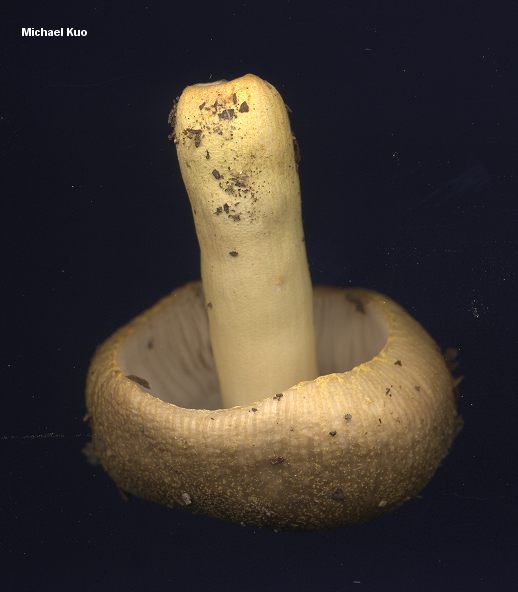
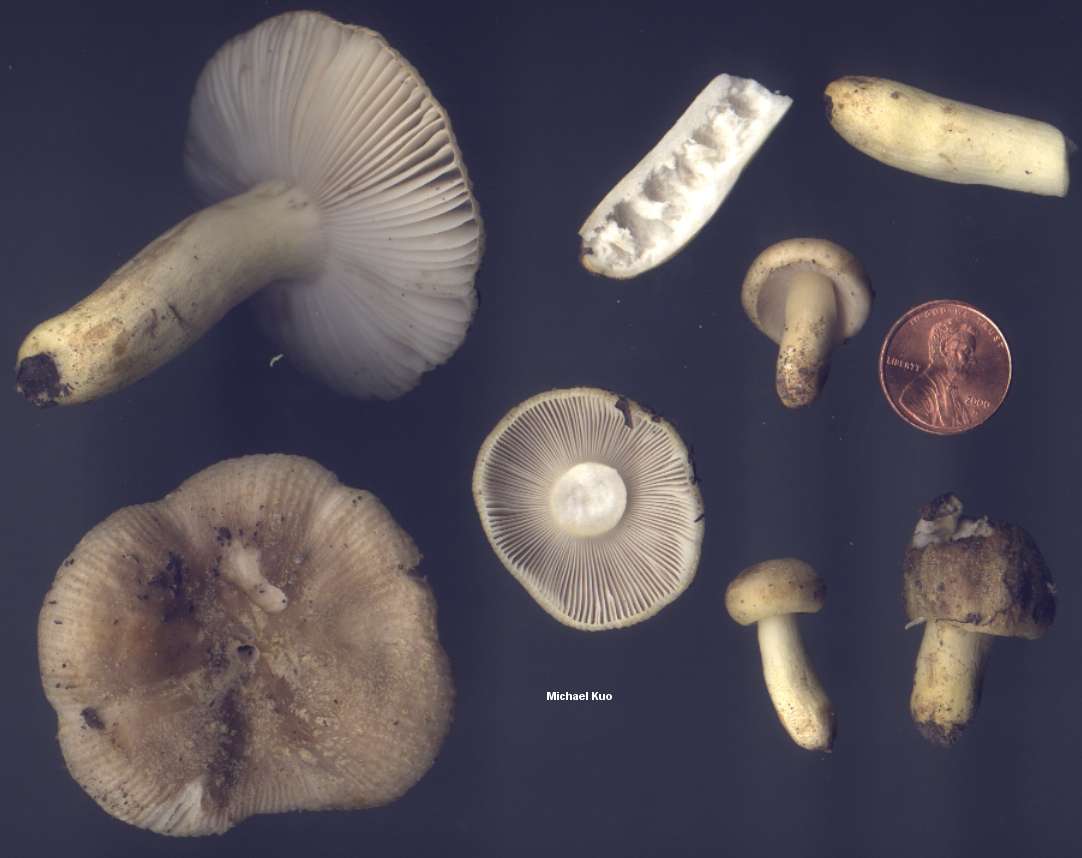
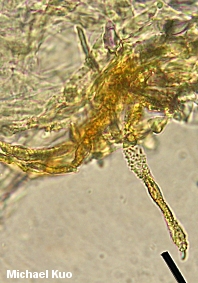
Russula pulverulenta [ Basidiomycetes > Russulales > Russulaceae > Russula . . . ] by Michael Kuo You might easily pass this mushroom by, thinking that it is just another boring, brownish to straw-colored russula. Close inspection, however, reveals Russula pulverulenta to be fairly distinctive--though some might still argue it's boring. What distinguishes this mushroom from many similar russulas is a layer of dense yellowish granules on the young caps; as the mushroom matures and the cap expands, the yellow material breaks up to form soft, yellowish patches, which are scattered across the cap surface. What, exactly, the powdery granules and scales of Russula pulverulenta are, or what "function" they are serving, is not completely clear. Typically, such things occur on mushroom caps either because the cap grows too fast to maintain the surface it had as a button--or because there was a universal veil covering the young mushroom. In Russula pulverulenta, the break-up of the layer of granules into soft patches is obviously caused by the expansion of the cap . . . but what was the layer doing there in the first place? Singer (1962) believed that this mushroom and the similar Russula granulata (see comments below) actually had veils, making them extremely rare among russulas. Shaffer (1972), however, analyzed the cell structure of the patches and found them to be closely aligned with the cells of the cap surface, perhaps refuting the veil explanation. If you're thinking, "And I care because . . . ?" I don't blame you. I thought it was kind of interesting, but then again, I'm a mushroom geek. You are of course welcome to throw your Russula pulverulenta at my head to see if any "interesting" break-up of floccose patches occurs there, too. Russula granulata is a very similar species that features a more crust-like, darker covering on the cap; under the microscope the crust-like material is composed of smooth, colorless or brownish cells--as opposed to the yellow, warty cells comprising the patches on Russula pulverulenta. Description: Ecology: Mycorrhizal with hardwoods or conifers; sometimes found in urban settings; growing alone (usually so, in my collecting experience), scattered, or gregariously; summer and fall; widely distributed east of the Rocky Mountains. Cap: 3.5-8 cm; convex with an inrolled margin when young, becoming broadly convex to flat with a shallow depression, with a more or less straight margin that is prominently grooved and pimply; dry or slightly moist; when young covered by a dense layer of orange-yellow to yellow material which eventually breaks up to form loose patches that often wear off with age; dark grayish brown to yellowish brown; the skin peeling away easily at the margin, sometimes about halfway to the center. Gills: Attached to the stem; close or almost distant; not generally forking, or occasionally forking near the stem; white; sometimes discoloring brownish to yellowish in age. Stem: 3.5-5 cm long; 1-2 cm thick; when young white, overlaid with yellow granules; later whitish towards the top and yellowish below; sometimes discoloring yellowish brown with age; dry; often becoming cavernous; fairly smooth. Flesh: White to pale yellowish; unchanging when sliced; olive to olive brown around worm holes. Odor and Taste: Odor sweet and fragrant, or slightly foul, or in some cases absent; taste slightly to moderately acrid. Chemical Reactions: KOH on cap surface orange to orangish or negative. Iron salts on stem surface negative. Spore Print: Creamy. Microscopic Features: Spores 6-8 x 5-7 µ; with warts .4-1.2 µ high; broadly elliptical or nearly round; connecting lines scattered, occasionally forming partial reticula. Pleurocystidia positive in sulphovanillin. Pileocystidia absent. Floccose patches on cap and stem composed of warty, septate hyphae that are yellow in a water mount (avoid KOH, which dissolves the warts). REFERENCES: Peck, 1902. (Saccardo, 1905; Burlingham, 1915; Beardslee, 1918; Kauffman, 1918; Shaffer, 1972.) Herb. Kuo 09010203, 10060501, 08310701. This site contains no information about the edibility or toxicity of mushrooms. |
© MushroomExpert.Com |
|
Cite this page as: Kuo, M. (2009, February). Russula pulverulenta. Retrieved from the MushroomExpert.Com Web site: http://www.mushroomexpert.com/russula_pulverulenta.html |