| Major Groups > Gilled Mushrooms > Pale-Spored > Russula > Russula flavisiccans |

|
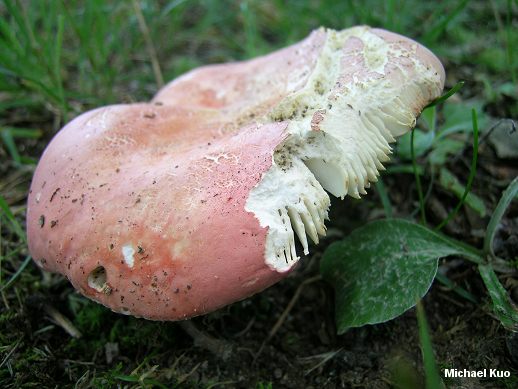
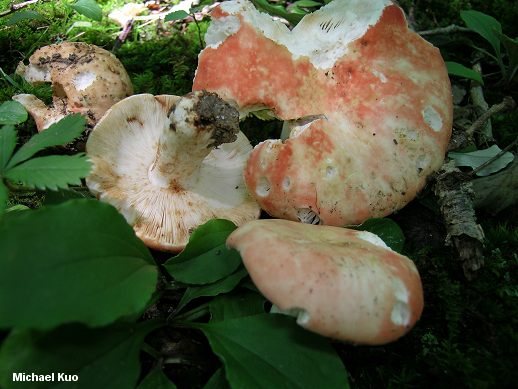
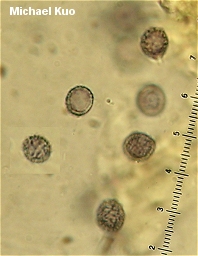
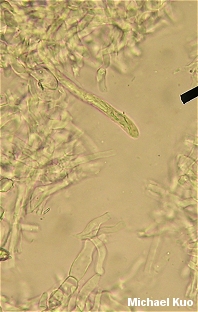
Russula flavisiccans [ Basidiomycota > Russulales > Russulaceae > Russula . . . ] by Michael Kuo First described from the southern Appalachians by Gerald Bills (1989), Russula flavisiccans is common and widespread in eastern North America's oak-hickory forests. It is a red russula--which is another way of saying it is hard to identify. However, Russula flavisiccans has just enough distinctive features that it is almost possible to identify it without microscopic analysis. The cap is dull and unpolished, and usually a dull pinkish red; the stem is white, without pink flushes; the gills and stem stain and discolor brownish; the taste is somewhat bitter or unpleasant; the spore print is white to creamy; and the flesh and surfaces turn dirty yellow when dried. Russula pulchra is very similar; see the comments on the linked page for a comparison. Description: Ecology: Mycorrhizal with oaks and perhaps with other hardwoods in oak-hickory forests; growing alone, scattered, or gregariously; summer and fall; probably widely distributed in eastern North America. The illustrated and described collections are from Illinois. Cap: 5–10 cm; convex when young, becoming broadly convex to flat or shallowly depressed; dry; very finely velvety to the touch, but appearing bald; usually developing fine cracks over the center or overall with maturity; pinkish red to pink when fresh, but often fading to orangish or yellowish pink; the center becoming mottled with yellowish or creamy areas; the margin usually not lined at maturity; the skin peeling with difficulty, usually only near the margin. Gills: Narrowly attached to the stem; close; forking occasionally; short-gills infrequent or absent; white when young but creamy or pale yellowish with maturity; discoloring and bruising orangish brown. Stem: 3–5 cm long; 1–2.5 cm thick; equal or tapered at the base; whitish; dry; bald; staining and discoloring brown. Flesh: White; very firm; unchanging when sliced. Odor and Taste: Odor not distinctive; taste oily and slightly acrid. Dried Specimens: Gills, stem, and flesh turning dull, dirty yellow; cap surface retaining dull pink colors but showing yellowed flesh in the cracks. The Latin species name of Russula flavisiccans means "drying yellow." Chemical Reactions: KOH on cap surface pink to orange; iron salts on stem surface negative. Spore Print: White. Microscopic Features: Spores 6–9 x 7–9 µm; subglobose; with amyloid warts and connectors up to REFERENCES: Bills, 1989. (Kibby & Fatto, 1990; Roody, 2003; Binion et al., 2008; Kuo & Methven, 2010; Kuo & Methven, 2014.) Herb. Kuo 06269507, 06230401, 07140703, 07090802, 07190803. This site contains no information about the edibility or toxicity of mushrooms. |
© MushroomExpert.Com |


|
Cite this page as: Kuo, M. (2016, September). Russula flavisiccans. Retrieved from the MushroomExpert.Com Web site: http://www.mushroomexpert.com/russula_flavisiccans.html |