| Major Groups > Gilled Mushrooms > Pale-Spored > Russula > Foetid Russulas > Russula amoenolens |

|
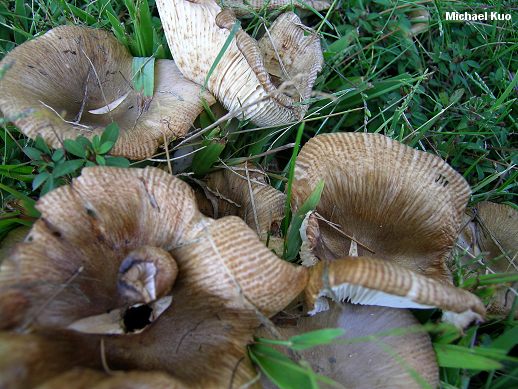
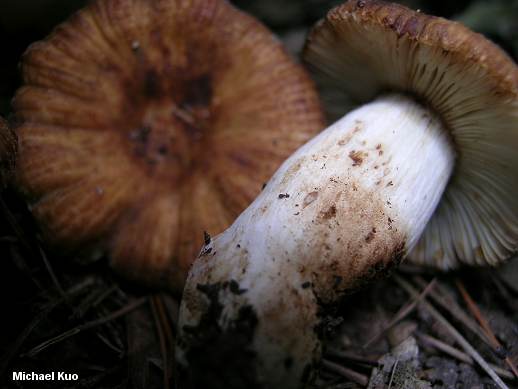
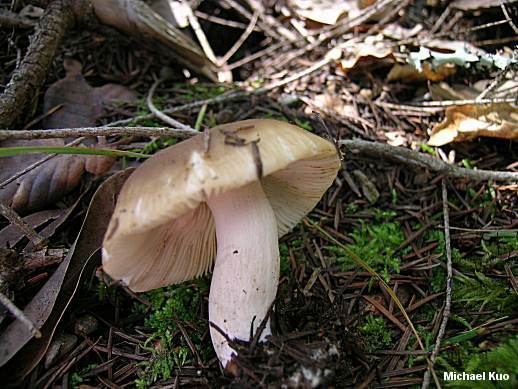
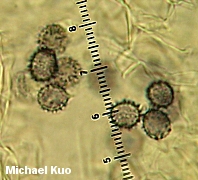
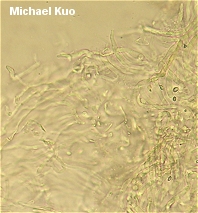
Russula amoenolens [ Basidiomycetes > Russulales > Russulaceae > Russula . . . ] by Michael Kuo Russula amoenolens is a brown, acrid tasting member of the foetid russulas group. Like other species in the group, it has a waxy benzaldehyde odor, somewhat reminiscent of maraschino cherries. The brown colors of Russula amoenolens help to distinguish it from the paler, straw colored Russula pectinatoides (which is also somewhat more fragile, and usually less acrid). Russula amoenolens is reported under a broad array of hardwoods and conifers across the continent--which suggests (to me, anyway) the possibility that several genetically distinct species are actually involved, since russulas are mycorrhizal and have thus evolved in concert with their hosts. Russula cerolens is a nearly identical species recorded from the Pacific Northwest and California. It grows under conifers (especially Sitka spruce), and its spores feature frequent connecting lines. Description: Ecology: Mycorrhizal; reported under hardwoods and conifers; growing alone, scattered, or gregariously; often found in grassy woodland areas; summer and fall (winter on the West Coast); widely distributed in North America. Cap: 4-10 cm across; convex, becoming broadly convex or flat, sometimes with a shallow central depression; sticky when fresh, but often dry when collected; light to dark yellowish brown, or grayish brown; the margin lined and pimpled at maturity; the skin peeling away easily at the margin, sometimes beyond halfway to the center. Gills: Attached to the stem; close or nearly distant; whitish to yellowish or pale orangish; often discoloring yellowish brown to brownish. Stem: 3-7 cm long and up to 3 cm thick; white, discoloring brownish to yellowish brown, especially near the base; dry; fairly smooth; becoming hollow with age. Flesh: White; unchanging when sliced. Odor and Taste: Odor waxy and reminiscent of maraschino cherries, almonds, or benzaldehyde; taste moderately to strongly acrid. Chemical Reactions: KOH on cap surface negative to faintly orangish. Iron salts on stem surface negative. Spore Print: Creamy. Microscopic Features: Spores 6-9 x 4.5-7 µ; broadly elliptical or, occasionally, subglobose; with relatively isolated spines up to 1 µ high; connecting lines few to scattered. Pileipellis a cutis, with occasional fusiform or subcapitate terminal elements with weakly granular, sulphovanillin-positive contents--but well defined pileocystidia absent. REFERENCES: Romagnesi, 1952. (Shaffer, 1972; Weber & Smith, 1985; Kibby & Fatto, 1990; Phillips, 1991/2005; Roody, 2003.) Herb. Kuo 08050402, 01160504, 09220806. This site contains no information about the edibility or toxicity of mushrooms. |
© MushroomExpert.Com |
|
Cite this page as: Kuo, M. (2009, February). Russula amoenolens. Retrieved from the MushroomExpert.Com Web site: http://www.mushroomexpert.com/russula_amoenolens.html |