| Major Groups > Stinkhorns > Pseudocolus fusiformis |

|
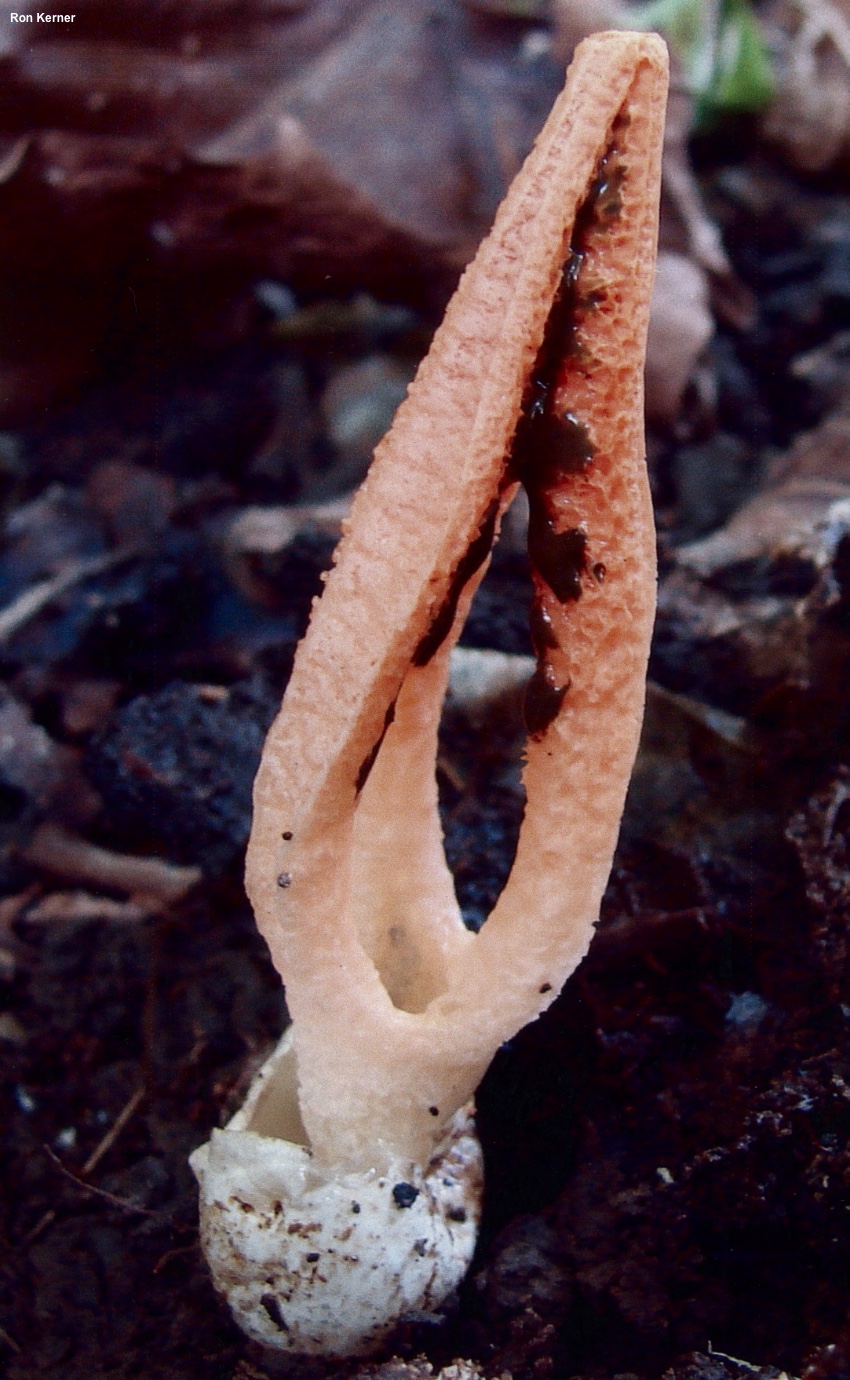
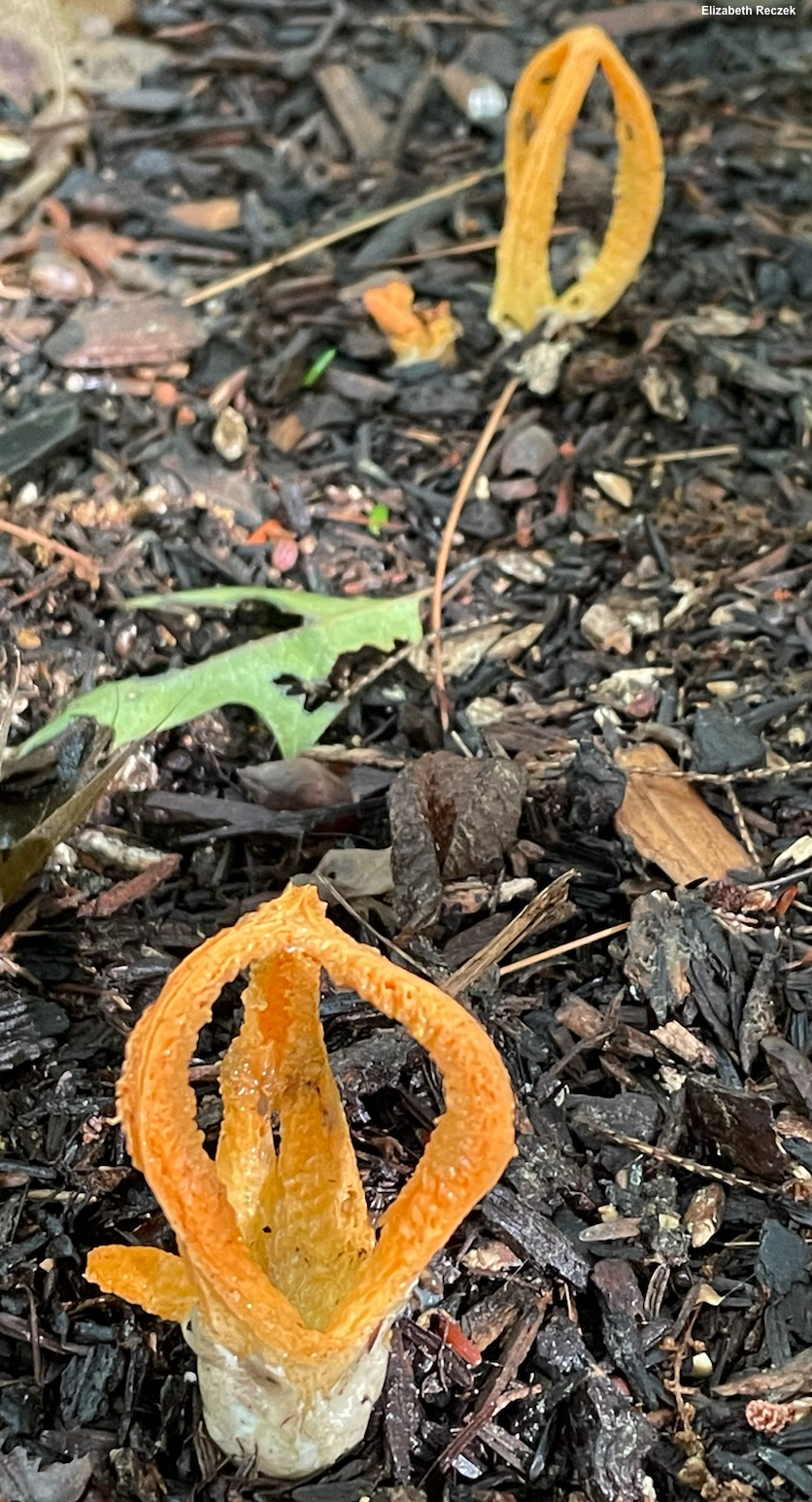
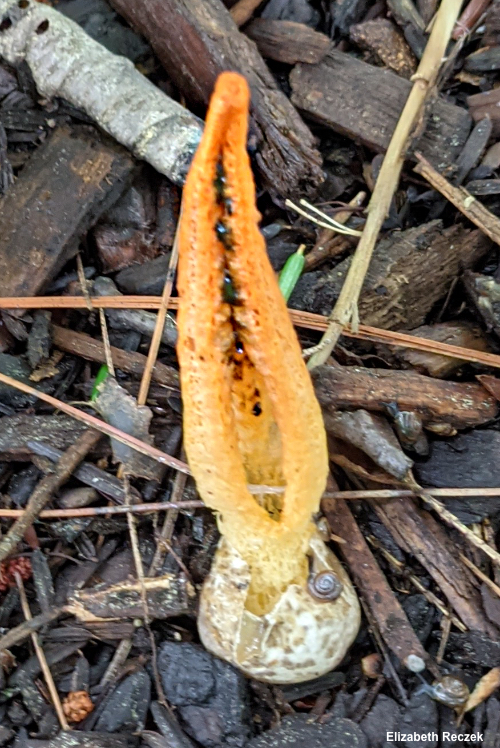
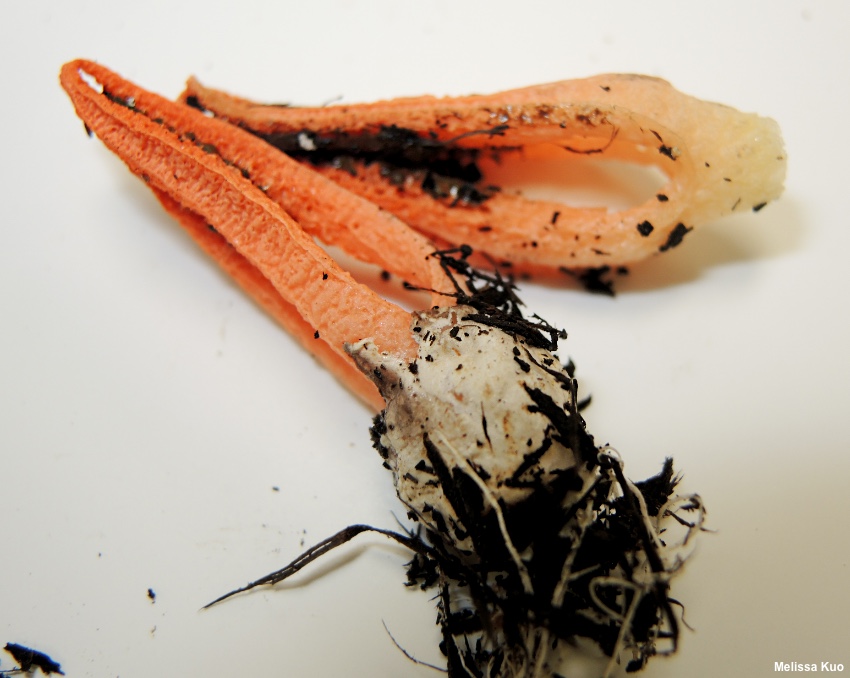
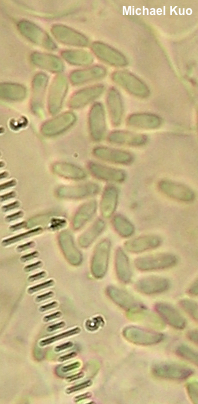
Pseudocolus fusiformis [ Basidiomycota > Phallales > Phallaceae > Pseudocolus . . . ] by Michael Kuo This little stinkhorn features three or four tapered, orange arms that arise from a shared stem structure, separate gracefully, and then rejoin at their tips. In most specimens the overall shape is reminiscent of an elongated teardrop, like the specimens in the photos to the right, but occasionally Pseudocolus fusiformis is wider toward the top, or even arched at the apex. Similar mushrooms include Clathrus archeri, with 4–8 red arms that usually separate at the top and fold backward, and Clathrus columnatus, which can look very similar but features a consistently arched apex and arms that arise individually out of the basal volva, rather than from a stem structure. Thanks to Ron Kerner and Elizabeth Reczek for documenting, collecting, and preserving Pseudocolus fusiformis for study; their collections are deposited in The Herbarium of Michael Kuo. Description: Ecology: Saprobic; growing alone or gregariously; often found in urban settings but sometimes appearing in woods as well; year-round, depending on climate; Australasia, Japan, Africa, South America, and, in North America, from Maine through Mexico to Central America. The illustrated and described collections are from Indiana, Massachusetts, and Ohio. Immature Fruiting Body: Initially a whitish to slightly brownish "egg," partially submerged in the substrate, from which the stinkhorn emerges with development. Mature Fruiting Body: 3–6 cm high, consisting of a short stem dividing into 3–4 vertical arms that are joined at their tips. Stem about 1–1.5 cm long and 1 cm thick; whitish to pale orange; hollow; surface spongy and finely pocketed; encased in a white to brownish, sack-like volva; attached to numerous white rhizomorphs. Arms with flattened or concave outer sides and convex inner sides; 0.5–1 cm thick; tapering to apex; spongy and pocketed; hollow; orange to reddish orange; inner, convex surfaces covered with dark brown spore slime when fresh. Odor: Strong and unpleasant. Microscopic Features: Spores 3–5.5 x 1–2 µm; cylindric; smooth; hyaline to ochraceous in KOH. Sphaerocysts of the arms 11–29 µm across; subglobose to irregular; smooth; hyaline to orangish in KOH; walls 0.5–1 µm thick. Hyphae of the volva 2–10 µm wide; smooth; hyaline in KOH; thin-walled; occasionally branching. Clamp connections not found. REFERENCES: (E. Fischer, 1890) Lloyd, 1909. (Saccardo, 1891; Blanton, 1976; Burk, 1978; Dring, 1980; Saenz et al., 1981; Smith, Smith & Weber, 1981; Phillips, 1991/2005; Lincoff, 1992; Bessette, Miller, Bessette & Miller, 1995; Hemmes & Desjardin, 2002; Miller & Miller, 2006; Hemmes & Desjardin, 2009; Kuo & Methven, 2014; Trierveiler-Pereira et al., 2014; Woehrel & Light, 2017; Elliott & Stephenson, 2018.) Herb. Kuo 09231103, 07142102. This site contains no information about the edibility or toxicity of mushrooms. |
© MushroomExpert.Com |
|
Cite this page as: Kuo, M. (2021, August). Pseudocolus fusiformis. Retrieved from the MushroomExpert.Com Web site: http://www.mushroomexpert.com/pseudocolus_fusiformis.html |