| Major Groups > Polypores > Laetiporus > Laetiporus cincinnatus |

|
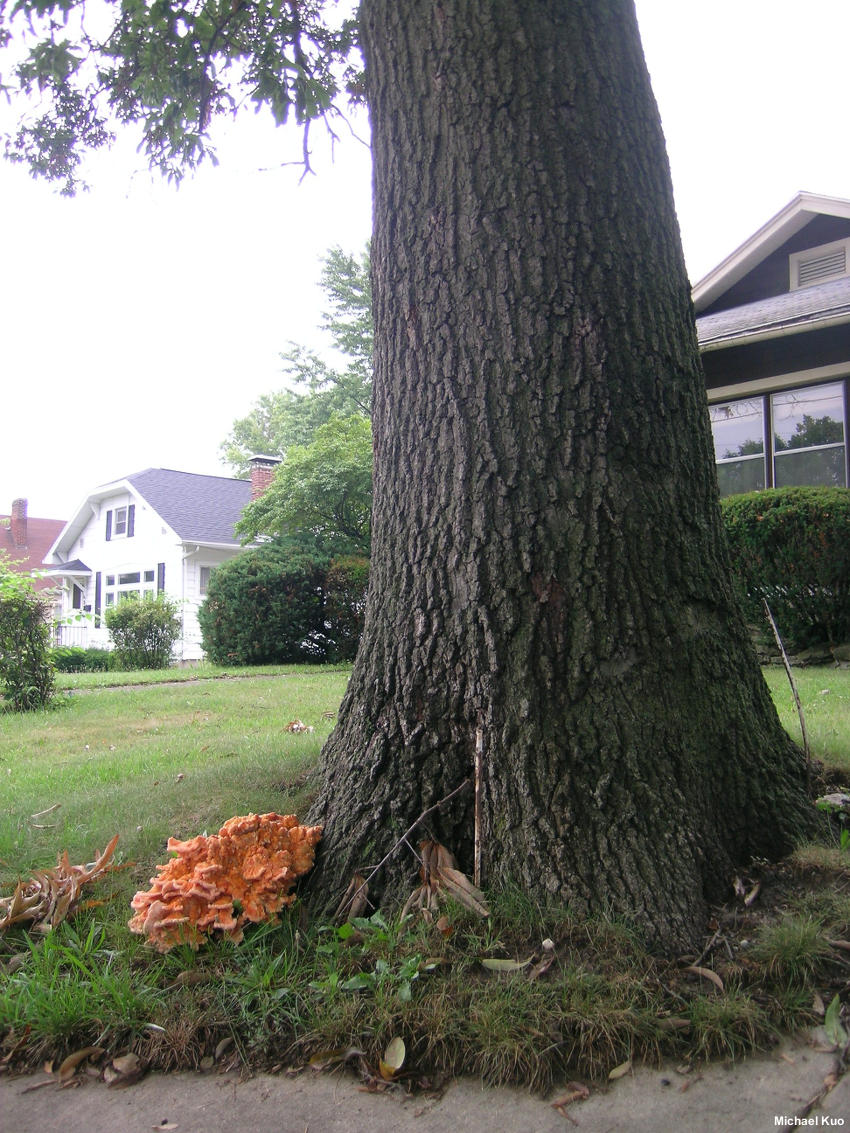
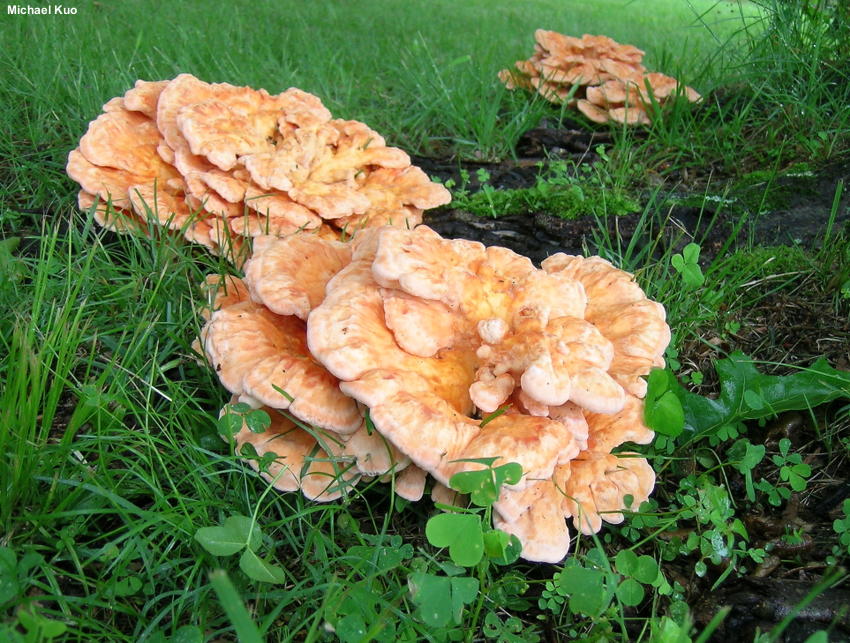
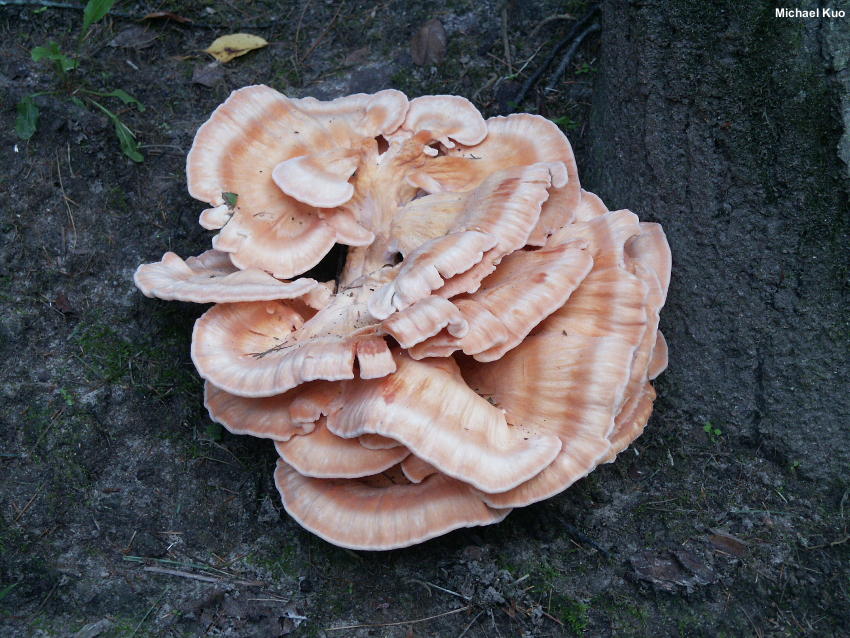
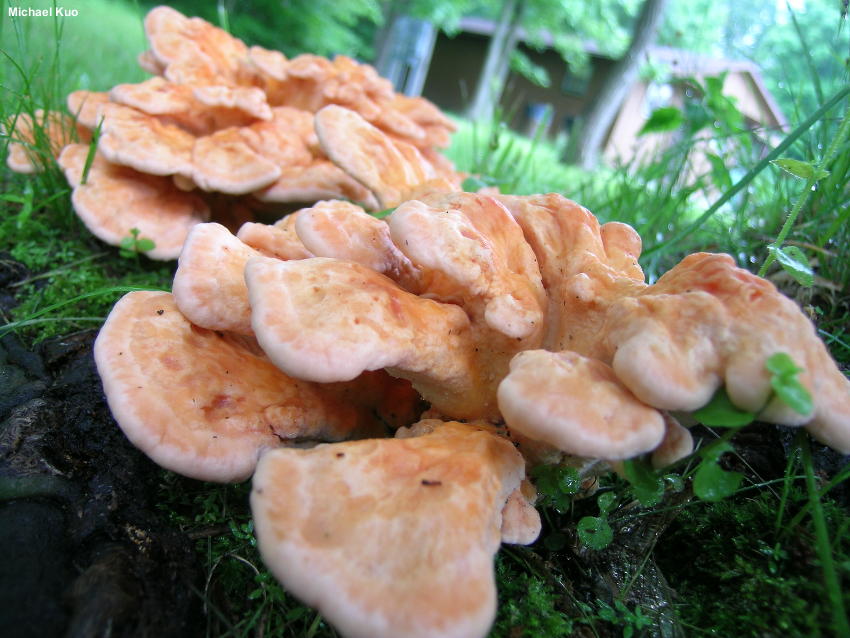
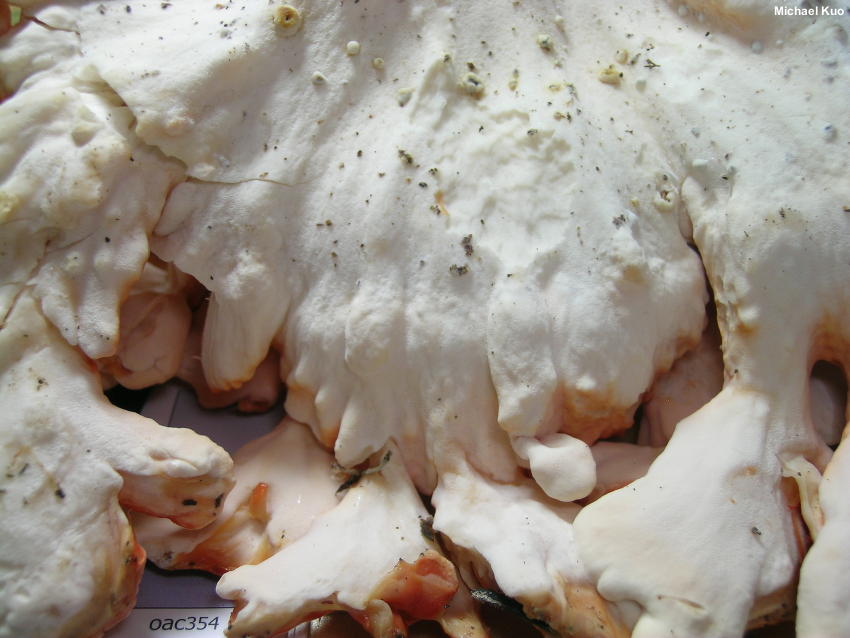
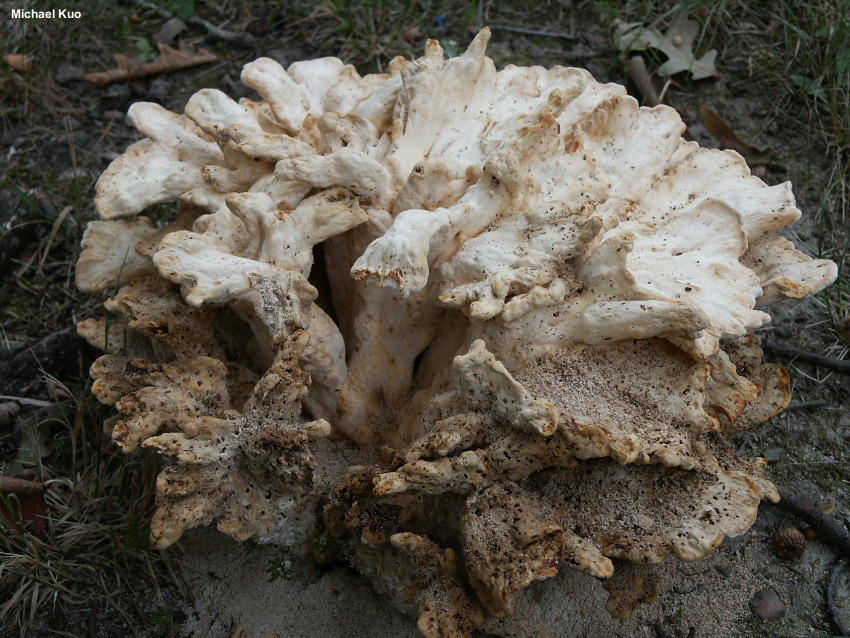
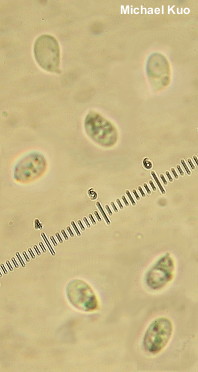
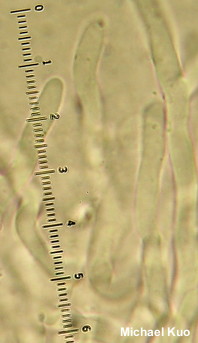
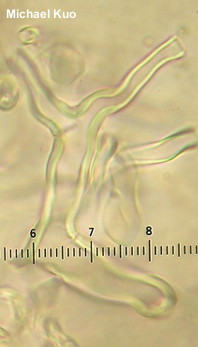
Laetiporus cincinnatus [ Basidiomycota > Polyporales > Laetiporaceae > Laetiporus . . . ] by Michael Kuo One of a handful of oak-inhabiting Laetiporus species in eastern North America, Laetiporus cincinnatus is a butt rot or root rot fungus—which means it grows at the bases of oak trees, rather than off the ground. While the "Queen City chicken" (yeah; I made that up) usually appears at the very base of the tree trunk, it can also fruit from buried roots at a fair distance from the tree, appearing to be terrestrial. Because of its fruiting location, Laetiporus cincinnatus develops as a rosette of individual caps, rather than arranging itself in shelving clusters on vertical surfaces. Laetiporus cincinnatus has a white to cream colored pore surface, which is another feature separating it from Laetiporus sulphureus, which has a yellow pore surface. Additionally, the cap surface of Laetiporus cincinnatus is usually a different shade of orange than the Laetiporus sulphureus cap, involving less yellow. This difference persists through the drying process, and specimens of the two species in the herbarium can often be separated by their colors. Originally designated as a separate species by Morgan (1885) on the basis of the white pore surface and the rosette-forming fruiting bodies, contemporary studies have upheld Laetiporus cincinnatus as both a biological species (distinct by virtue of mating incompatibility with other species) and a phylogenetic species (distinct by its DNA). Description: Ecology: Parasitic and saprobic on living and dead oaks; causing a brown rot of the butt and roots; growing alone or gregariously at the bases of oaks or on the ground nearby; late spring through fall; fairly widely distributed from the Great Plains eastward. The illustrated and described collections are from Illinois. Fruiting Body: Up to 45 cm across; usually consisting of several to many caps in a rosette but very rarely consisting of a shelving array near the base of the tree. Caps: 4–20 cm across; 6–20 cm deep; up to 2 cm thick; fan-shaped to semicircular, kidney-shaped, or irregularly lobed; smooth to wrinkled; finely suedelike; pale to bright pinkish orange, often with vague concentric bands of alternating shades of color; frequently fading in maturity and with direct sunlight; the margin often whitish. Pore Surface: Whitish; not bruising; with 2–3 circular to angular pores per mm; tubes to 5 mm deep. Stem: Usually absent; when present poorly defined, whitish, tough, more or less central. Flesh: Thick; soft and watery when young, becoming chalky and eventually crumbling easily; white; not changing when sliced. Dried Specimens: Cap surface and pore surface become dull pinkish orange to dull brownish orange and retain these shades for at least 20 years in the herbarium; they can often be distinguished from herbarium specimens of Laetiporus sulphureus, which are yellow to yellow-orange. Odor and Taste: Not distinctive. Chemical Reactions: KOH negative on cap surface and flesh. Spore Print: White. Microscopic Features: Spores 4–6 x 3–4 µm; broadly ellipsoid; smooth; hyaline in KOH; inamyloid. Hymenial cystidia not found. Contextual hyphal system dimitic. Contextual binding hyphae 5–15 µm wide; often branching; aseptate; smooth; walls 1–1.5 µm thick; hyaline in KOH. Hymenial trama generative hyphae 4–7 µm wide; tubular and unbranched; usually parallel; septate; smooth; thin-walled; hyaline in KOH. Clamp connections not found. REFERENCES: (Morgan, 1885) Burdsall, Banik & Volk, 1998. (Overholts, 1953; Smith, Smith & Weber, 1981; Phillips, 1991/2005; Banik & Burdsall, 2000; Burdsall & Banik, 2001; Roody, 2003; Kuo, 2007; Binion et al., 2008; Lindner & Banik, 2008; Banik et al., 2010; Kuo & Methven, 2014; Song & Cui, 2017.) Herb. Kuo 06019501, 08150501, 07141403. This site contains no information about the edibility or toxicity of mushrooms. |
© MushroomExpert.Com |
|
Cite this page as: Kuo, M. (2017, November). Laetiporus cincinnatus. Retrieved from the MushroomExpert.Com Web site: http://www.mushroomexpert.com/laetiporus_cincinnatus.html |