| Major Groups > Polypores > Inonotus radiatus |

|
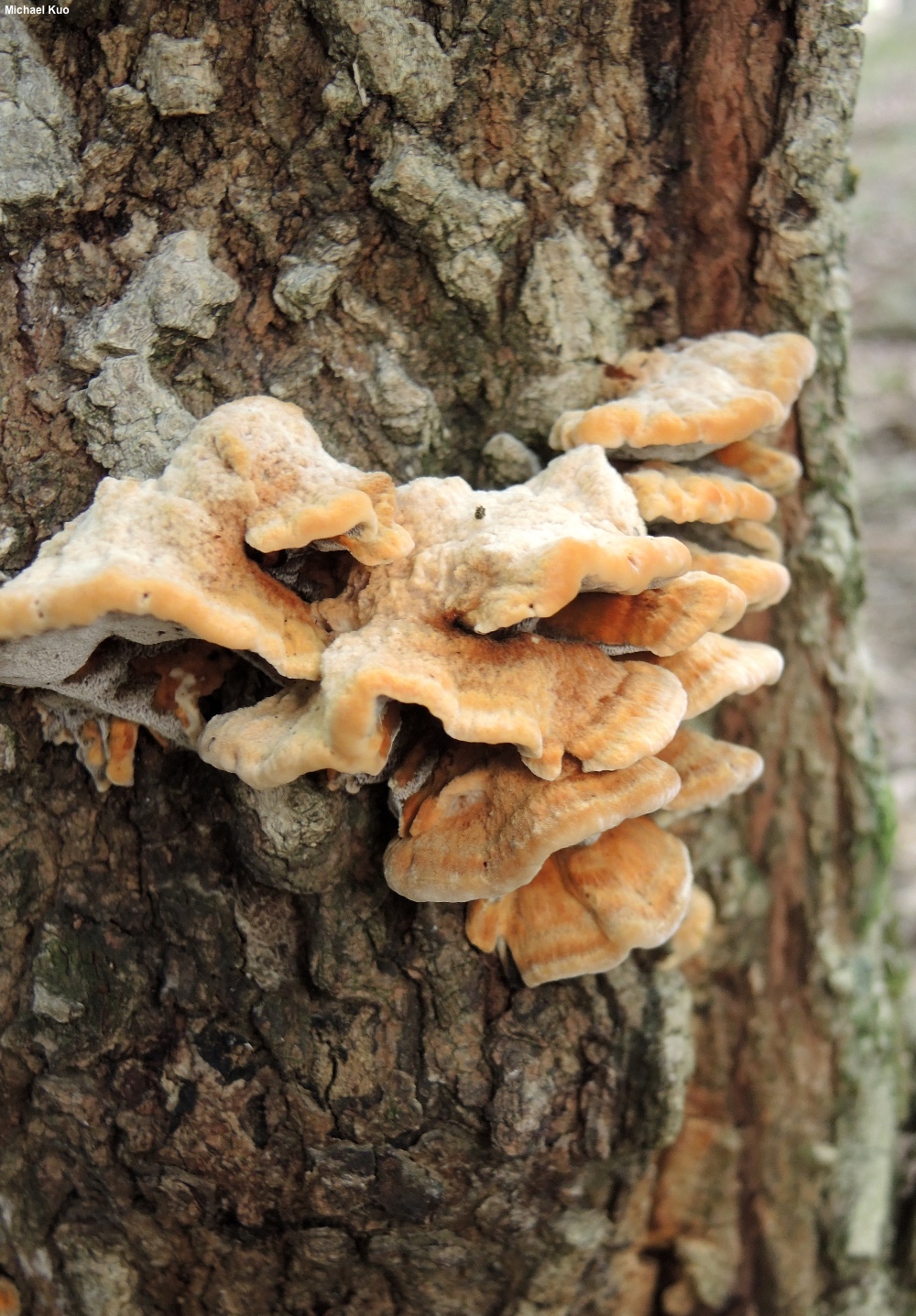
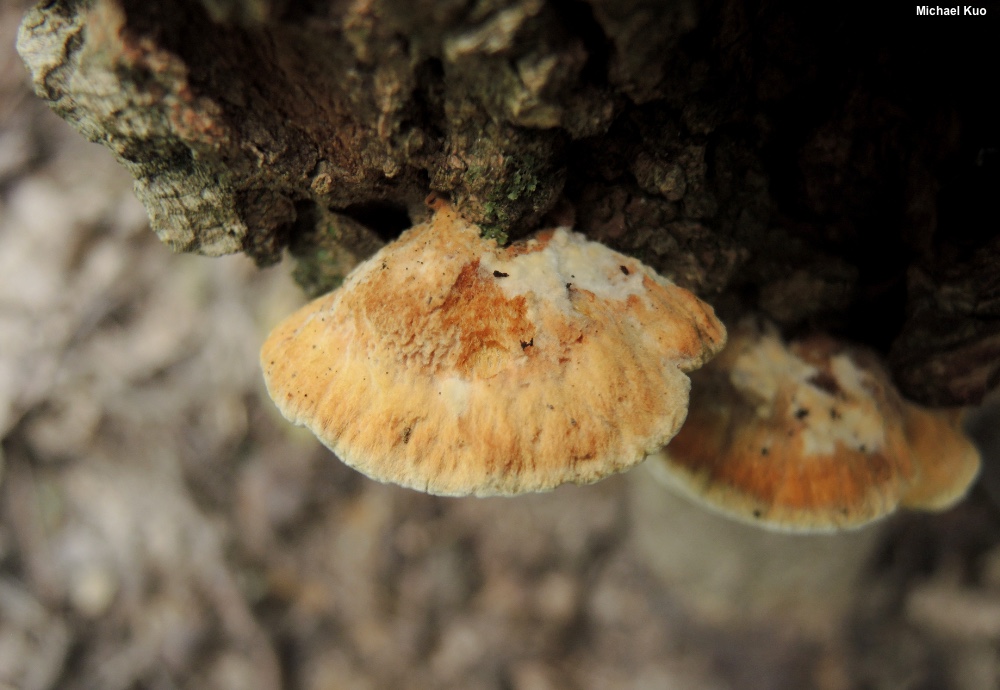
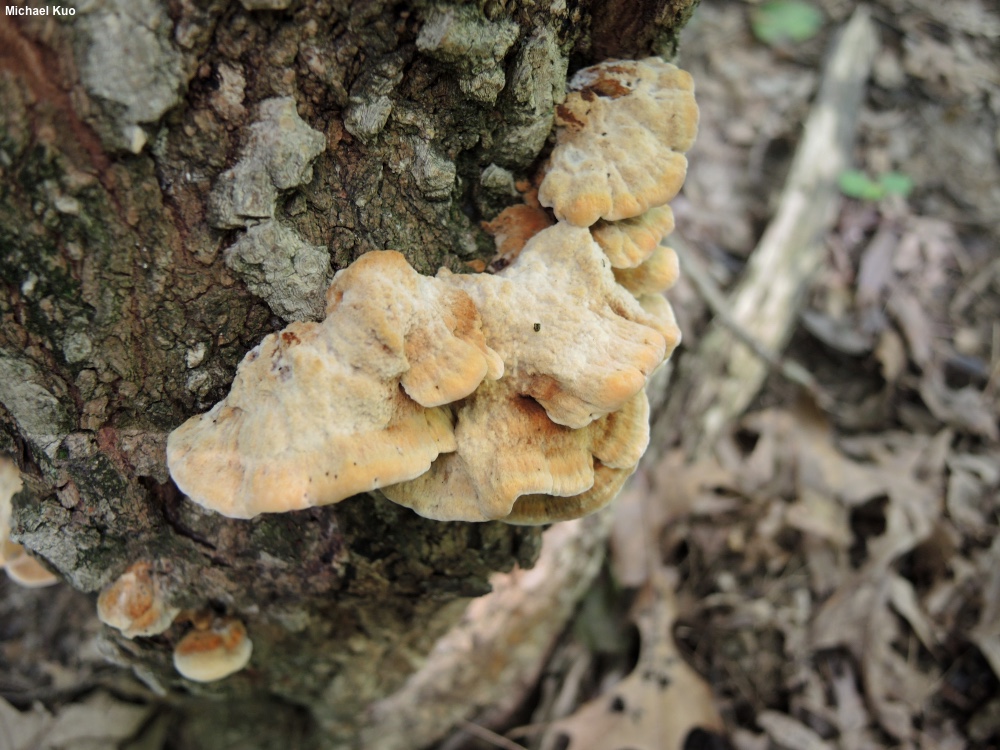
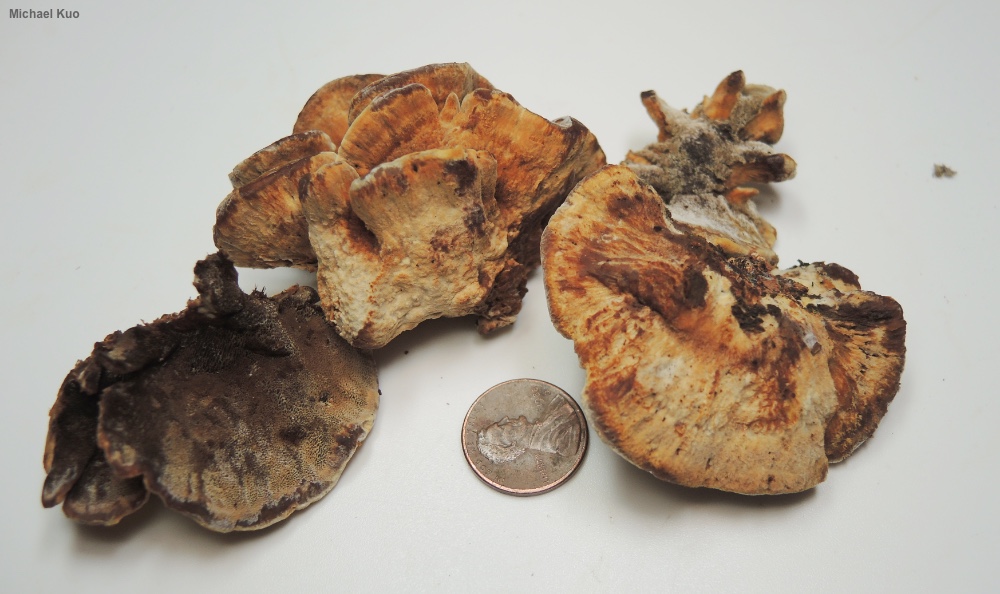
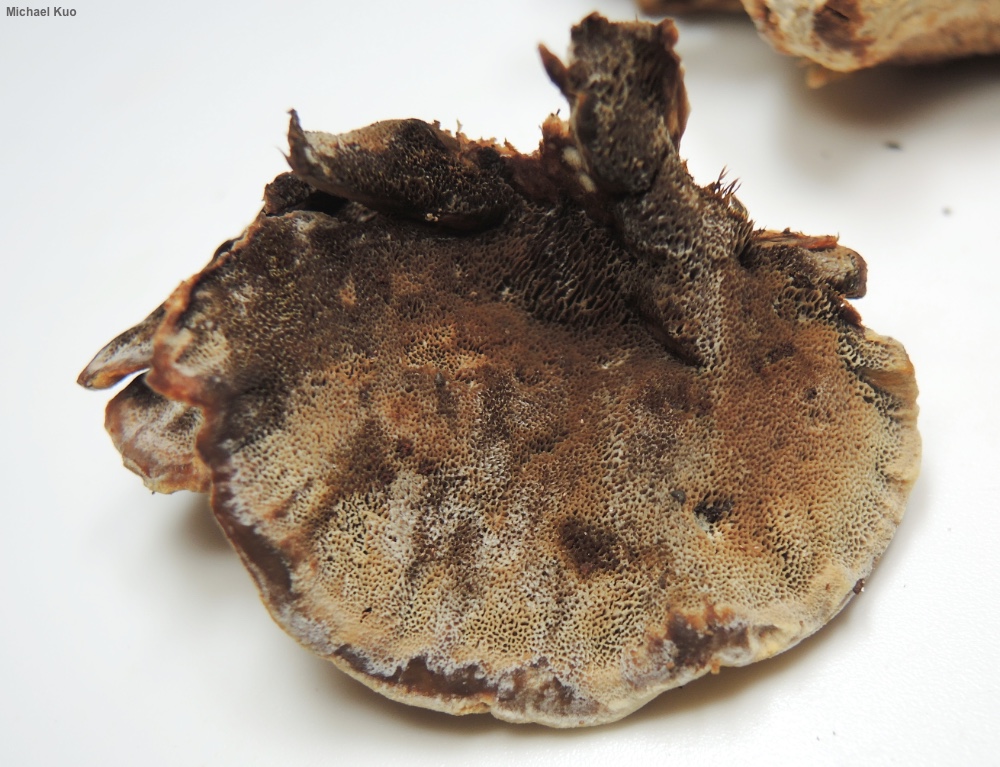
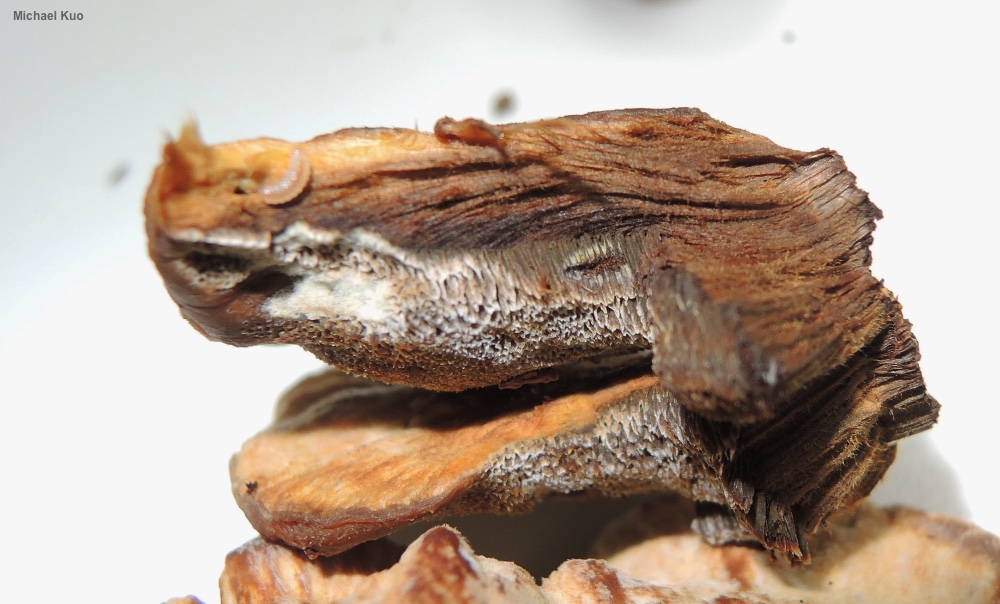
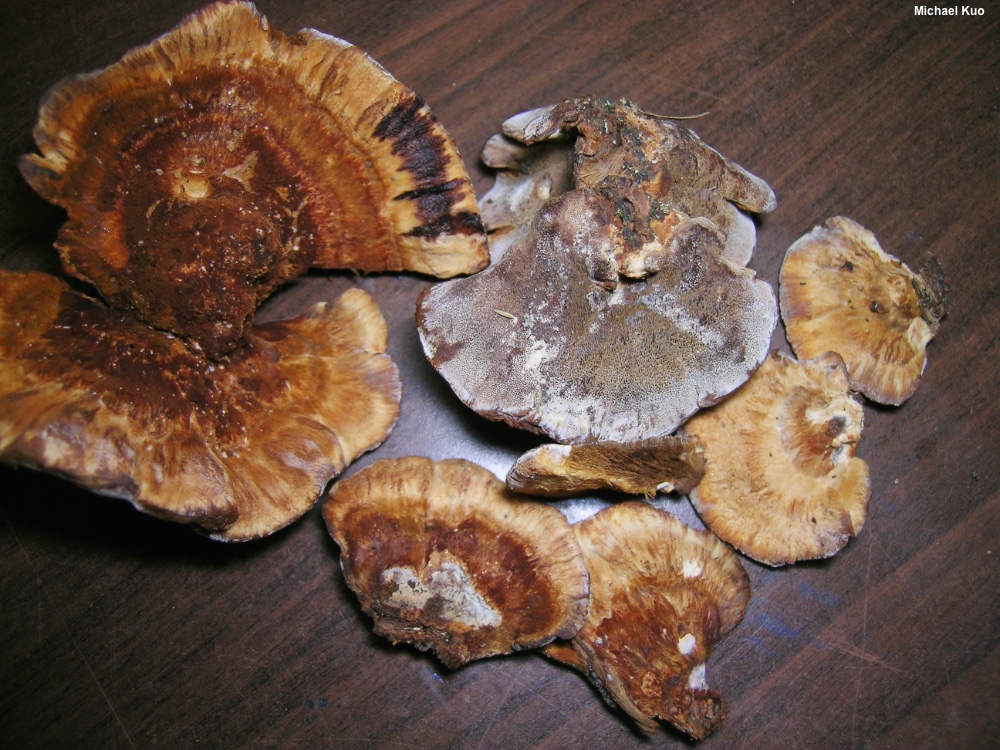
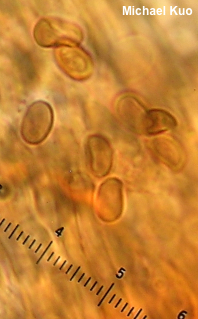
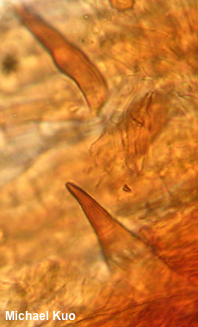
Inonotus radiatus [ Basidiomycota > Hymenochaetales > Hymenochaetaceae > Inonotus . . . ] by Michael Kuo Inonotus radiatus is a fairly small annual polypore found on the deadwood of hardwoods. When young it has an attractive, yellowish, finely velvety cap—but it eventually becomes bald and darkens to brown or black. It is found well above the ground, on stumps and logs (rather than at the bases of stumps), which will help to separate it from some look-alikes. Ultimately, however, microscopic features (including ellipsoid spores and the presence of gorgeous, swollen hymenial setae) define the species. Mensularia radiata and Xanthoporia radiata are among many synonyms. Description: Ecology: Saprobic on the deadwood of hardwoods; causing a soft white rot; annual; growing alone, gregariously, or in shelving clusters; summer and fall (or over winter in warm climates); originally described from England; fairly widely distributed in North America from the Great Plains to the maritime provinces and through Mexico—and rare to occasional in the Pacific Northwest (primarily on alders); common in Europe. The illustrated and described collections are from Illinois and Missouri. Cap: 3–8 cm across and 2–6 cm deep; semicircular to kidney-shaped in outline; often arranged in shelves and sometimes fused laterally with other caps; usually convex to planoconvex; very finely velvety when young, becoming bald with age; yellowish to orangish at first, becoming yellowish brown to tan and eventually darkening to dark brown or black; often zoned; the margin thin and often wrinkled. Pore Surface: Grayish to yellowish brown when young, becoming darker brown; bruising brown when young and gray; with 3–4 angular pores per mm; tubes to 3 mm deep; with age becoming somewhat ragged and appearing "toothed." Stem: Absent. Flesh: Yellowish brown to rusty brown; tough and stringy; faintly zoned. Odor: Not distinctive. Chemical Reactions: KOH black on flesh and cap surface. Microscopic Features: Spores 5.5–7 x 3.5–4.5 µm; smooth; ellipsoid; hyaline to brownish in KOH; inamyloid or faintly dextrinoid. Hymenial setae scattered; 25–40 x 6–10 µm; fusoid; often with a swollen base. Setal hyphae absent. Hyphal system monomitic; hyphae thin- to thick-walled, 2–7 µm wide, smooth; hyaline to brown-walled; clamp connections not found. REFERENCES: (Sowerby, 1799) P. Karsten, 1881. (Fries, 1821; Saccardo, 1888; Overholts, 1953; Phillips, 1981; Breitenbach & Kränzlin, 1986; Gilbertson & Ryvarden, 1986; Phillips, 1991/2005; Barron, 1999; Wagner & Fischer, 2002; McNeil, 2006; Ghobad-Nejhad & Kotiranta, 2008; Buczacki et al., 2012; Valenzuela et al., 2013; Wu et al., 2015; Læssøe & Petersen, 2019.) Herb. Kuo 09240509, 08182003. This website contains no information about the edibility or toxicity of mushrooms. |
© MushroomExpert.Com |
|
Cite this page as: Kuo, M. (2021, March). Inonotus radiatus. Retrieved from the MushroomExpert.Com Web site: http://www.mushroomexpert.com/inonotus_radiatus.html |