| Major Groups > Gilled Mushrooms > Dark-Spored > Gymnopilus > Gymnopilus liquiritiae |

|
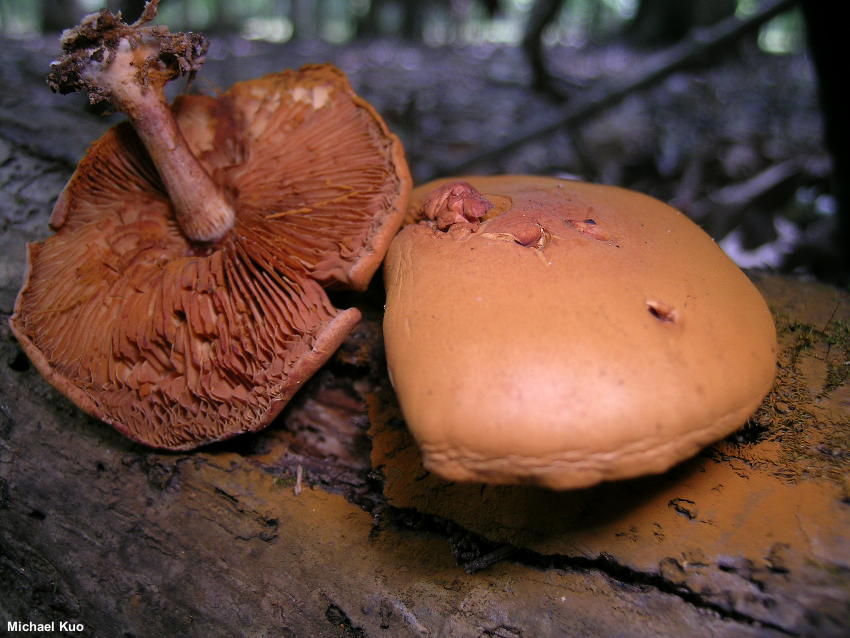
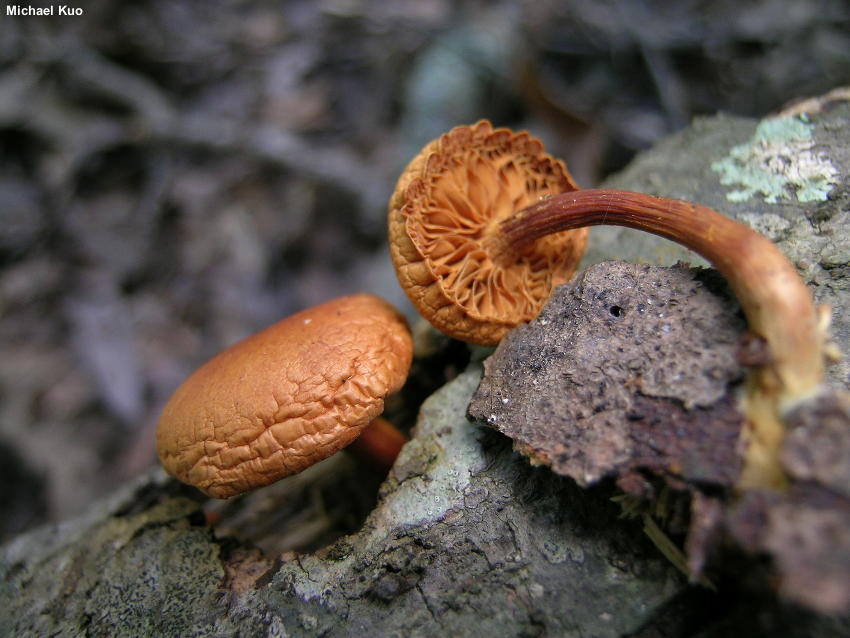
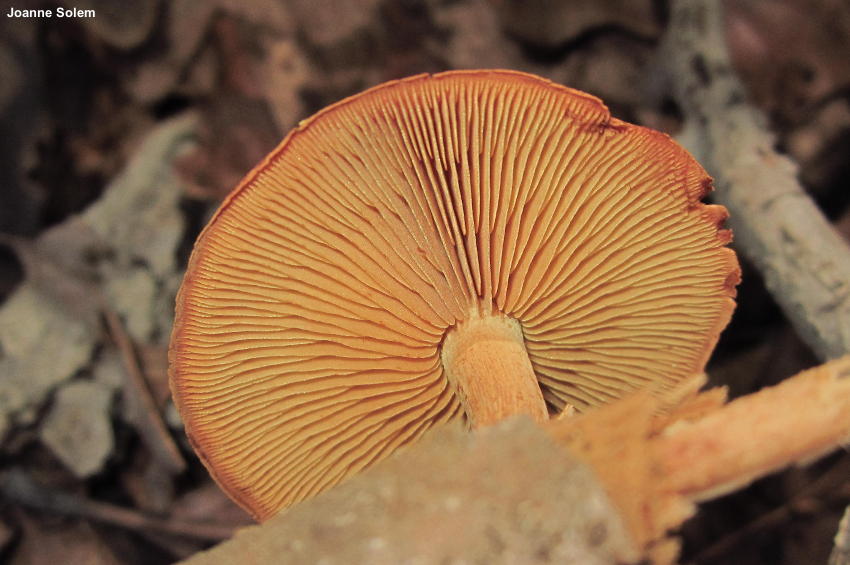
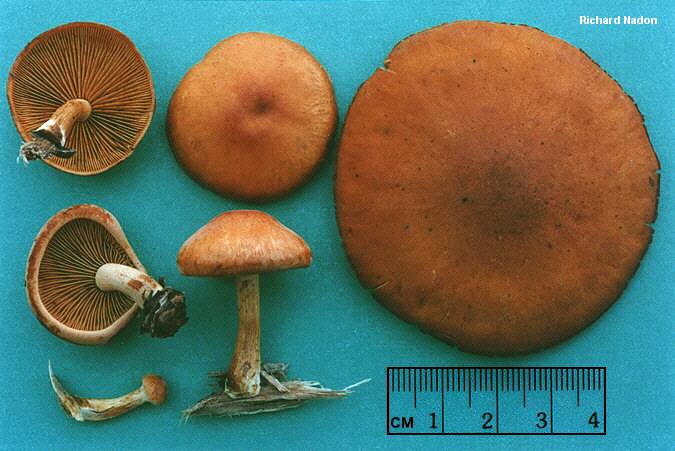
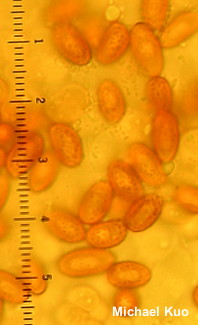
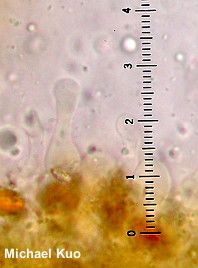
Gymnopilus liquiritiae [ Basidiomycota > Agaricales > Strophariaceae > Gymnopilus . . . ] by Michael Kuo Gymnopilus liquiritiae is a widely distributed wood rotting mushroom with a smooth, orange cap and a very bitter taste. Its job in the northern and western regions of the continent appears to be to assist conifer wood in the process of decay—but in southern regions it is more partial to dead hardwoods. It is not the easiest of mushrooms to identify, but the complete absence of a partial veil helps to narrow things down a bit. Microscopic features separate Gymnopilus liquiritiae from similar species: it features dextrinoid spores, along with inconspicuous pleuro- and cheilocystidia with swollen apices. Thanks to Bob and Joanne Solem for collecting, documenting, and preserving Gymnopilus liquiritiae for study; their collection is deposited in The Herbarium of Michael Kuo. Description: Ecology: Saprobic on the rotting wood of fallen hardwoods (especially in the south) and conifers (especially in the north and west); growing alone or gregariously; summer and fall; apparently widely distributed in North America. The illustrated and described collections are from Missouri, Maryland, and Québec. Cap: 2–6 cm; convex when young, expanding to broadly convex or slightly bell-shaped; dry; bald; soft; rusty brown to brownish orange; the margin sometimes becoming finely lined at maturity. Gills: Narrowly attached to the stem, but sometimes pulling away from it in age; close; short-gills frequent; yellowish or pale orange at first, maturing to rusty orange; sometimes with reddish brown spots. Stem: 2–4 cm long; 3–5 mm thick; more or less equal; bald or finely fibrillose; whitish to brownish or brownish orange; basal mycelium yellow to rusty. Flesh: Whitish in the cap; orangish in the stem; unchanging when sliced. Odor and Taste: Taste very bitter; odor mild, fragrant, or like that of raw potatoes. Chemical Reactions: KOH dark purplish red on cap surface. Spore Print: Rusty brown. Microscopic Features: Spores 6–10 x 4–5 µm; ellipsoid; echinulate; dextrinoid; reddish brown in KOH. Pleurocystidia and cheilocystidia 20–40 x 4–7 µm; cylindric with subcapitate to capitate apices; thin-walled; smooth; hyaline to brownish orange in KOH. Pileipellis a cutis. Clamp connections present. REFERENCES: (Persoon, 1801) Karsten, 1879. (Saccardo, 1887; Hesler, 1969; Weber & Smith, 1985; Guzman-Davalos & Guzman, 1991; Guzman-Davalos & Guzman, 1995; McNeil, 2006; Kuo & Methven, 2014.) Herb. Kuo 09180406, 09071401. This website contains no information about the edibility or toxicity of mushrooms. |
© MushroomExpert.Com |

|
Cite this page as: Kuo, M. (2016, August). Gymnopilus liquiritiae. Retrieved from the MushroomExpert.Com Web site: http://www.mushroomexpert.com/gymnopilus_liquiritiae.html |