| Major Groups > Gilled Mushrooms > Pink-Spored > Entolomatoid Mushrooms > Entoloma vernum |

|
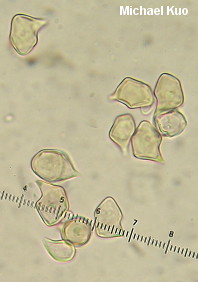
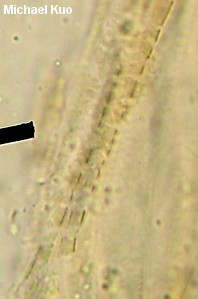
[Basidiomycota > Agaricales > Entolomataceae > Entoloma . . . ] Entoloma vernum agg. by Michael Kuo, 29 August 2024 A lot of pointy, brown entolomatoid mushrooms appear in springtime woods on our continent, and they are often encountered by morel hunters and others who are eager to spend time in the woods after a long winter. Although these mushrooms can be labeled "Entoloma vernum" in an aggregate, field-guide-ish sense, many of North America's springtime Entoloma species may be unnamed—and even those that meet a stricter definition of the European species Entoloma vernum might not survive the application of this species name in a contemporary, DNA-based setting. The European Entoloma vernum is a springtime denizen of conifer plantations (though it sometimes also appears under hardwoods) with a pointy, dark brown cap, defined primarily on the basis of microscopic characters, including a lack of cheilocystidia, the presence of encrusting pigment in the pileipellis, the presence of clamp connections, and heterodiametric spores averaging over 10 µm long. In North America, vernum-like collections are often made that match the European species on these features. But other, not-quite-vernum collections are also made, especially under hardwoods; these are often pale to medium brown, and not as pointy. Hesler's 1967 treatment of Entoloma in the southeastern United States does not include Entoloma vernum, but using Hesler's keys for a vernum-like collection one arrives at Hesler's species Entoloma tortuosum, which he named as new on the basis of a Tennessee collection made in March in "mixed deciduous-coniferous woods." European Entoloma expert Machiel Noordeloos, studying Hesler's type collection (1988), decided it was actually Entoloma vernum and synonymized the name tortuosum. No contemporary, DNA-based study, however, has investigated the issue. In his West-Coast treatment, Largent (1994) records Entoloma vernum (as Nolanea verna) from Alaska and suggests it is very rare or absent elsewhere in the west; however, Largent names a variety with isodiametric, rather than heterodiametric, spores from Oregon, Idaho, and Wyoming (Nolanea verna var. isodiametrica). Regardless, the name Entoloma vernum is widely applied in West-Coast field guides. Nolanea verna is a synonym. Thanks to Michelle Lierl for documenting, collecting, and preserving Entoloma vernum for study; her collection is deposited in The Herbarium of Michael Kuo. Description: Ecology: Saprobic, or possibly mycorrhizal; growing scattered to gregariously, especially in pine plantations (including red pine plantations); but also found in hardwood forests under tulip trees and oaks; spring; originally described from Sweden (Lundell 1937); widespread in Europe; reported across North America. The illustrated and described collections are from Illinois, Indiana, Michigan, and Pennsylvania. Cap: 2–7.5 cm across; conic to broadly conic, flattening out somewhat but retaining a sharp, central bump or "nipple"; dry; silky to nearly bald; dark brown to medium brown; occasionally slightly hygrophanous; the margin becoming slightly lined, or splitting with age. Gills: Narrowly attached to the stem, or nearly free from it; close or nearly distant; beige to dull buff to grayish or brownish at first, becoming pinkish; short-gills frequent. Stem: 3–10 cm long; 3–8 mm thick; equal, or slightly tapered toward the apex; dry; finely fibrillose-punctate near the apex, but pruinose or nearly bald elsewhere; brownish to tan or brown overall, but paler at the apex; sometimes twisted; splitting apart easily; hollowing; basal mycelium white and usually prominent. Flesh: Thin; insubstantial; brownish; unchanging when sliced. Odor: Not distinctive, or occasionally foul or slightly mealy. Chemical Reactions: KOH negative to reddish on cap surface. Spore Print: Deep pink. Microscopic Features: Spores 8–11 x 5–8 µm; heterodiametric, with a large apiculus; predominately 6-sided; smooth; thin-walled; hyaline and usually uniguttulate in KOH; inamyloid. Basidia 30–32 x 7–10 µm; clavate; 4-sterigmate. Hymenial cystidia not found. Pileipellis a radial cutis, sometimes partially gelatinized; elements 5–15 µm wide, hyaline and smooth or encrusted with brown pigment globules, hyaline to brown or golden brown intracellular pigment in ammonia or KOH; subcutis of inflated elements. Clamp connections present. REFERENCES: S. Lundell, 1937. (Hesler, 1967; Smith, Smith & Weber, 1979; Arora, 1986; Noordeloos, 1988; Lincoff, 1992; Metzler & Metzler, 1992; Largent, 1994; Breitenbach & Kränzlin, 1995; Roody, 2003; McNeil, 2006; Boccardo et al., 2008; Noordeloos, 2008; Buczacki et al., 2012; Kuo & Methven, 2014; Desjardin, Wood & Stevens, 2015; Baroni, 2017; Noordeloos, 2018; Læssøe & Petersen, 2019.) Herb. Kuo 05289502, 05289503, 05170203, 05080305, 05231404, 06071501, 04032401. This site contains no information about the edibility or toxicity of mushrooms. |
© MushroomExpert.Com |


|
Cite this page as: Kuo, M. (2024, August). Entoloma vernum agg. Retrieved from the MushroomExpert.Com Web site: http://www.mushroomexpert.com/entoloma_vernum.html |