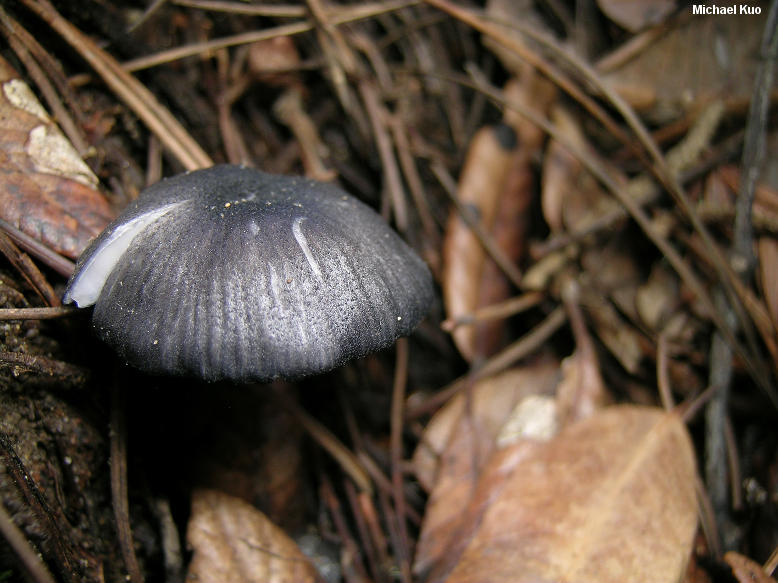
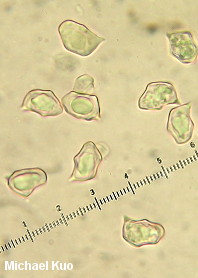
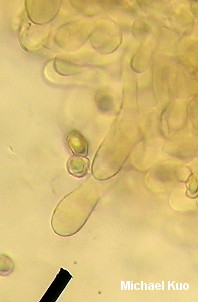
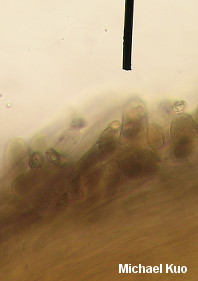
Cap: 1-4 cm; convex, becoming broadly convex or depressed; silky or finely scaly, especially over the center; bluish black, fading to purplish gray; the margin finely lined in age.
Gills: Attached to the stem or beginning to run down it; close; whitish or pale bluish gray at first, eventually pinkish; with black or bluish black edges; jagged.
Stem: 3-8 cm long; 2-3 mm thick; equal; silky at the apex and smooth below; hollow; colored like the cap; with white mycelium at the base, according to most authors, but perhaps with "basal tomentum absent" (Ramsey) in the Pacific Northwest.
Flesh: Thin; fragile; pale or grayish.
"Ecology, Shmeecology"
The collection and documentation of Entoloma serrulatum in North America is a classic example of how mycology has been lazy--or flat-out negligent--when it comes to the collection of ecological data. I suspect we are now paying the price for this negligence as one after another DNA study reveals that the physical features of mushrooms (the main focus of mycologists' attention for centuries) are not always informative of evolution and speciation. Yet these same DNA studies often tend to uphold ecological features, when they are available--which is not often.
In the case of Entoloma serrulatum, ecological documentation has been uneven over the course of the 20th Century in North America. Here, in chronological order, are the relevant entries from my library:
Kauffman (1918), Leptonia serrulata: "Scattered or gregarious. In low wet places, of mixed hemlock woods in the north [of Michigan]; ash, elm and maple woods of southern Michigan. Throughout the State. July-September. Frequent locally."
Kauffman (1918), Eccilia atrides: "Solitary or gregarious. On very rotten wood. Houghton, Bay View [Michigan]. July-August. Infrequent in maple and hemlock woods of northern Michigan."
Graham (1944), Leptonia serrulata: "On the ground in low, wet woods of elm, ash, etc., locally common, July-Sept., Wisconsin to New England, and Illinois."
Graham (1944), Eccilia atrides: "Solitary or gregarous [sic] on very rotten wood, not common, July-Aug., Minnesota to New York, mainly northern."
Hesler (1967), Entoloma serrulatum: "On soil, at times on moss-covered logs, North Carolina and Tennessee, June-September. . . . Many authors regard Eccilia atrides as a synonym of L. serrulata (E. serrulatum) and, with the evidence at hand, we are following this concept."
Smith, Smith & Weber (1979), Rhodophyllus serrulatus: "Solitary to gregarious on rich humus, in bogs, etc., widely distributed in North America, summer and fall, common but not in large numbers."
Lincoff (1992), Entoloma serrulatum: "June-September. Single to several, on the ground in rich humus or on moss-covered logs. Quebec to North Carolina; Midwest; Pacific NW.; Mexico. . . . This little blue mushroom is frequently encountered in wet summer woods."
Roody (2003), Leptonia serrulata: "Usually in small groups on the ground in woods and semi-open grassy areas, or sometimes on decaying moss-covered logs and stumps; saprobic; early summer-fall; occasional [in West Virginia]."
One thing to notice in these passages--though this is not my main point--is the way mushroom authors rely on one another's accounts, reiterating, editing, and/or augmenting information that has been previously reported. This is not necessarily a problem, but anyone who played the "telephone game" as a child knows what can happen when a story is passed around between narrators. See, for example, how a dubious and ancient story of Hygrocybe conica poisoning cases has been passed from author to author.
More importantly, however, notice the deterioration of ecological data between Kauffman's and Graham's fairly rigorous accounts of their personal collecting experience and Hesler's "[o]n soil, at times on moss-covered logs." Simultaneously, the accounting of microscopic features goes from a few words on spore shape and size in Kauffman and Graham to a rigorous, 74-word account of every determinable microscopic feature in Hesler. As I have argued many times in other places, this shift in emphasis may tell us more about the history of mycology than about the mushrooms. Hesler would have been laughed off of the mycological stage, in 1967, if he had not weighed microscopic features more heavily than anything else.
But no one, with the possible exceptions of Alexander Smith or David Largent, has probably ever collected as many entolomas as Hesler, and it is a scientifically tragic loss that the culture of mycology in the mid-20th Century influenced one of the greatest mushroom minds in history to neglect documenting crucial information from his field experience. The whole point of taxonomy is to name and organize organisms in a way that reflects their natural affinities and differences--which means attempting to assess how they evolved. "Identification" may be something you can accomplish by, for example, examining an Entoloma serrulatum specimen in your laboratory, but if you have not thought about how the mushroom interacts with its environment your taxonomic system will reflect your laboratory, not nature. Imagine what would have happened if Darwin had merely collected birds from the Galapagos Islands (I suppose that means shooting, painting, and describing them à la Audubon) and then taken them back to England for study--rather than spending countless hours watching their behavior.
Did you notice, above, that an ecologically distinct species disappeared? The wood-rotting saprobe Eccilia atrides was folded into Entoloma serrulatum, a decomposer of terrestrial forest litter, somewhere between 1944 and 1967. I have not investigated what Hesler means by "many authors" or "the evidence at hand" supporting the synonymy of the species, but I doubt I need to in order to be sure that the "evidence" was microscopic examination. To judge from Kauffman's and Graham's accounts the species, originally described by Fries in the early 19th Century, were considered distinct because of a putative difference in gill attachment (running down the stem in Eccilia)--but Kauffman notes that "these two species run into each other."
I agree that a minor difference in gill attachment is probably not a character on which to hang a different species, and I am willing to accept the probability (without looking it up) that the two taxa are microscopically indistinguishable. As far as I know, we have no DNA evidence to add to the picture--but notice that we are now not likely to have DNA evidence to help us examine this question, since specimens will henceforth be labeled "Entoloma serrulatum" or "Leptonia serrulata" in herbaria, and molecular biologists may not know whether the specimens they are testing were collected on rotting wood or on the forest floor--or, as Roody suggests, in grass. If we are later looking at a cladogram in which Entoloma serrulatum occurs on several branches, we may have no choice but to assume that the studied collections were misidentified, or that the taxon name is genetically invalid--for unknown reasons.
In the end, it may well be the case that we will decide Entoloma serrulatum is a single species--one that is "facultatively" saprobic and can adapt itself to become a decomposer of diverse substrates (this is fairly common in the mushroom world). But this information would be just as important for our understanding of things as the opposite case, in which we determine that the wood-rotting mushroom formerly known as Eccilia atrides is indeed a separate species, and evolved separately. And, for example, what if it's moss that is ecologically significant? In the accounts above, moss is mentioned a few times when wood is discussed, but not when the mushroom is described as terrestrial. But given the half-hearted way in which ecological factors are documented in mycology, it is not inconceivable that every one of the terrestrial collections actually occurred in moss, as well. I am not, of course, actually positing a relationship between Entoloma serrulatum and moss, but attempting to demonstrate the chasm-like rift in mycological knowledge that has resulted from neglecting ecology. We have almost no decent evidence for such potentially important theorizing!
I am encouraged by the fact that Lincoff's and Roody's more recent accounts of Entoloma serrulatum begin to re-integrate their extensive field experience and ecological observations. And, to put my money where my mouth is, I will note that the specimens illustrated above were collected in northern California in January--according to my notes, "in moss on an embankment in disturbed ground, under Tanoak and Bishop Pine."
Further Online Information:
Entoloma serrulatum at Fungi of Poland
Cite this page as:
Kuo, M. (2005, February). Entoloma serrulatum. Retrieved from the MushroomExpert.Com Web site: http://www.mushroomexpert.com/entoloma_serrulatum.html