| Major Groups > Gilled Mushrooms > Dark-Spored > Cortinarius > Cortinarius malicorius |

|
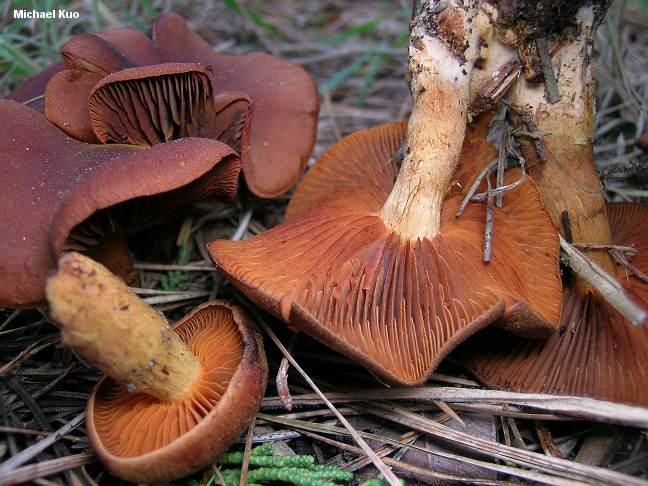
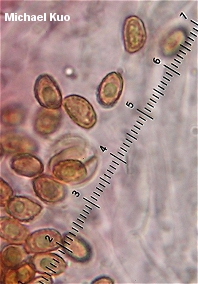
Cortinarius malicorius [Basidiomycetes > Agaricales > Cortinariaceae > Cortinarius ... ] by Michael Kuo The young gills of this beautiful Cortinarius are orange, which helps to separate it from many similar species. It is pretty much impossible to identify Cortinarii successfully without knowing what color the gills are before turning rusty to cinnamon brown as the spores mature; you will always need to have young specimens in your collection. Even when the color of the young gills is known, however, microscopic analysis is usually required--and Cortinarius malicorius is no exception. Some of the other orange-gilled look-alikes (those in the Cortinarius aureifolius species cluster) grow only in sand, and one look-alike (Cortinarius zakii) appears to be limited to association with Douglas-fir. Cortinarius malicorius appears to prefer pines--but its small spores (see measurements below) must be confirmed in order to separate it definitively. There used to be two species involved in what is now called Cortinarius malicorius. Cortinarius croceofolius (AKA Cortinarius croceifolius) was described by the American mycologist Charles Peck in 1911; it lacked olive colorations on the cap and in the flesh, and was considered distinct from Cortinarius malicorius, a European species that does demonstrate olive shades. However, the two species have been proclaimed synonymous, and the older name prevails . . . a situation that is likely to change, in my opinion, once DNA studies are done. Dermocybe malicoria, Cortinarius croceofolius, Cortinarius croceifolius, Dermocybe croceofolia, and Dermocybe croceifolia are synonyms. While not a synonym, the "Cortinarius cinnamomeus" of many field guides may be Cortinarius malicorius (see also the yellow-gilled Cortinarius croceus regarding confusion with Cortinarius cinnamomeus). Description: Ecology: Mycorrhizal with conifers, especially pines; growing scattered or gregariously, often in wet areas or with sphagnum; fall (and winter on the West Coast); widely distributed in North America but more common in the Northeast. Cap: 1.5-5 cm; convex or nearly conical at first, becoming broadly convex, flat, depressed, or broadly bell-shaped; fairly dry; silky to finely scaly; yellowish or orangish at first, often with olive tones, becoming orangish brown to cinnamon brown overall. Gills: Attached to the stem but sometimes pulling away from it in age; close; orange at first, becoming cinnamon to rusty; covered by a yellowish to orangish cortina when young. Stem: 2-7 cm long; up to 1 cm thick; more or less equal; dry; silky with orangish to yellowish (later cinnamon) fibers; yellowish, often discoloring olive brown to brownish below; sometimes with a rusty ring zone. Flesh: Yellowish or olive. Odor: Radishlike. Chemical Reactions: KOH on cap surface red or reddish black. Spore Print: Rusty brown. Microscopic Features: Spores 6-7.5 x 4-4.5 µ; ellipsoid; moderately roughened. Cheilo- and pleurocystidia absent, but inconspicuous marginal cells present on gill edges. Pileipellis a cutis. Contextual and lamellar elements pinkish purple to purplish in KOH. REFERENCES: Fries, 1838. (Saccardo, 1887; Kauffman, 1918; Kauffman, 1932; Ammirati, 1972; Ammirati, 1988; Phillips, 1991/2005; Lincoff, 1992; Hansen & Knudsen, 1992; McNeil, 2006.) Herb. Kuo 01170506. This site contains no information about the edibility or toxicity of mushrooms. |
© MushroomExpert.Com |
|
Cite this page as: Kuo, M. (2011, November). Cortinarius malicorius. Retrieved from the MushroomExpert.Com Web site: http://www.mushroomexpert.com/cortinarius_malicorius.html |