| Major Groups > Gilled Mushrooms > Dark-Spored > Cortinarius > Cortinarius croceus |

|
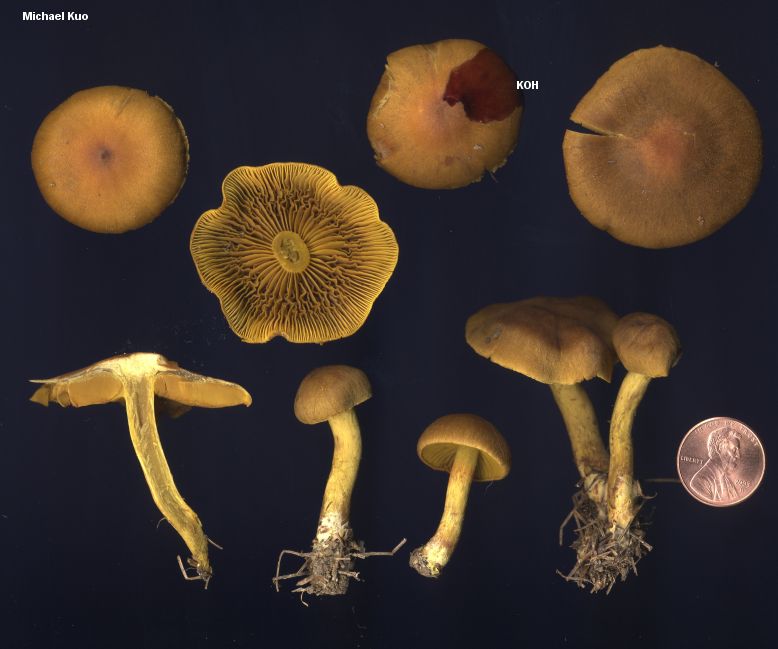
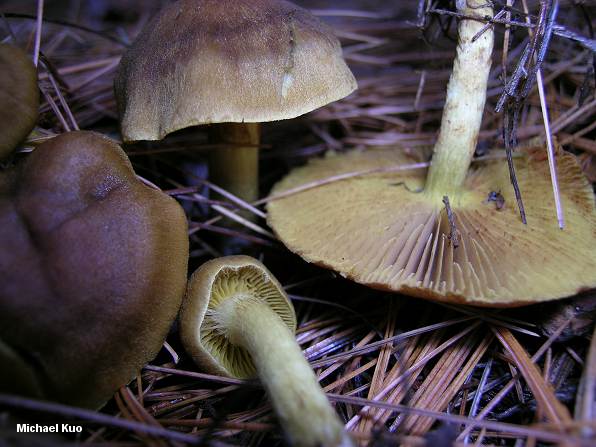
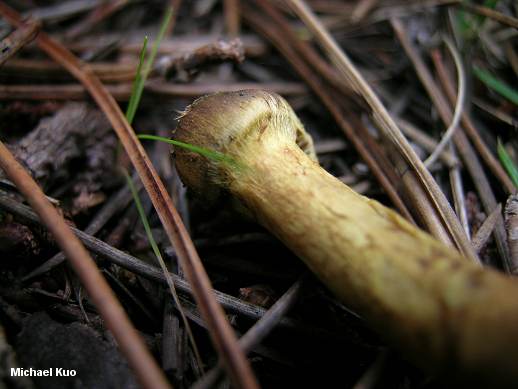
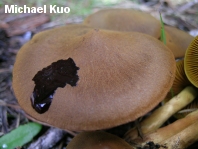
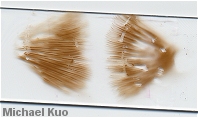
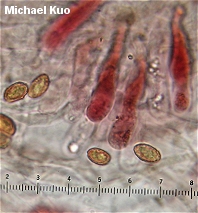
Cortinarius croceus [Basidiomycetes > Agaricales > Cortinariaceae > Cortinarius ... ] by Michael Kuo As I am treating it, Cortinarius croceus has yellow gills, a yellowish brown to olive brown cap, mild to radishlike odor and taste, and a dark red to reddish black reaction to KOH on the cap surface. It is officially a European species, and one common North American version has been labeled Cortinarius incognitus; it has slightly larger spores and a mild taste. But Cortinarius croceus does occur in North America, according to Joseph Ammirati (1984), who says it is "highly variable" (53). The mushrooms belong to subgenus Dermocybe of Cortinarius and my sense, reading Cortinarius literature, is that the whole project of delineating species on the basis of subtle distinctions in morphology is on hold while mycologists wait for DNA research to clear the playing field. At least one DNA investigation (Liu and collaborators, 1997) found several of the sections and species names to be incoherent, genetically speaking. So it seems best, for the time being anyway, to paint species in this area with broad strokes. Dermocybe crocea is a synonym. Cortinarius cinnamomeus as it is treated by some field guide authors (in short, as a yellowish brown species) may be the same mushroom as the one described here. However, Cortinarius cinnamomeus, according to its original (European) description, has a reddish cinnamon cap, reddish cinnamon gills, and a yellowish stem. Ammirati (1972) says the name "has often been misapplied and selection of a neotype is needed to put this species on a sound taxonomic basis" (274). Description: Ecology: Mycorrhizal with conifers; growing alone or scattered, often in dry areas; summer and fall; widely distributed in North America. Cap: 1.5-8 cm; convex or nearly conical at first, becoming broadly convex, flat, or broadly bell-shaped, sometimes with a sharp central bump; dry; silky; yellowish brown to olive brown, often aging to dark brown, especially over the center; the margin often more yellowish. Gills: Attached to the stem but often pulling away from it in age; close or crowded; yellow at first (orangish in some varieties), becoming cinnamon to rusty; covered by a yellowish cortina when young; sometimes spotting and discoloring reddish brown. Stem: 3-7 cm long; up to 1 cm thick at the apex; more or less equal; dry; silky with brownish fibers; yellowish above, sometimes olive brown to reddish brown below; sometimes with a rusty ring zone; basal mycelium pale yellow. Flesh: Yellowish. Odor: Radishlike or not distinctive. Chemical Reactions: KOH on cap surface red, then dark red to black. Spore Print: Rusty brown. Microscopic Features: Spores 6.5-9 x 4.5-6 µ; ellipsoid; slightly to moderately roughened. Some basidia with reddish to purplish or reddish brown contents. Cheilo- and pleurocystidia absent. Pileipellis a cutis. REFERENCES: (Schaeffer, 1774) Gray, 1821. (Saccardo, 1887; Ammirati, 1972 [C. incognitus]; Ammirati & Smith, 1984; Hansen & Knudsen, 1992; Evenson, 1997; Breitenbach & Kränzlin, 2000; Trudell & Ammirati, 2009.) Herb. Kuo 08170305, 11220405, 01150508, 08060507. This site contains no information about the edibility or toxicity of mushrooms. |
© MushroomExpert.Com |

|
Cite this page as: Kuo, M. (2011, November). Cortinarius croceus. Retrieved from the MushroomExpert.Com Web site: http://www.mushroomexpert.com/cortinarius_croceus.html |