| Major Groups > Gilled Mushrooms > Dark-Spored > Cortinarius > Cortinarius hesleri |

|
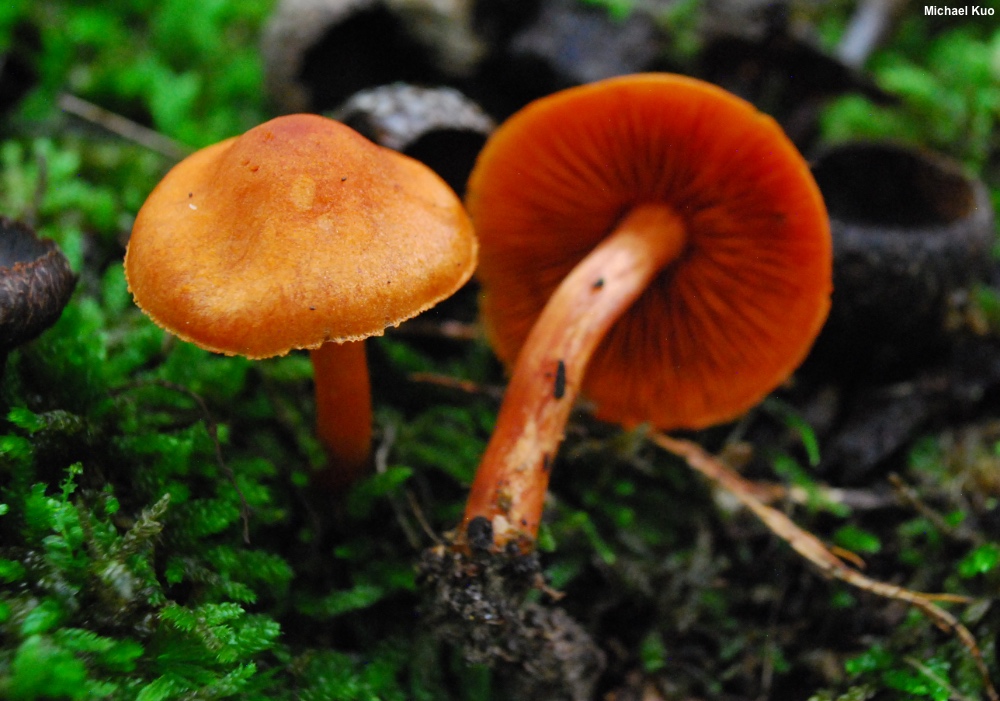
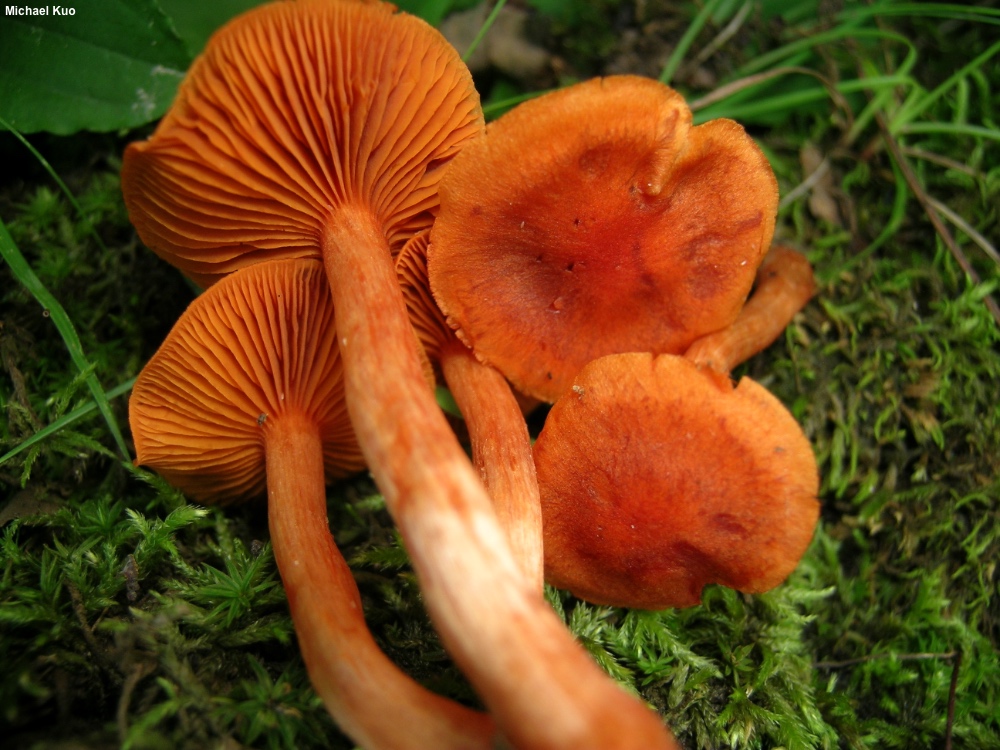
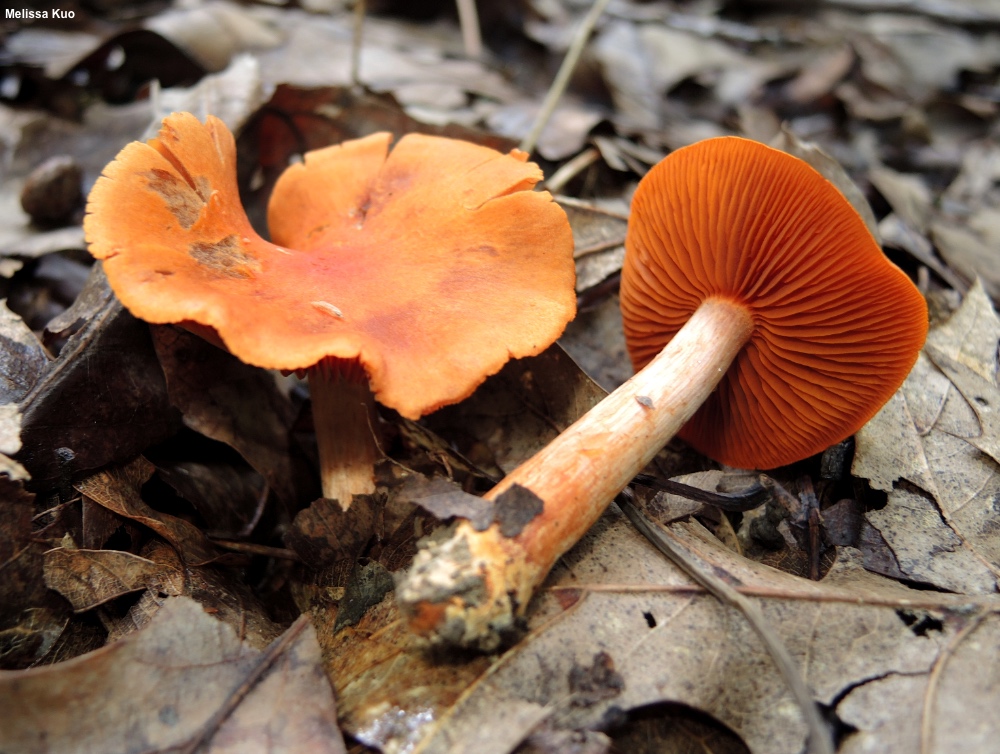
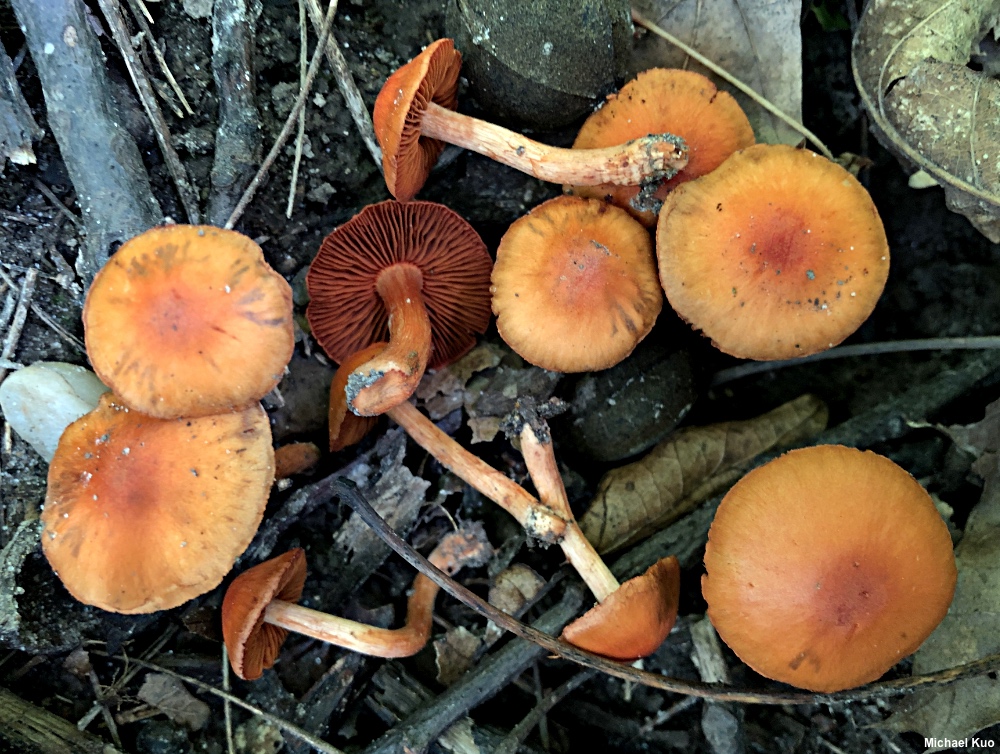
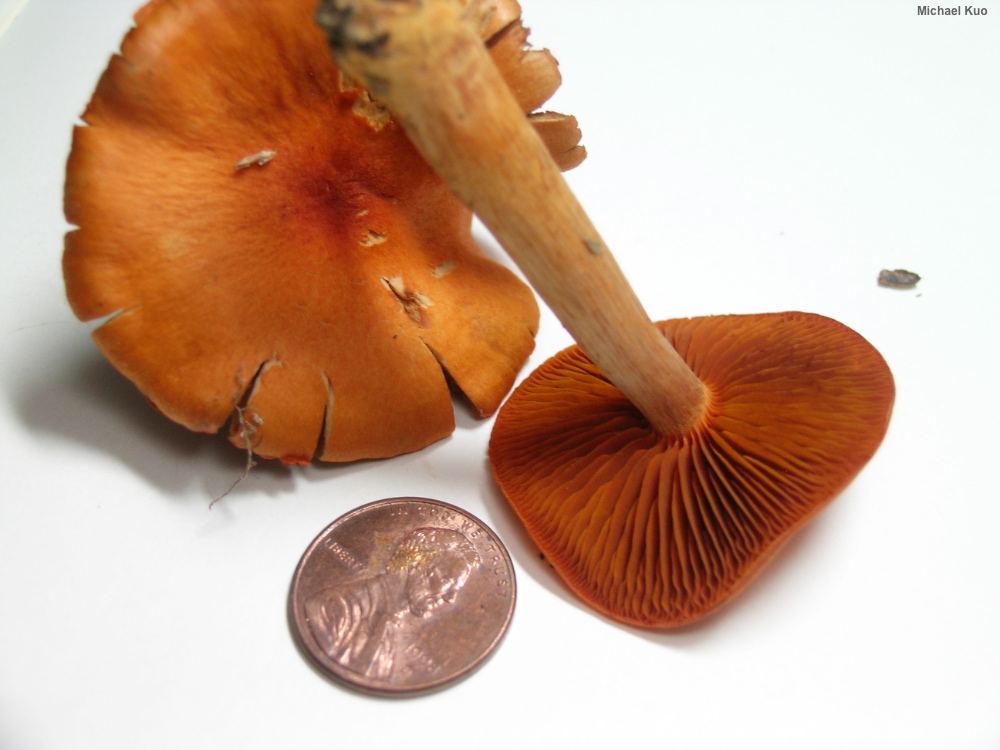
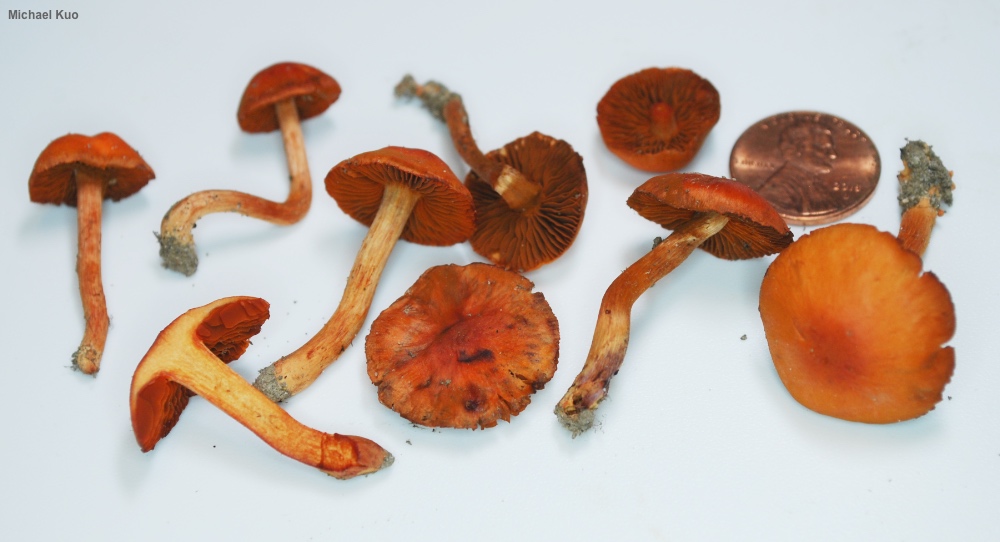
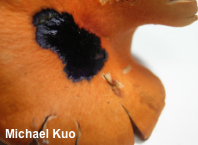
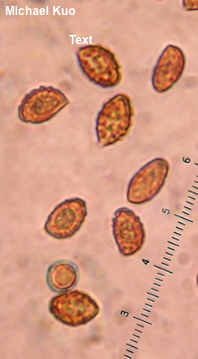
Cortinarius hesleri [Basidiomycota > Agaricales > Cortinariaceae > Cortinarius ... ] by Michael Kuo This gorgeous, brilliant orange Cortinarius is often one of the first Cortinarii to appear each year in eastern North America, where it is found under oaks. In my area (central Illinois) only Cortinarius distans precedes it, Cortinarius-wise. May and June are the months for Cortinarius distans, while Cortinarius hesleri usually appears in June and July. The cap, lower stem, and gills of Cortinarius hesleri are all bright orange when fresh, making it a fairly unmistakable species. Cortinarius hesleri is one of several North American versions of the European, beech-loving species Cortinarius cinnabarinus, frequently featured in field guides as a species complex. A western version, Cortinarius californicus, is associated with conifers and appears in the fall; its cap is brownish orange. Cortinarius marylandensis, also under hardwoods and probably widely distributed east of the Rocky Mountains, is similar but features a red cap and red gills, along with spores that are less prominently ornamented. Description: Ecology: Mycorrhizal with oaks, beech, and other hardwoods; growing alone, scattered, or gregariously; late spring and summer; originally described from Michigan; fairly widely distributed in eastern North America. The illustrated and described collections are from Illinois; several of the collections are paratype collections. Cap: 1–7 cm; convex, bell-shaped, or nearly conical at first, becoming broadly convex, nearly flat, or (frequently) broadly bell-shaped; dry; silky-fibrillose, but often becoming more or less bald with age; bright reddish orange when fresh, sometimes fading to pale orange or brownish orange. Gills: Attached to the stem by a notch; close; bright orange, becoming cinnamon to rusty orange and, eventually, rusty brown; short-gills frequent; covered by an orange cortina when young. Stem: 2–10 cm long; 0.5–1.5 cm thick; more or less equal; dry; silky or bald; pale orangish above, colored like the cap below; often darkening to reddish brown near the base or when handled; sometimes with a rusty ring zone; basal mycelium when fresh pastel orange. Flesh: Pale orangish to yellowish or, sometimes, whitish; deeper orange in the stem base. Odor: Fragrant, or sometimes not distinctive. Chemical Reactions: KOH on cap surface purple or purplish black; on flesh black. Iron salts negative on cap surface. Ultraviolet Light: Surfaces purple. Spore Print: Rusty brown. Microscopic Features: Spores 7–10 x 4.5–6 µm; amygdaliform to broadly ellipsoid; coarsely verrucose; brown to orange-brown in KOH; dextrinoid. Basidia 22–25 x 6–8 µm; clavate; 4-sterigmate. Cystidia not found. Pileipellis a cutis; elements 5–10 µm wide, smooth, hyaline to purplish in KOH; clamp connections present. Contextual and lamellar elements pinkish purple to purple in KOH. REFERENCES: J. F. Ammirati, T. Niskanen & K. Liimatainen, 2013. (Ammirati, 1972; Ammirati & Smith, 1984; Phillips, 1991/2005; Ammirati et al. 2012; Kuo & Methven, 2014.) Herb. Kuo 06049503, 06140203 (paratype), 07110401 (paratype), 05300702 (paratype), 06300710 (paratype), 07110803 (paratype), 08271601, 07242003, 07292003. This site contains no information about the edibility or toxicity of mushrooms. |
© MushroomExpert.Com |
|
Cite this page as: Kuo, M. (2022, March). Cortinarius hesleri. Retrieved from the MushroomExpert.Com Web site: http://www.mushroomexpert.com/cortinarius_hesleri.html |