| Major Groups > Stinkhorns > Clathrus ruber |

|
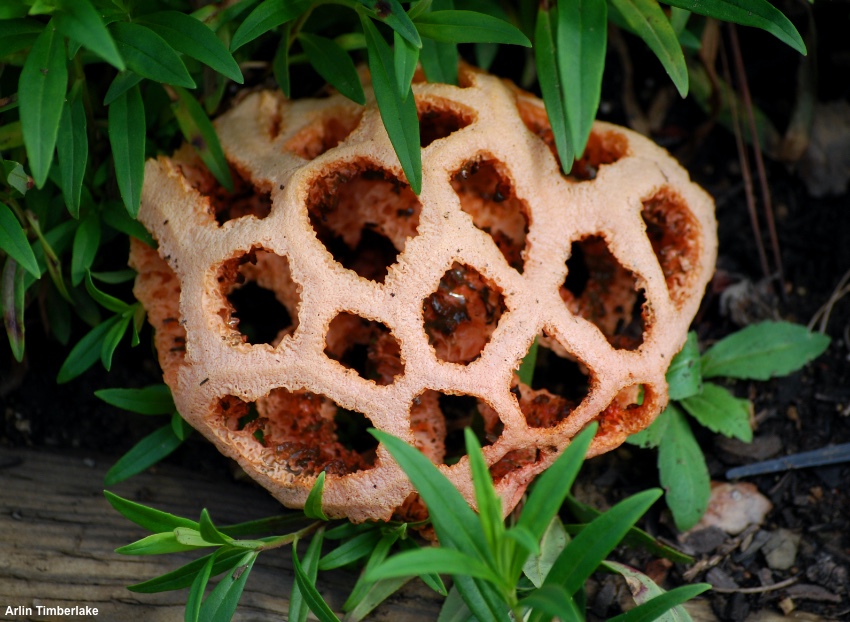
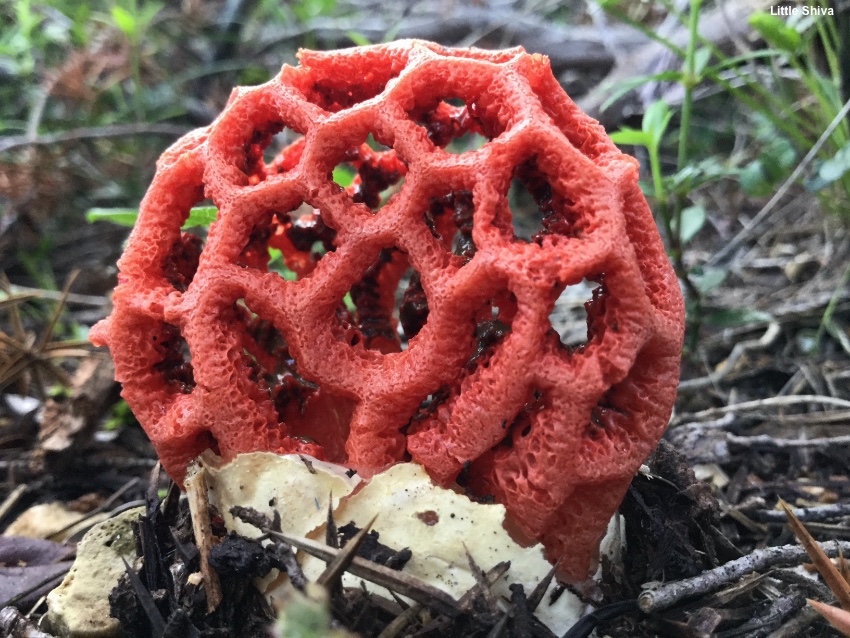
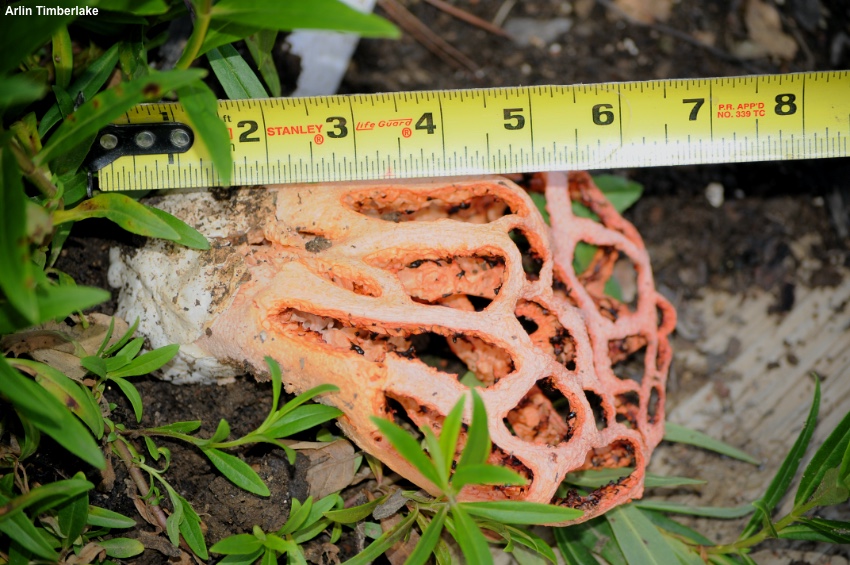
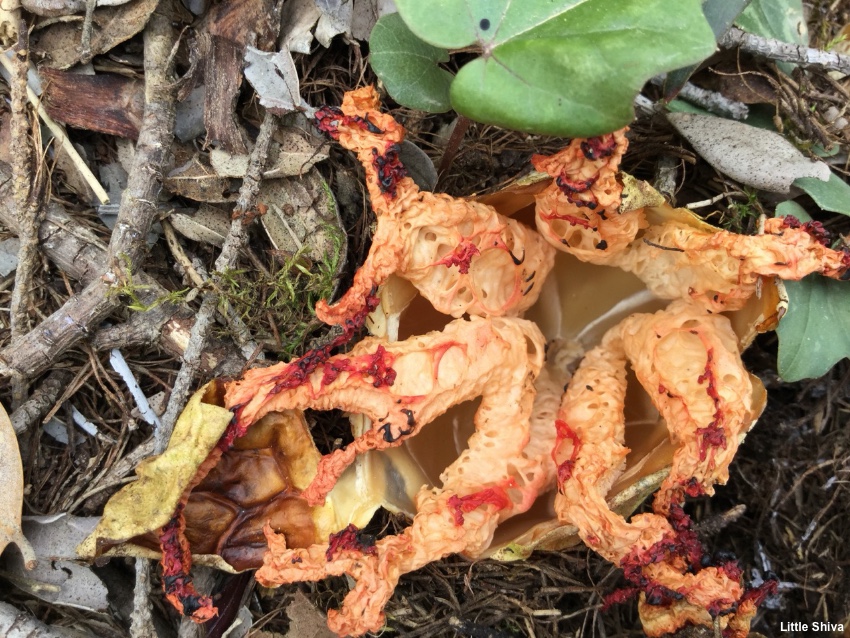
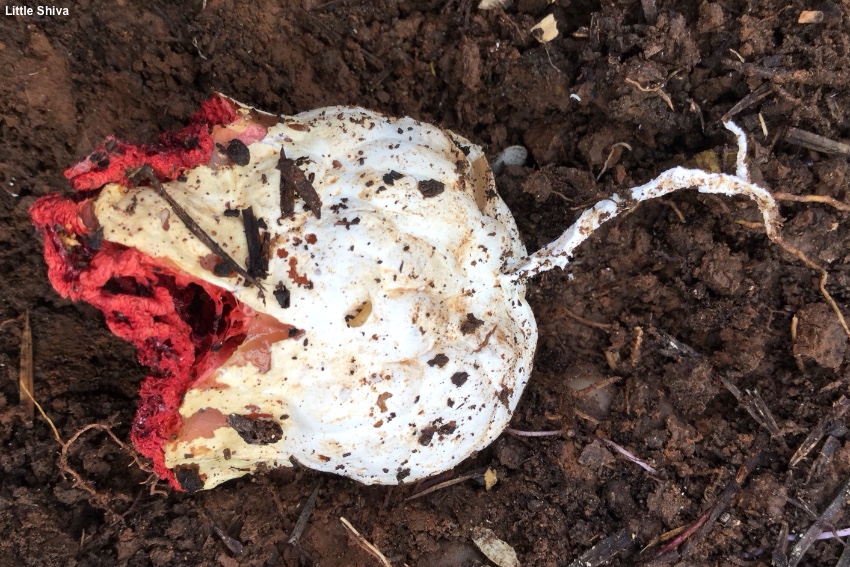
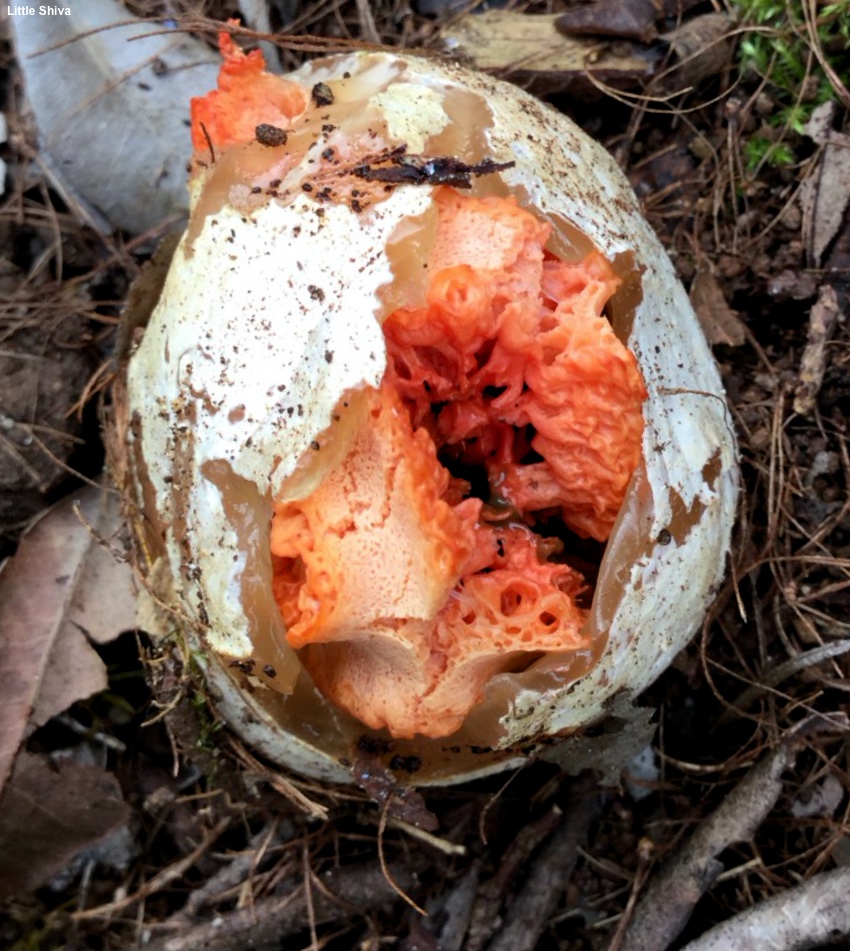
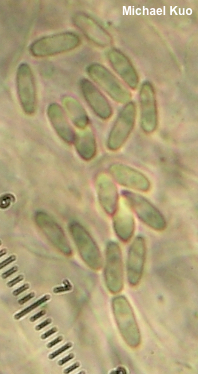
Clathrus ruber [ Basidiomycota > Agaricomycetes > Phallales > Clathraceae > Clathrus . . . ] by Michael Kuo If there were such a thing as an orange "Wiffle football," it would be Clathrus ruber. You wouldn't want to hike it to a friend, however, since its interior surfaces are coated with a foul-smelling slime that attracts flies and other insects (who then disperse the mushroom's spores). Like other stinkhorns, it arises from an "egg" that is attached to the ground with long cords. Originally described from the Mediterranean, Clathrus ruber or something very like it is found with some regularity in northern California, as well as in South America and Asia. A similar species, Clathrus crispus, appears in Florida and along the Gulf Coast; it can be separated by the corona-like grooves surrounding each hole in the lattice structure. Thanks to Arlin Timberlake and Little Shiva for documenting, collecting, and preserving Clathrus ruber for study; their collections are deposited in The Herbarium of Michael Kuo. Clathrus cancellatus is a synonym. Description: Ecology: Saprobic; growing alone or gregariously, often near woody debris, in lawns, gardens, cultivated soil, and so on; spring through fall (or over winter in warm climates); common throughout the Mediterranean, from where it has spread into temperate Europe–and in North America in Mexico and California, where it is a "regular" in San Francisco's Golden Gate Park; also known from Asia. The illustrated and described collections are from California and Croatia. Immature Fruiting Body: Like a whitish to faintly brownish "egg" 3–5 cm across; when sliced revealing the orange to orangish red stinkhorn-to-be encased in a brownish gelatinous substance. Mature Fruiting Body: 5–18 cm high; 4–10 cm wide; consisting of a mesh of arms that surround semi-regular openings, creating a lattice-like structure; with maturity the lower meshes sometimes become elongated vertically, almost appearing like supporting columns; base attached to white rhizomorphs. Arms: Up to about 1 cm thick; hollow; spongy and soft; outer surfaces sometimes becoming flattened with maturity; roughened or bumpy between meshes; orangish red to red, fading to pinkish or pinkish orange. Volva: Sac-like, encasing the base of the fruiting body; whitish to pale brownish. Spore Slime: Brown; produced on the insides of the arms; malodorous. Microscopic Features: Spores 4–6 x 1.5–2 µm; cylindric; smooth; hyaline in KOH. Sphaerocysts of the branch context 6–15 µm across; subglobose to irregular; smooth; thin-walled; hyaline to yellowish in KOH. Volval hyphae 1–7 µm wide; smooth; thin-walled; hyaline in KOH; often septate; with occasional clamp connections; sometimes terminating in swollen, clavate cells up to 10 µm across. REFERENCES: P. Micheli, ex Persoon, 1801. (Dring, 1980; Smith, Smith & Weber, 1981; Arora, 1986; Pegler & Læssøe, 1995; Calonge et al., 2004; Kibby, 2006; Buczacki et al., 2012; Hosaka, 2012; Trierveiler-Pereira et al., 2014; Desjardin, Wood & Stevens, 2015; Siegel & Schwarz, 2016; Læssøe & Petersen, 2019.) Herb. Kuo 03291401, 11141501, 04201601. This site contains no information about the edibility or toxicity of mushrooms. |
© MushroomExpert.Com |

|
Cite this page as: Kuo, M. (2020, February). Clathrus ruber. Retrieved from the MushroomExpert.Com Web site: http://www.mushroomexpert.com/clathrus_ruber.html |