| Major Groups > Cup Fungi > Chlorociboria aeruginascens |

|
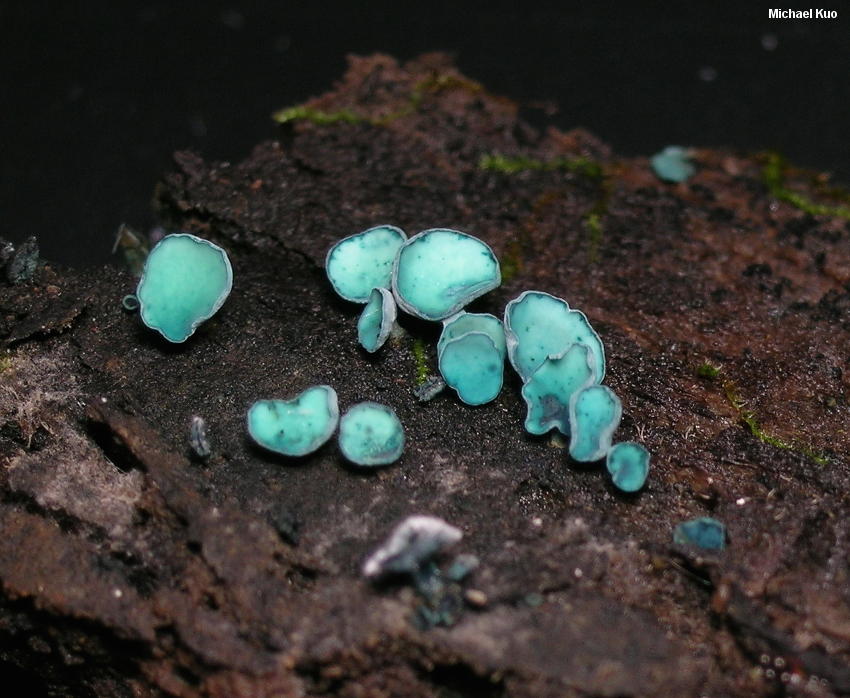
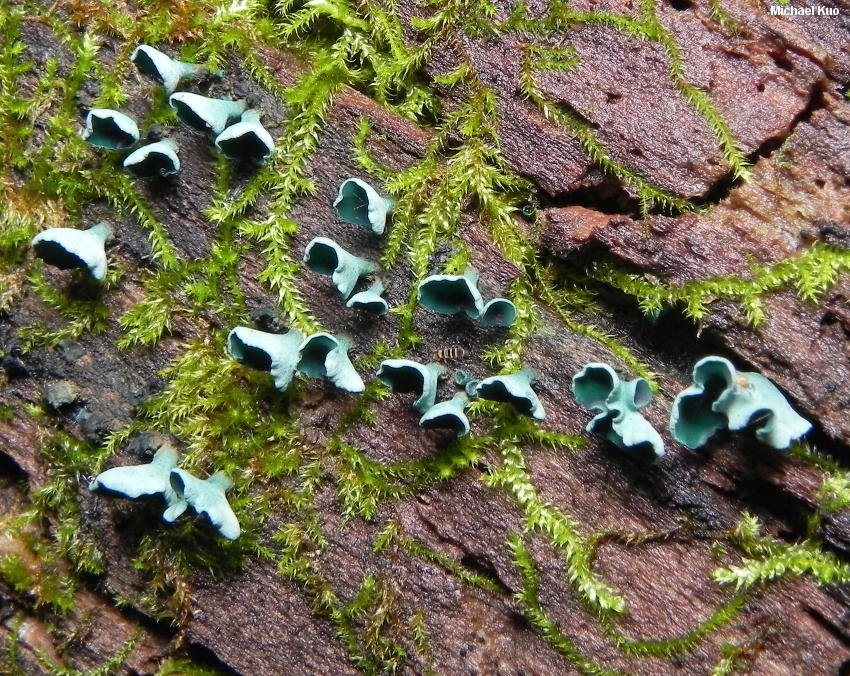
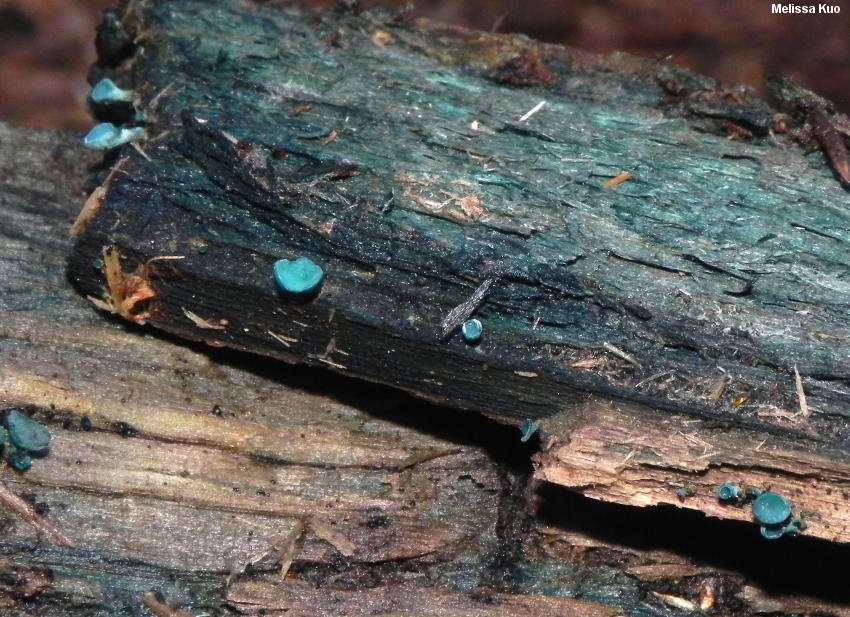
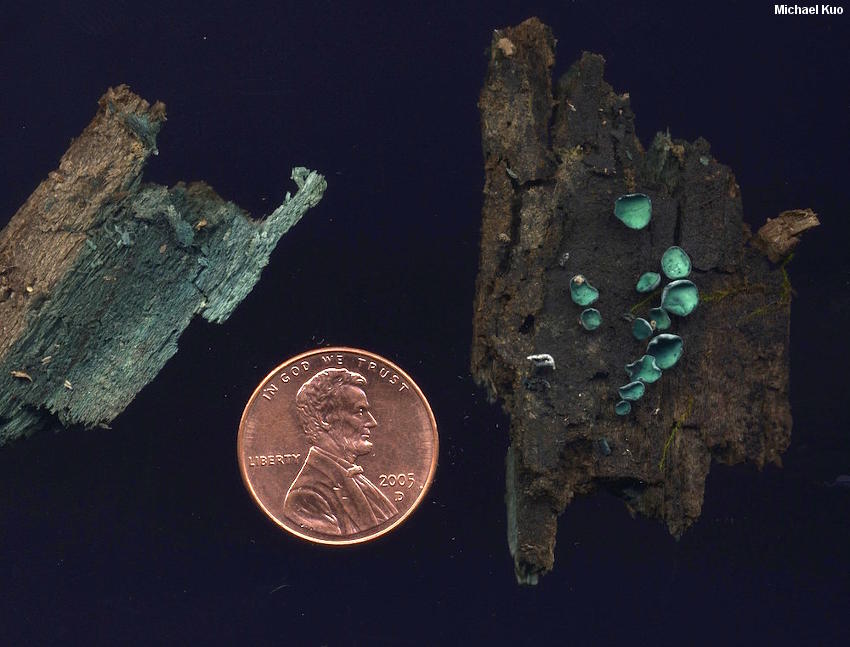
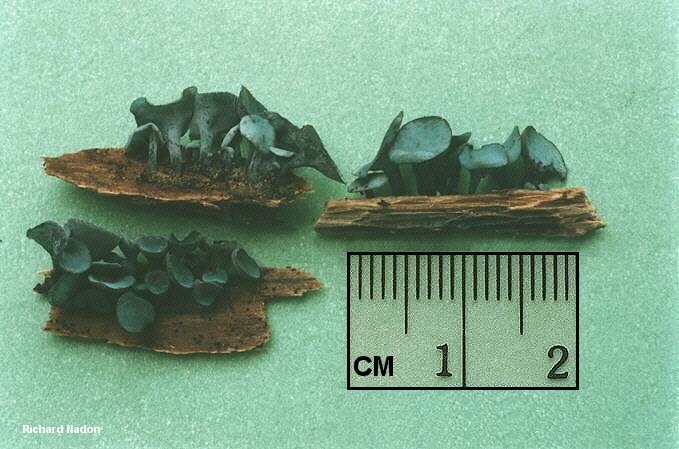
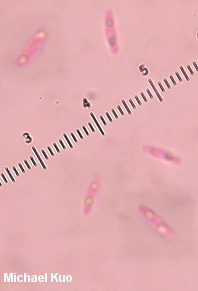
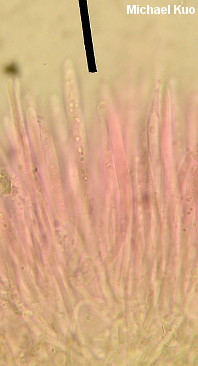
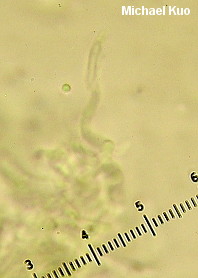
Chlorociboria aeruginascens [ Ascomycota > Helotiales > Heliotaceae > Chlorociboria ... ] by Michael Kuo I find evidence of Chlorociboria fungi growing on wood much more often than I actually find the tiny mushrooms themselves. These little blue cup fungi fruit infrequently--but they manage to stain the wood a gorgeous shade of bluish green. The stained wood is distinctive and, when the wood is from an oak tree, sometimes called "green oak." In North America we have two species of Chlorociboria: Chlorociboria aeruginascens, featured here, and Chlorociboria aeruginosa, which is practically identical to the naked eye but features longer spores and larger, roughened terminal cells on its outer surface. Description: Ecology: Saprobic on well-decayed, barkless logs and sticks, including those of both hardwoods and conifers; evident as green-stained wood year-round, but the fruiting bodies typically appear in summer and fall; widely distributed in North America. The illustrated and described collections are from Ohio, Pennsylvania, and Québec. Fruiting Body: Cup-shaped at first, becoming flattened or disc-shaped; 2-5 mm across; with a tiny stem (1-2 mm long) that may be central or somewhat off-center; upper surface bald, blue-green; undersurface similar. Odor and Taste: Not distinctive. Microscopic Features: Spores 6-8 x 1-2 µ; subfusiform to nearly cylindric; smooth; biguttulate with a small oil droplet near each end. Paraphyses filiform; 70-80 x 1 µ; apices subacute; hyaline. Terminal cells on excipular surface cylindric; often twisted or contorted; 1-1.5 µ wide; smooth. REFERENCES: (Nylander, 1868) Kanouse 1947 ex Ramamurthi, Korf & Batra, 1957. (Saccardo, 1889; Ramamurthi, Korf & Batra, 1957; Dixon, 1975; Smith, Smith & Weber, 1981; Arora, 1986; Phillips, 1991/2005; Lincoff, 1992; Barron, 1999; Roody, 2003; McNeil, 2006; Binion et al., 2008; Trudell & Ammirati, 2009; Beug, Bessette & Bessette, 2014.) Herb. Kuo 07171002, 07221402. This site contains no information about the edibility or toxicity of mushrooms. |
© MushroomExpert.Com |
|
Cite this page as: Kuo, M. (2015, May). Chlorociboria aeruginascens. Retrieved from the MushroomExpert.Com Web site: http://www.mushroomexpert.com/chlorociboria_aeruginascens.html |