| Major Groups > Stinkhorns > Aseroë rubra |

|
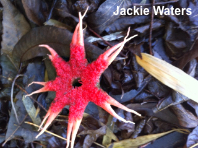
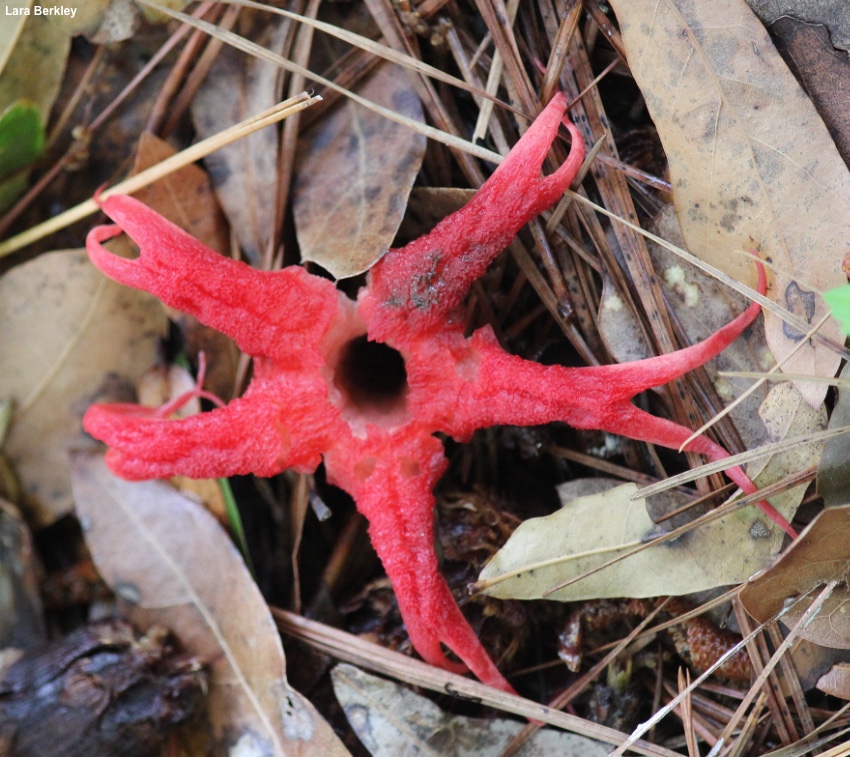
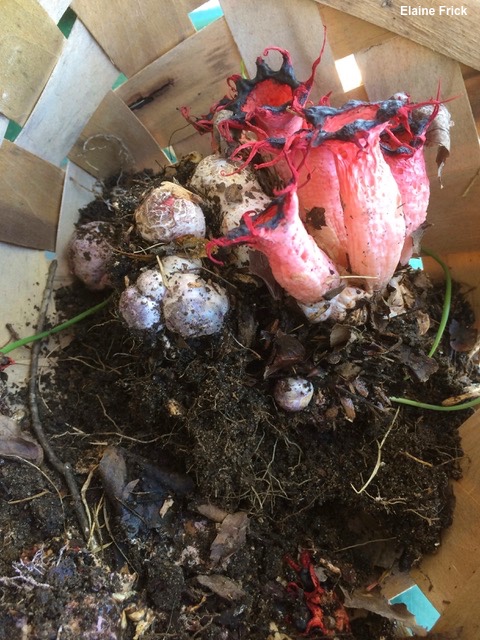
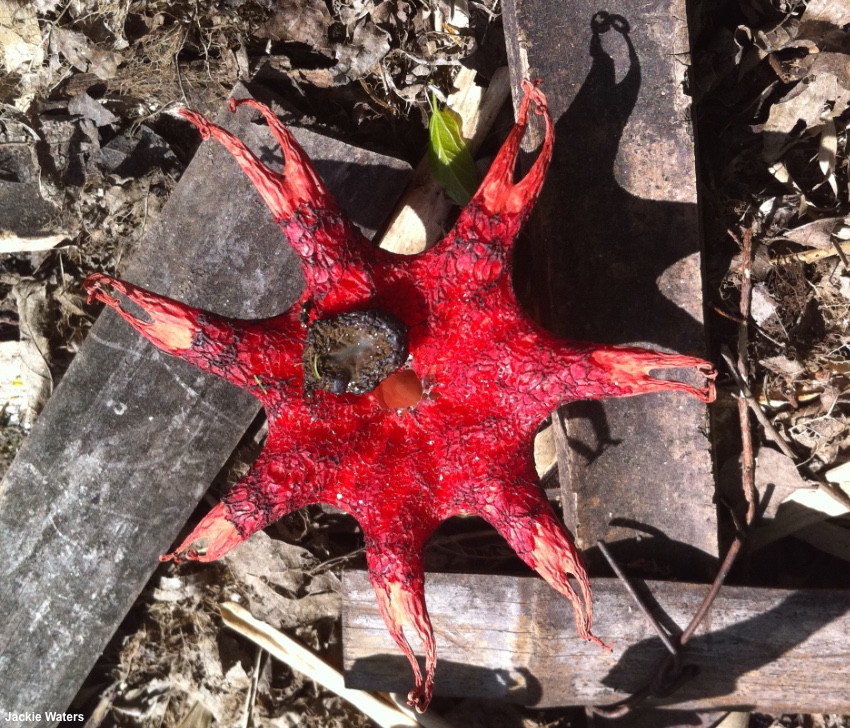
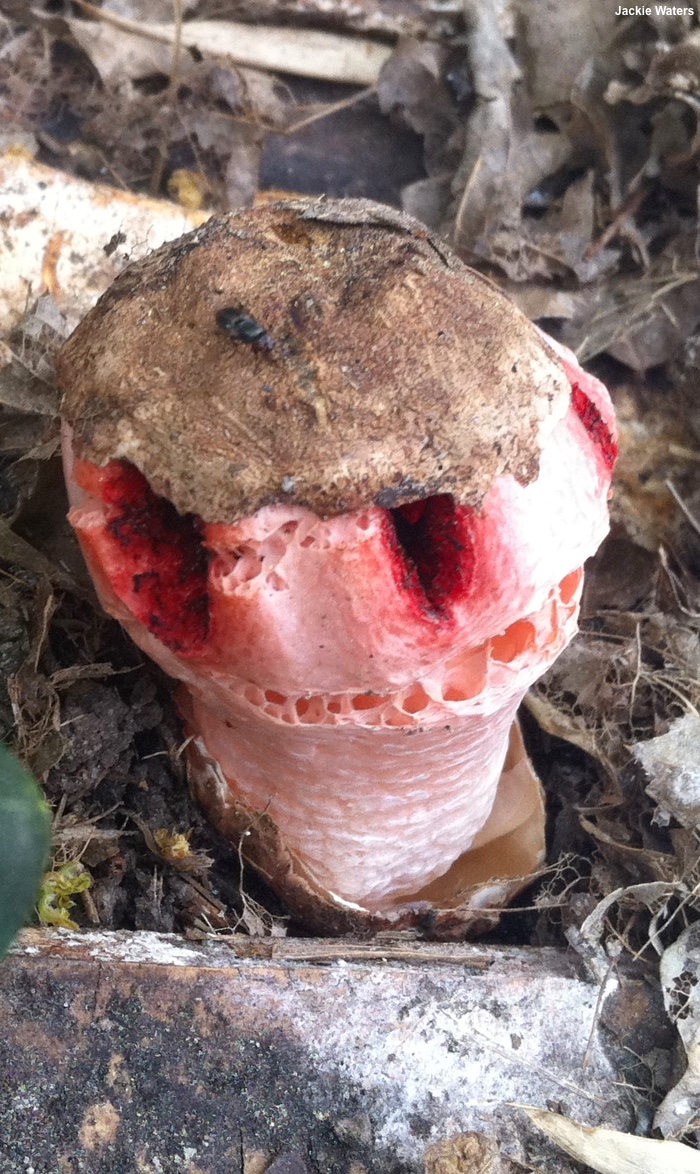
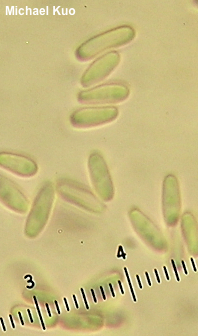
Aseroë rubra [ Basidiomycota > Phallales > Phallaceae > Aseroë . . . ] by Michael Kuo This awesome stinkhorn appears in tropical and subtropical areas. In the United States it is common in Hawaii and in the southeastern states, where it has apparently been introduced. It features a central column that is topped by an array of short, doubled tentacles. The central portion of the crown is initially covered with a foul-smelling brown spore slime that attracts flies and other insects, who then disperse the mushroom's spores elsewhere. Thanks to Lara Berkley, Elaine Frick, Philip Inman, and Jackie Waters for collecting, documenting, and preserving Aseroë rubra for study; their collections are deposited in The Herbarium of Michael Kuo. Description: Ecology: Saprobic on plant litter and woody debris; growing alone or gregariously; found in woods or, more commonly, in cultivated areas and compost (in gardens, along paths, and so on); appearing year-round; common in Hawaii and frequently found in the southeastern United States; also found in tropical and subtropical areas across the globe (especially Australia, New Zealand, and southern Africa). The illustrated and described collections are from North Carolina, South Carolina, and Georgia. Immature Fruiting Body: Like a whitish to brownish "egg" up to about 3 cm high; attached to numerous rhizomorphs; when sliced revealing the stinkhorn-to-be encased in a gelatinous substance. Mature Fruiting Body: Up to about 8 cm high; stem clearly defined, round in cross-section, with a horizontally furrowed surface, white to pink, red, or orange, encased at the base in a whitish volva; head portion flattened, covered with brown to olive brown, foul-smelling slime; with 5–7 radiating tentacles that are arranged symmetrically around the edge of the head and measure up to about 4 cm long; tentacles doubled, white to pink, red, or orange. Microscopic Features: Spores 5–6.5 x 1.5–2 µm; cylindric; smooth; inamyloid; hyaline or yellowish in KOH; walls not cyanophilic. Sphaerocysts in stem subglobose; 20–40 µm wide. Volval hyphae interwoven; 2–7 µm wide; branching; smooth; hyaline in KOH; clamp connections not found. REFERENCES: LaBillardiere, 1800. (Fries, 1823; Saccardo, 1888; Dring, 1980; Sáenz & Nassar, 1982; Calonge et al., 2004; Calonge et al., 2005; Hemmes & Desjardin, 2002; Hosaka et al., 2006; Hemmes & Desjardin, 2009; Kreisel & Hausknecht, 2009; Trierveiler-Pereira et al., 2013; Trierveiler-Pereira et al., 2014.) Herb. Kuo 06291003, 02071201, 05061601, 04251901. This site contains no information about the edibility or toxicity of mushrooms. |
© MushroomExpert.Com |

|
Cite this page as: Kuo, M. (2019, September). Aseroë rubra. Retrieved from the MushroomExpert.Com Web site: http://www.mushroomexpert.com/aseroe_rubra.html |