| Major Groups > Gilled Mushrooms > Pink-Spored > Melanophyllum haematospermum |

|
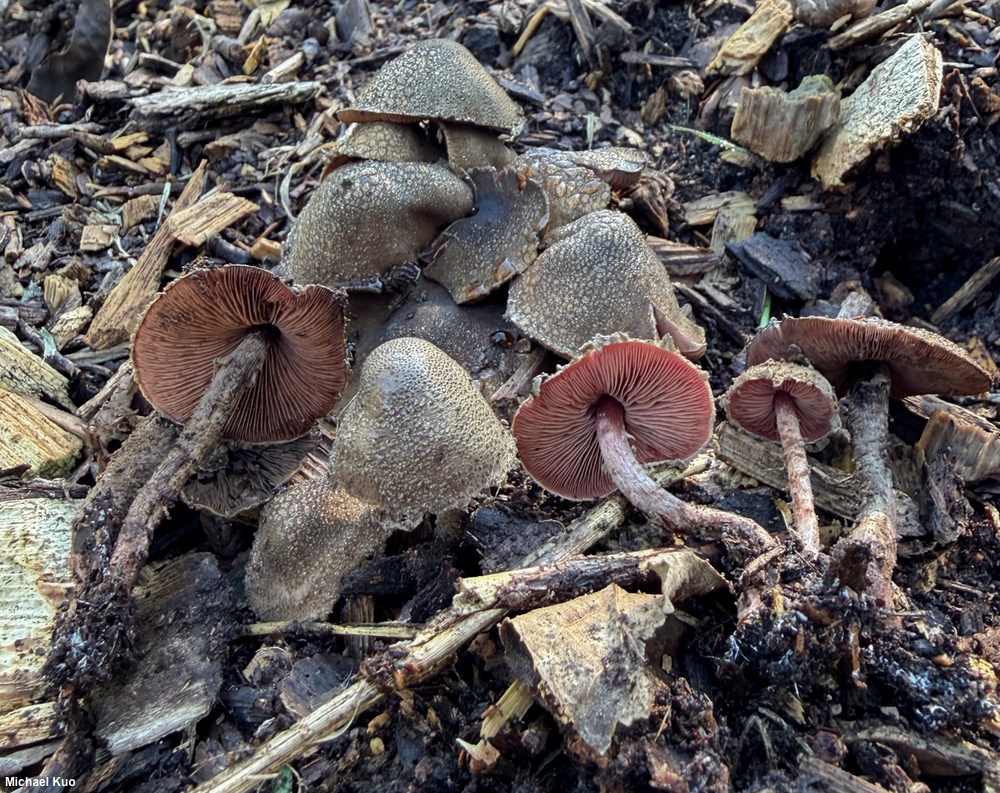
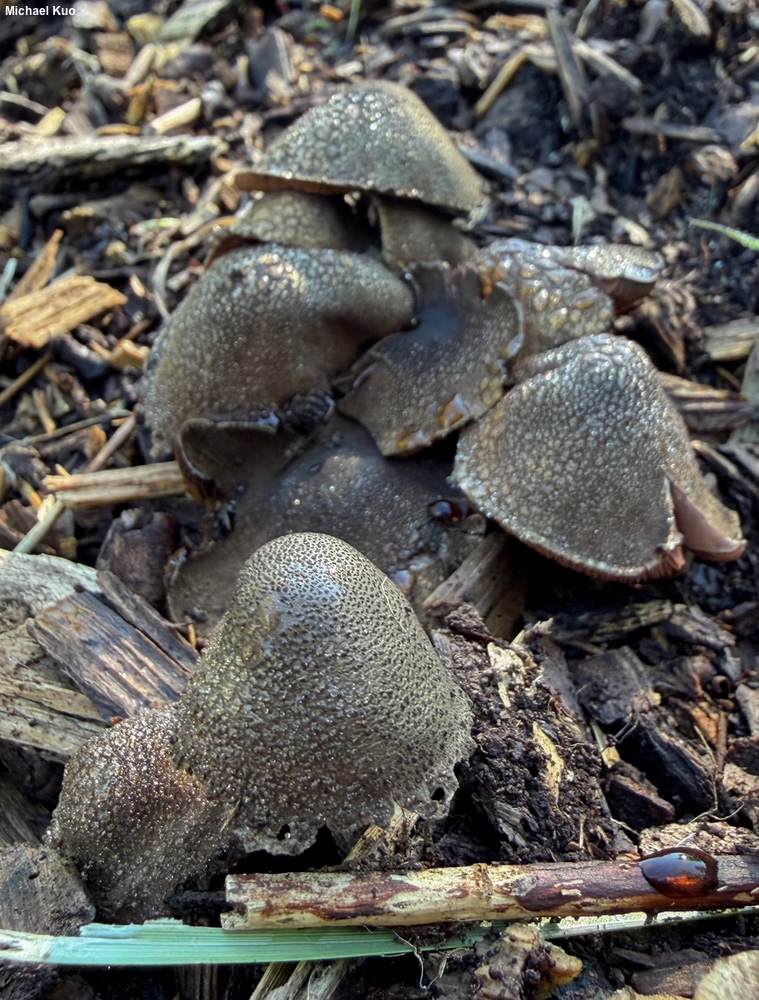
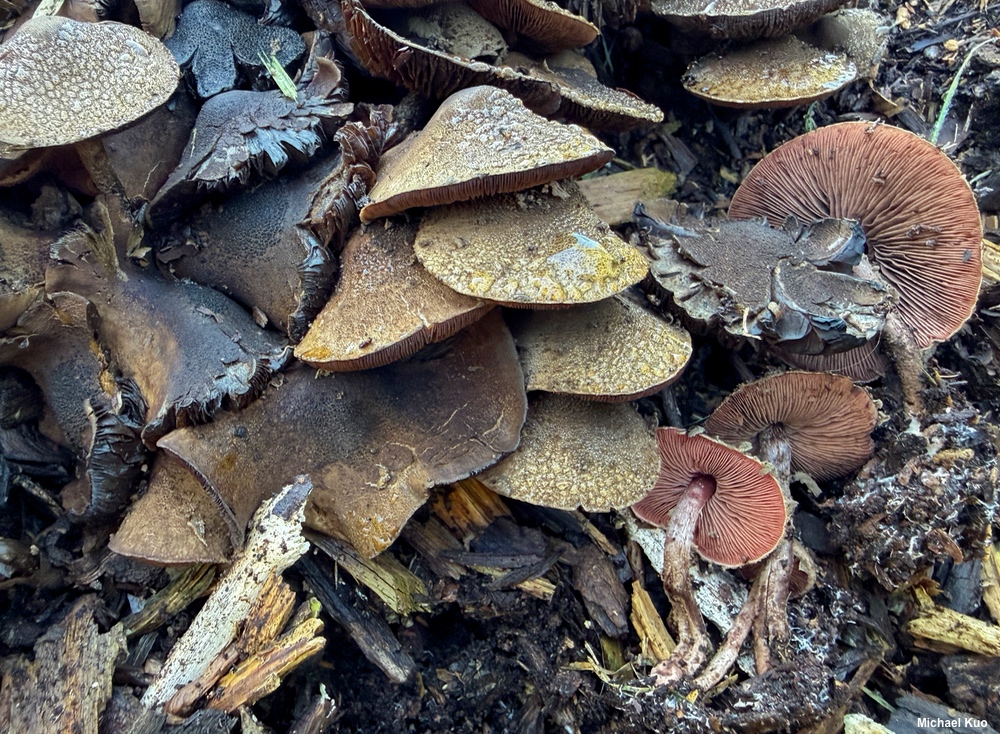
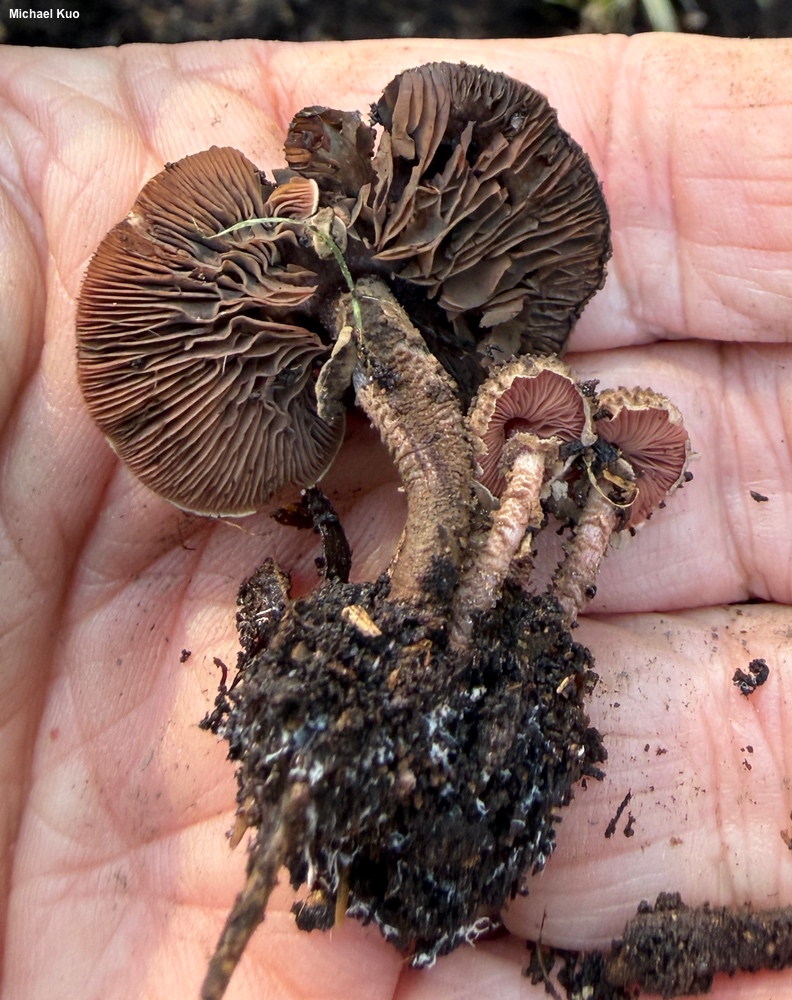
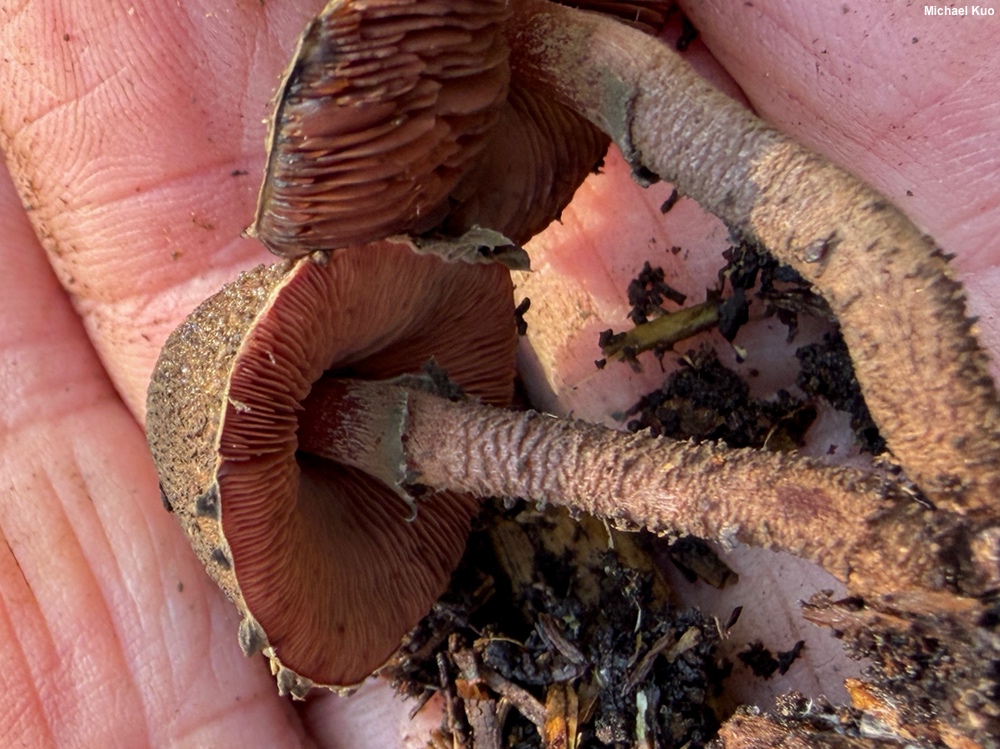
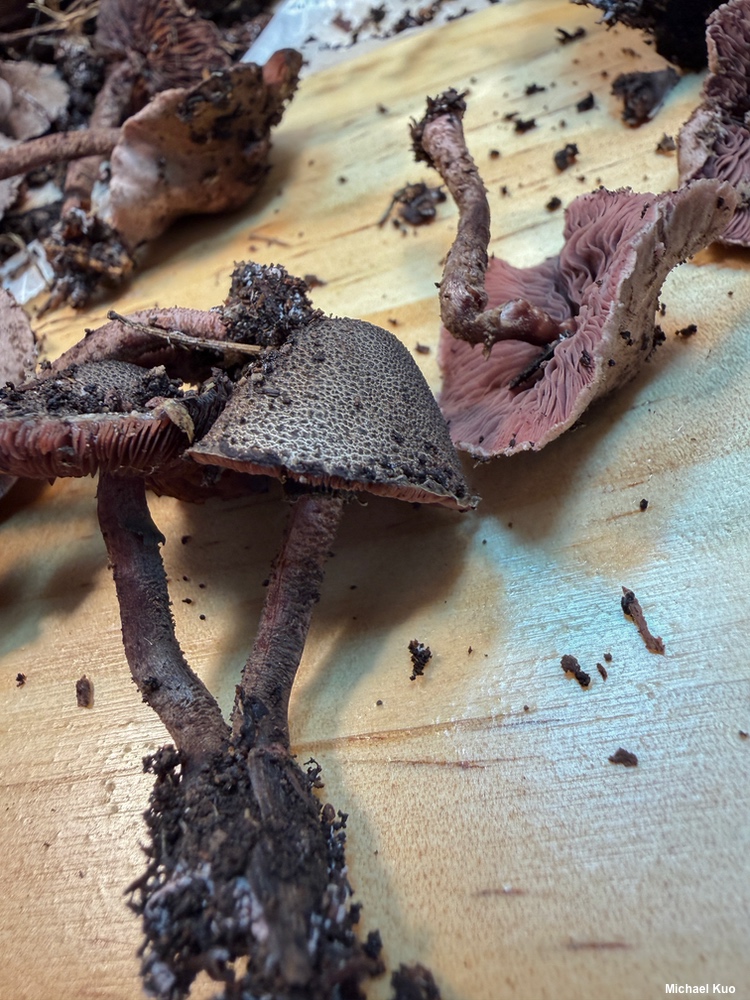
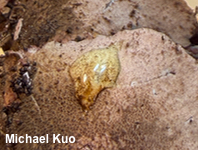
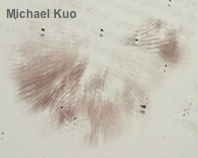
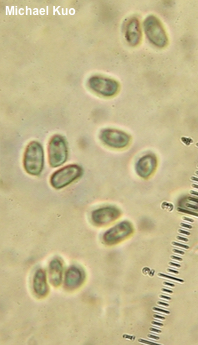
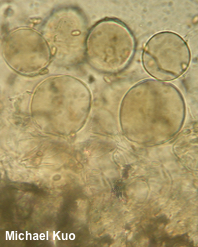
[Basidiomycota > Agaricales > Agaricaceae > Melanophyllum . . . ] Melanophyllum haematospermum by Michael Kuo, 2 October 2026 My neighbor has an enormous woodchip bed that produces an amazing number of mushrooms, including several that I have never seen anywhere else: Leucoagaricus meleagris, Agrocybe arvalis, and, just the other day, Melanophyllum haematospermum. I almost missed these mushrooms, since their dark grayish brown caps were roughly the same color as the damp woodchips. But once I turned one over and saw the amazing red gills, I was on all fours: there were dozens. Melanophyllum haematospermum is unlikely to be confused with anything else: its gray-brown cap is finely granular-scaly, its gills are pinkish red, and its stem is narrow and pinkish, also covered with fine scales. Any difficulty with identifying the mushroom, in North America at least, is more likely to result from not finding it in field guides or websites, since it is not often described in reference sources for our continent. According to the literature the spore print of Melanophyllum haematospermum is amazingly olive green when fresh, turning quickly reddish brown as it dries out. Whaaat? I eagerly set up several spore prints and checked them hourly: they were initially pink, then became a little more brownish as they dried out. Hmmmm. It wasn't until I re-examined my photos that I found the olive spore powder, caught by the rings on the stems of a few younger specimens. So, in my limited experience, a "fresh" spore print in this case would need to be observed in situ, with really fresh mushrooms. Melanophyllum haematospermum groups with species of Cystolepiota in phylogenies (Vellinga 2003, Li et al. 2025). Melanophyllum echinatum is a synonym. Description: Ecology: Saprobic; growing gregariously or in clusters in woodchips, in compost, or in woods; summer and fall; originally described from France (Bulliard 1793); widely distributed in Europe; in North America distributed east of the Rocky Mountains, along the West Coast, and in Mexico; reported from Oceania, Asia, and South America. The illustrated and described collection is from Ohio. Cap: 1–5 cm; dry; conic-convex at first, expanding to broadly convex or bell-shaped; dry; covered with small granular scales; dark brownish gray, fading to grayish; the margin not lined, but often adorned with whitish fragments of the partial veil when young. Gills: Narrowly attached to the stem; close or nearly crowded; short-gills frequent; dull salmon in buttons, becoming dark grayish pink and eventually nearly black; at first covered by a whitish, membranous partial veil. Stem: 2–5 cm long; 2–3 mm thick; equal; dry; shaggy or scaly with fine brownish gray scales; sometimes with a high, collapsed, skirtlike, ephemeral ring that is dusted with dull olive spores; dull pink when young, becoming more brownish; base attached to white mycelium and rhizoids. Flesh: Whitish; unchanging when sliced. Odor: Fragrant. Dried Specimens: All surfaces very dark brown to black. Chemical Reactions: Cap surface yellow with KOH. Spore Print: Olive when very fresh and in situ; later pinkish to brownish pink (see discussion above). Microscopic Features: Spores 4–5 x 2–3 µm; subcylindric to ellipsoid; smooth; inamyloid; hyaline to faintly yellowish brown in KOH. Basidia 17–22 x 3–4 µm; subclavate; 4-sterigmate. Hymenial cystidia not found. Lamellar trama subparallel. Pileipellis a cystoderm; elements 22–38 µm wide, globose or subglobose, smooth, thin-walled, brownish to brown in KOH; hymeniform, obclavate elements also present. REFERENCES: (J. B. F. Bulliard, 1793) H. Kreisel, 1984. (Kauffman, 1918; Smith, 1949; Moser, 1978; Smith, Smith & Weber, 1979; Phillips, 1981; Lincoff, 1992; Breitenbach & Kränzlin, 1995; Migliozzi & Zecchin, 2001; Vellinga, 2001; Vellinga, 2003; Vellinga 2004; Boccardo et al., 2008; Albizu & Teres, 2009; Trudell & Ammirati, 2009; Buczacki et al., 2012; Siegel & Schwarz, 2016; Baroni, 2017; Lange, 2018; Læssøe & Petersen, 2019; Kibby, 2020; Li et al., 2025.) Herb. Kuo 09252602. This site contains no information about the edibility or toxicity of mushrooms. |
© MushroomExpert.Com |
|
Cite this page as: Kuo, M. (2026, October). Melanophyllum haematospermum. Retrieved from the MushroomExpert.Com Web site: http://www.mushroomexpert.com/melanophyllum_haematospermum.html |