| Major Groups > Gilled Mushrooms > Dark-Spored > Agrocybe & Cyclocybe > Agrocybe arvalis |

|
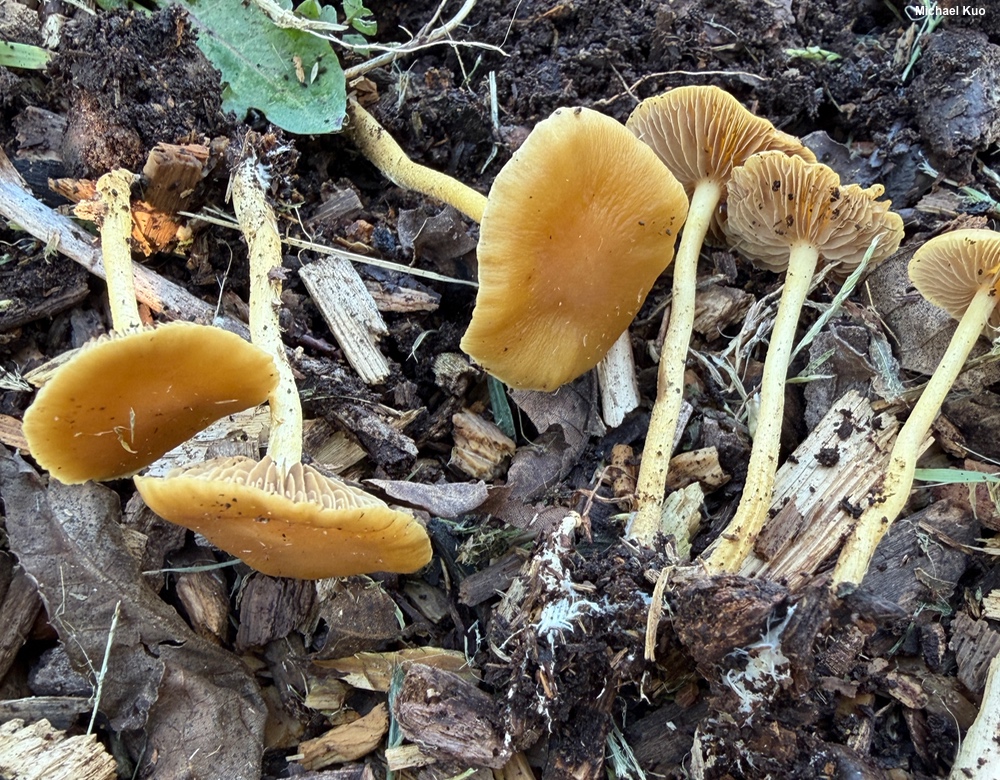
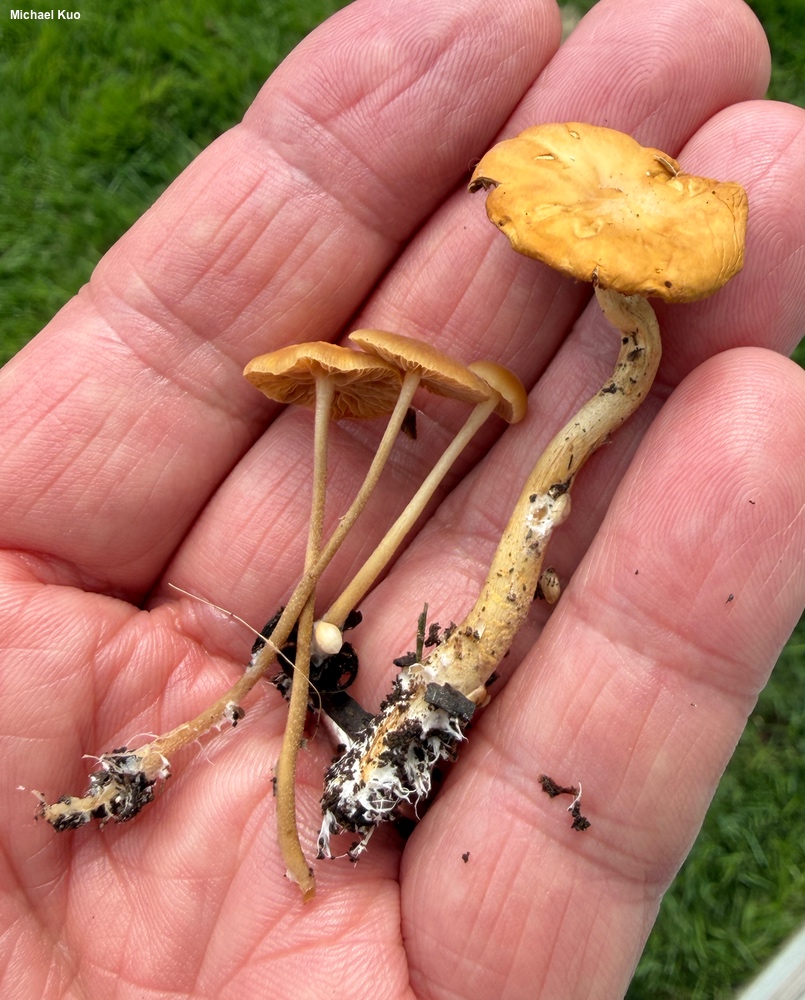
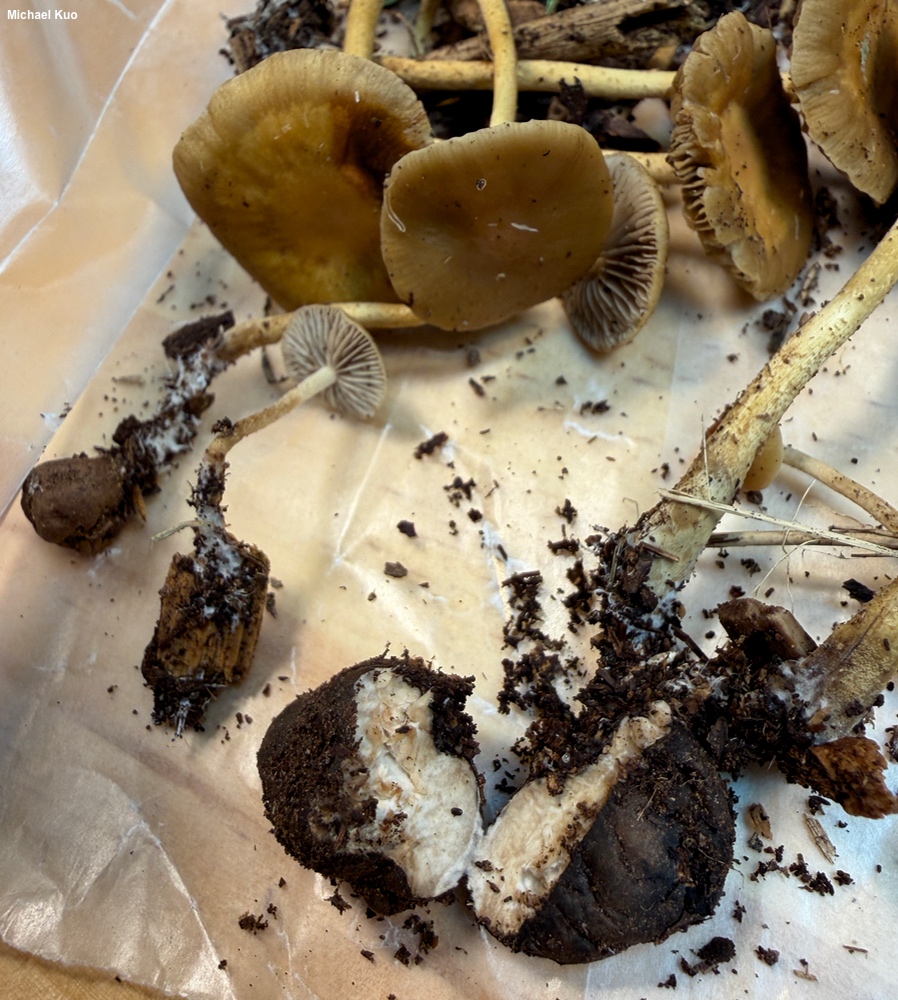
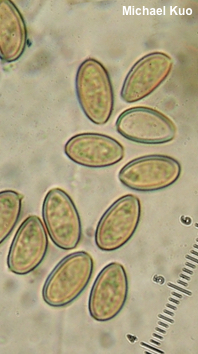
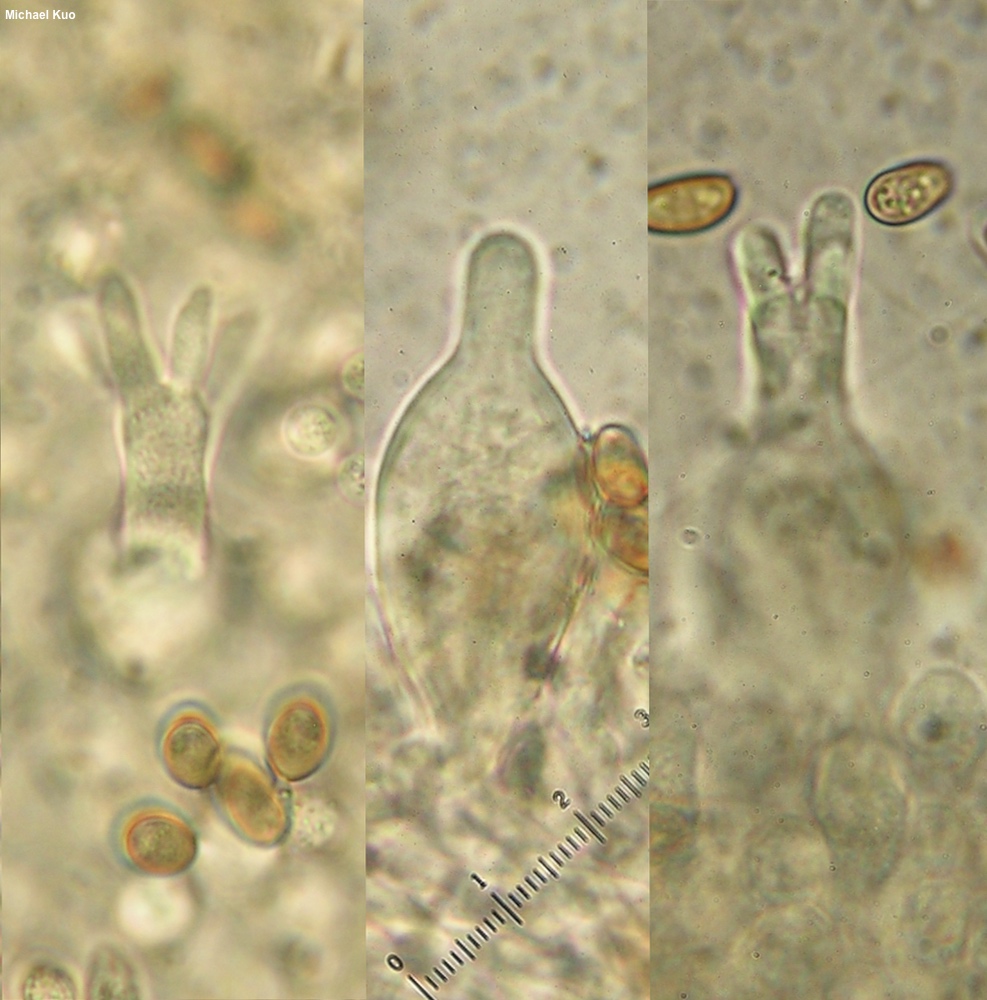
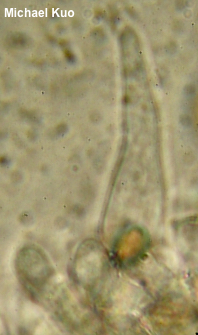
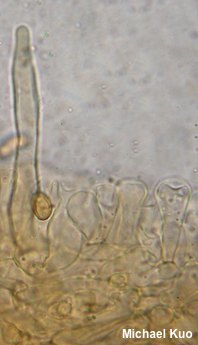
[ Basidiomycota > Agaricales > Agrocybaceae > Agrocybe . . . ] Agrocybe arvalis by Michael Kuo, 30 September 2026 Small, yellowish species of Agrocybe are not the easiest mushrooms to identify, but Agrocybe arvalis has a few distinctive defining features, not all of which are microscopic. At the top of the list is the presence of an underground tuber, often connected to the base of the stem. The tuber is pea- to bean-sized, and black; it can often be found by digging around gently beneath the mushroom with your fingers (it can be fairly deeply buried). But if you did not know that one of the little yellowish Agrocybe species has a tuber attached, how would you have known to dig around for it? And, as you have probably already guessed from my use of the word "often," the tuber isn't always there—which brings us to the other non-microscopic features: habitat in woodchips, lack of a partial veil or a ring on the stem, a slightly bitter taste, and a cap surface that turns pink to red with the application of KOH. Under the microscope, the most distinctive feature of Agrocybe arvalis is the presence of fingerlike projections at the tops of some of the pleurocystidia. But you may need to search for quite a while to find examples, since not all the pleurocystidia feature the fingers, and you will need to use a well oriented section (for example a Roman aqueduct section) because the cheilocystidia do not have fingers and you'll need to know the difference. And, in the interest of full disclosure, I have examined several specimens that included no pleurocystidia with fingers (I know this because they matched in every other detail and grew alongside specimens that did feature the fingers). Other microscopic features helping to define Agrocybe arvalis include the spores with relatively small pores (0.5–1.0 µm across), and the hymeniform pileipellis that features pileocystidia. Description: Ecology: Saprobic; growing scattered or gregariously in woodchip beds, waste places, disturbed soil, or in woods; summer and fall; originally described from Sweden (Fries 1821); widespread in Europe; in North America well documented east of the Rocky Mountains, and reported from the West Coast and Mexico. The illustrated and described collections are from Ohio. Cap: 0.5–3 cm; convex, becoming broadly convex or nearly flat; moist when fresh; bald; brownish yellow; hygrophanous; the margin not lined, or becoming slightly lined at maturity. Gills: Narrowly attached to the stem; close; short-gills present; whitish at first, becoming brownish and eventually pale brown. Stem: 2–7 cm long and 1–3 mm thick; equal; bald; whitish to yellowish above, brownish below; basal mycelium white; base often attached to a buried tuber (1–3 x 1–2 cm, egg-shaped to nearly round, surface black, interior tough and white). Flesh: Insubstantial; whitish to yellowish; unchanging when sliced. Odor and Taste: Odor not distinctive; taste slightly bitter. Chemical Reactions: KOH on cap surface pinkish to red. Microscopic Features: Spores 7.5–11 x 5–6 µm; subellipsoid, with a small pore 0.5–1.0 µm wide; smooth; walls about 1 µm thick; pale brownish to brownish yellow in KOH. Basidia 25–32 x 6–7 µm; clavate; 4-sterigmate. Cheilocystidia 35–50 x 10–15 µm; lageniform or fusiform; smooth; thin-walled; hyaline in KOH. Pleurocystidia 45–60 x 15–18 µm; utriform with a wide basal section and a fairly long neck, or sometimes developing up to 6 fingerlike apical projections (4–10 x 2–3 µm); smooth; thin-walled; hyaline in KOH. Pileipellis hymeniform; terminal cells 6–28 µm wide, clavate to subglobose or obpyriform; hyaline to brownish in KOH; pileocystidia scattered, 30–70 x 3–7 µm, lageniform, smooth, walls to 1.0 µm thick. REFERENCES: (E. M. Fries, 1821) R. Singer, 1936. (Singer, 1978; Watling, 1982; Moser, 1983; Breitenbach & Kränzlin, 1995; Nauta, 2005; Boccardo et al., 2008; Buczacki et al., 2012; Gminder & Böhning, 2017; Ryman, 2018; Læssøe & Petersen, 2019; Kibby, 2021.) Herb. Kuo 08182602, 09252601. This site contains no information about the edibility or toxicity of mushrooms. |
© MushroomExpert.Com |
|
Cite this page as: Kuo, M. (2026, September). Agrocybe arvalis. Retrieved from the MushroomExpert.Com Web site: http://www.mushroomexpert.com/agrocybe_arvalis.html |