| Major Groups > Boletes > Gyroporus > Gyroporus purpurinus |

|
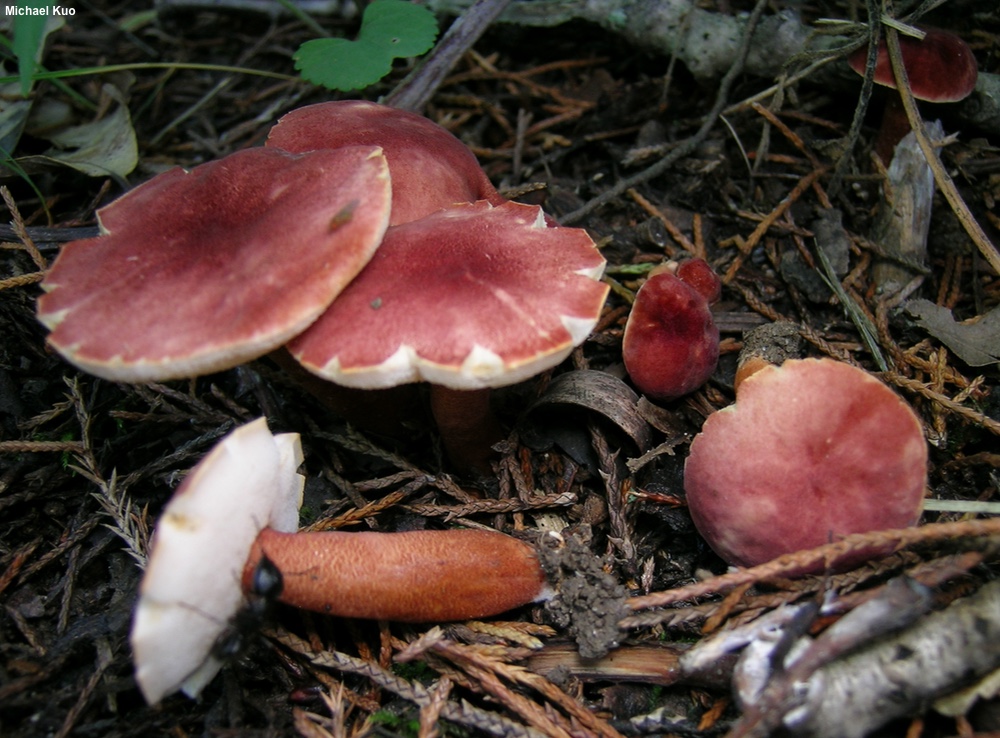
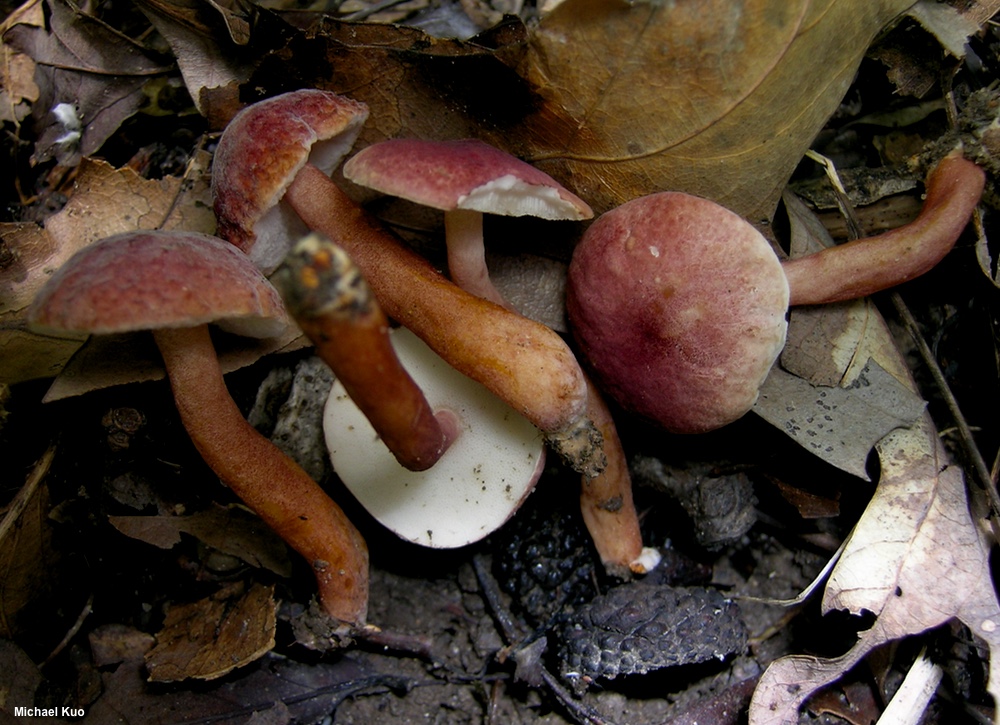
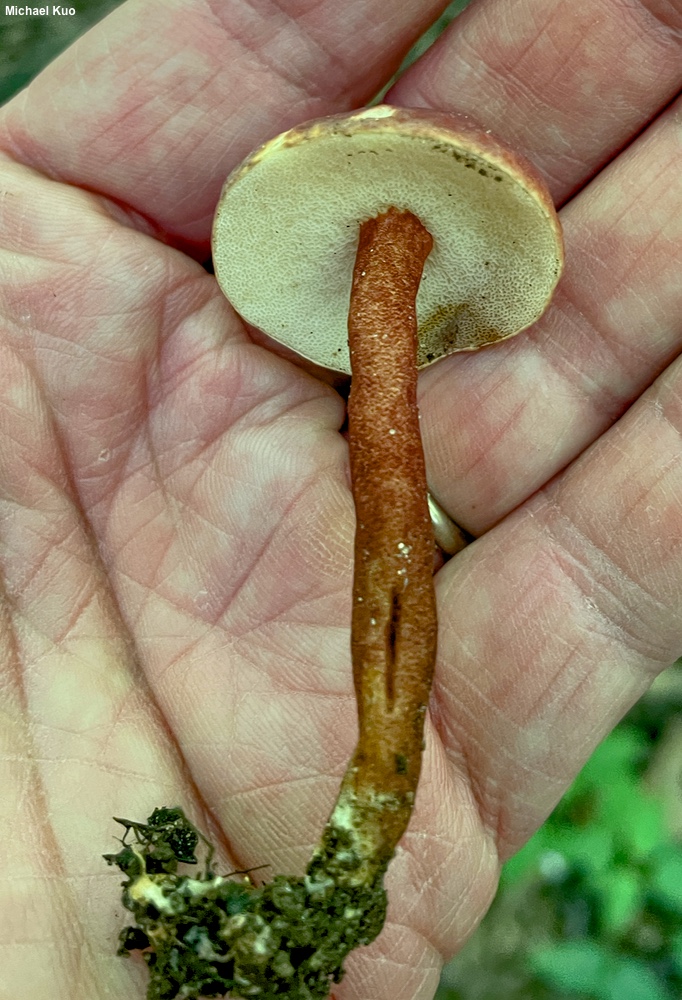
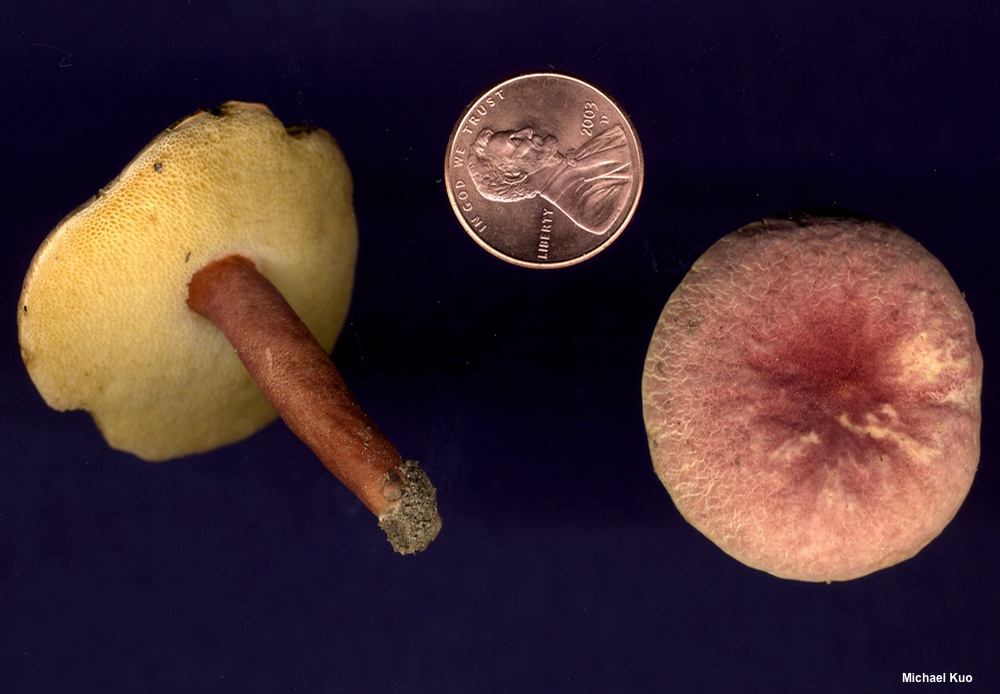
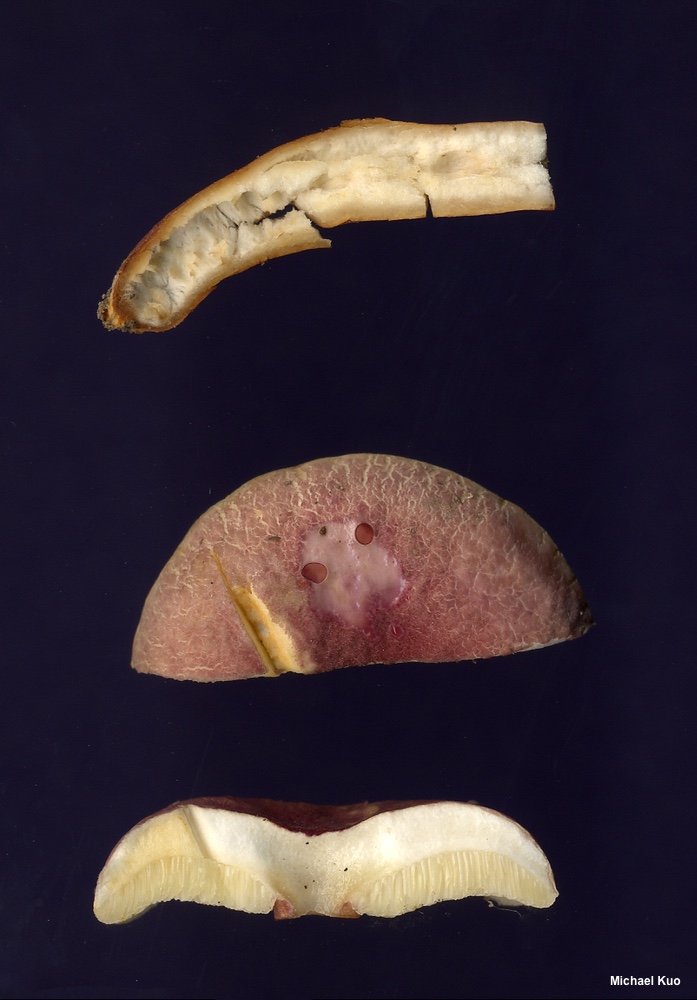
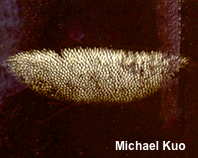
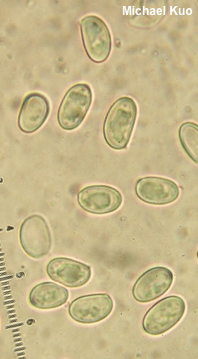
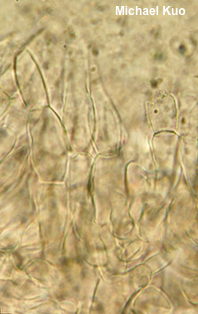
[ Basidiomycota > Boletales > Gyroporaceae > Gyroporus . . . ] Gyroporus purpurinus by Michael Kuo, 9 June 2026 This is one of those mushrooms I'm always eager to find, but only rarely encounter. I don't know how many times I have excitedly stooped down to pick it, only to discover that I am looking at one of several purplish Tylopilus species. But unlike Tylopilus species, Gyroporus purpurinus has yellowish spores, and therefore has a pore surface that eventually becomes pale yellow—while Tylopilus pore surfaces are typically pinkish by maturity. Other than its color, not a lot separates Gyroporus purpurinus from Gyroporus borealis and Gyroporus smithii, which are similar in stature but are (usually) brown and brownish orange, respectively. I think all three of these "species" should be treated as Gyroporus castaneus. See the page for Gyroporus for a thorough discussion. Description: Ecology: Mycorrhizal with oaks and other hardwoods, growing alone, scattered, or gregariously on the ground, especially in disturbed-ground locations like path sides, embankments, and so on; summer and fall; originally described from New York (Snell 1936); fairly widely distributed east of the Rocky Mountains, and reported in Mexico. The illustrated and described collections are from Illinois. Cap: 1.5–5 cm; convex, becoming broadly convex or nearly flat in age; dry; bald or slightly velvety; sometimes becoming somewhat wrinkled, or slightly cracked in age (like me, according to my friends); purplish red to purplish pink. Pore Surface: Whitish at first, becoming pale yellow; not bruising, or bruising slowly brownish; 1–2 circular to angular pores per mm; tubes to 5 mm deep. Stem: 3–5 cm long; 0.5–1 cm thick; more or less equal; dry; brittle; hollowing; colored like the cap; not bruising; not reticulate; basal mycelium white to pale yellowish. Flesh: White; not staining on exposure. Odor and Taste: Not distinctive. Chemical Reactions: Ammonia negative on cap surface and flesh. KOH negative on cap surface; negative to yellowish on flesh. Iron salts negative on cap surface and flesh. Spore Print: Yellow. Microscopic Features: Spores 8–11 x 5–6 µm; ellipsoid; smooth; hyaline in KOH. Basidia 22–25 x 9–13 µm; clavate; 4-sterigmate. Hymenial cystidia 25–45 x 3–6 µm; fusiform to narrowly lageniform, sometimes with a long neck; smooth; thin-walled; hyaline in KOH. Pileipellis a trichoderm; elements 6–15 µm wide, smooth, septate, hyaline in KOH; terminal cells fusiform to lageniform; subterminal cells not swollen. REFERENCES: R. Singer, 1945 ex N. Davoodian & R. E. Halling, 2013. (Singer, 1945; Snell & Dick, 1970; Smith & Thiers, 1971; Smith, Smith & Weber, 1981; Arora, 1986; Phillips, 1991/2005; Lincoff, 1992; Both, 1993; Horn, Kay & Abel, 1993; Bessette, Roody & Bessette, 2000; Wilson et al., 2012; Davoodian & Halling, 2013; Kuo & Methven, 2014; Bessette, Roody & Bessette, 2016; Sturgeon, 2018; Davoodian et al., 2018; Davoodian et al., 2020.) Herb. Kuo 06289504, 09289620, 07230306, 06300709, 07050802, 07120810. This website contains no information about the edibility or toxicity of mushrooms. |
© MushroomExpert.Com |
|
Cite this page as: Kuo, M. (2013, December). Gyroporus purpurinus. Retrieved from the MushroomExpert.Com Web site: http://www.mushroomexpert.com/gyroporus_purpurinus.html |