| Major Groups > Boletes > Gyroporus > Gyroporus cyanescens |

|
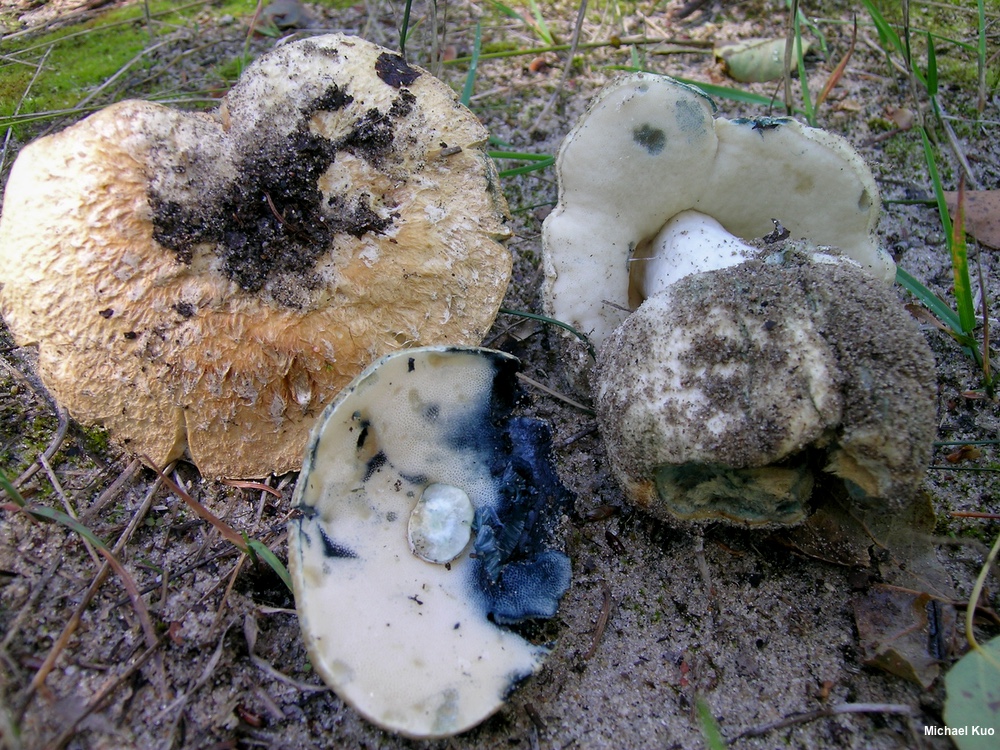
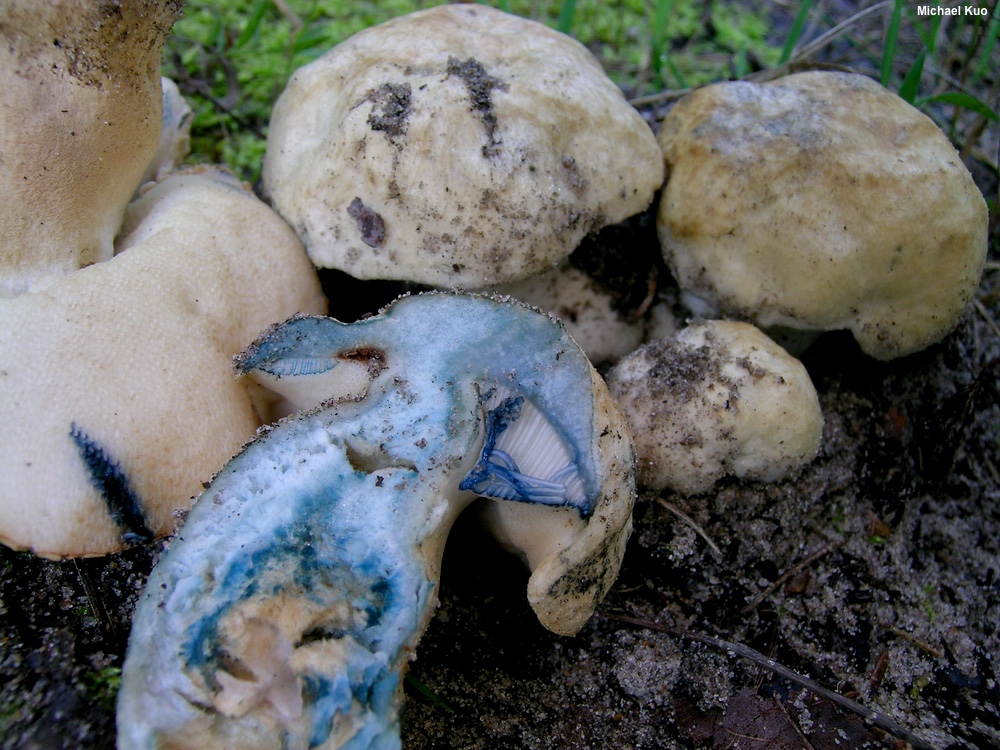
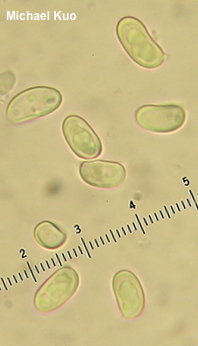
[ Basidiomycota > Boletales > Gyroporaceae > Gyroporus . . . ] Gyroporus cyanescens by Michael Kuo, 8 June 2026 If you were to blow on it hard, Gyroporus cyanescens just might bruise blue. This easily recognized mushroom is found in eastern North America, usually in sandy soil (it is especially fond of grassy areas at woods' edges, road banks, and so on). Its straw yellow colors and brittle consistency, together with its strong bluing reactions and yellow spore print, separate Gyroporus cyanescens from other boletes. Although Singer (1945) noted that this mushroom "does not seem regularly to form mycorrhiza," and that "no preference of any forest tree is shown, and sometimes fruiting bodies are formed far from any tree at all," his suspicion about the mushroom's trophic status has been overturned definitively (see Agerer 1999, Tedersoo et al. 2010, Wilson et al. 2007) with support for the idea that the species is in fact mycorrhizal. I wonder if Singer's version of "far from any tree at all" accounted for "toppling range," which is a more accurate measure of potential mycorrhizal association than a tree's dripline. The best name for the collections described and illustrated here may be Gyroporus violaceotinctus, née Gyroporus cyancescens var. violaceotinctus, which was originally described by Roy Watling (1969) on the basis of two northern Michigan collections and one southern Michigan collection. In these collections "the flesh changed first lilac then rich purple and finally indigo," leading Watling to name a separate variety, since what he viewed as typical cyanescens collections stained "greenish yellow when cut and finally azure blue." This subtle difference in staining reactions is not likely to reflect much beyond weather conditions, chemical composition of the soil, and so on, in my humble opinion—but the name violaceotinctus is the only one in the on-deck circle for North America, and in the 60 years since Watling's original description of violaceotinctum, studies have done little to clarify the North American cyanescens picture (Watling 2006, Wilson et al. 2007, Vizzini et al. 2015, Davoodian et al. 2018 & 2020). A thorough, multi-locus study of many well documented North American collections, compared to the epitype collection of Gyroporus cyanescens from Italy (designated in Vizzini et al. 2015), is what is needed. Description: Ecology: Mycorrhizal, probably primarily with oaks and other hardwoods, but also sometimes recorded under conifers; growing alone, scattered, or gregariously, often in sandy soil, especially in disturbed ground (roadbeds, path sides, and so on); summer and fall; originally described from France (Bulliard 1788), and epitypified from Italy (Vizzini et al. 2015); widely distributed but fairly rare in Europe; in North America widely distributed east of the Great Plains. The illustrated and described collections are from Michigan. Cap: 4–12 cm; convex, becoming broadly convex or nearly flat in age; dry; coarsely roughened or, sometimes, matted-scaly and hairy; straw colored or paler; bruising quickly blue. Pore Surface: White to yellowish; bruising immediately blue; 1–3 round pores per mm; tubes to 18 mm deep. Stem: 4–12 cm long; 1–3 cm thick; more or less equal, or swollen; brittle; soon hollowing; colored like the cap or slightly paler; not reticulate; textured like the cap, or nearly bald in age; bruising quickly blue; basal mycelium whitish. Flesh: White to pale yellow; brittle; bruising promptly blue on exposure. Odor and Taste: Not distinctive. Chemical Reactions: Ammonia negative to pale orange on cap surface; negative to brownish on flesh. KOH negative to orange on cap surface; negative to brownish on flesh. Iron salts olive to nearly black on flesh. Spore Print: Pale yellow. Microscopic Features: Spores variable in size but mostly 8–11 x 4–5 µm (however, not infrequently as small as 6 x 3 µm and as large as 14 x 6.5 µm); ellipsoid; smooth; hyaline to yellowish in KOH. Hymenial cystidiato about 60 x 10 µm; subfusiform to subclavate; thin-walled; yellowish in KOH. Pileipellis a cutis of elements 10–15 µm wide; yellow in KOH. REFERENCES: (J. B. F. Bulliard, 1788) L. Quélet, 1886. (Coker & Beers, 1943; Singer, 1945; Watling, 1969; Snell & Dick, 1970; Smith & Thiers, 1971; Grund & Harrison, 1976; Phillips, 1981; Smith, Smith & Weber, 1981; Arora, 1986; Breitenbach & Kränzlin, 1991; Phillips, 1991/2005; Lincoff, 1992; Both, 1993; Agerer 1999, Barron, 1999; Bessette, Roody & Bessette, 2000; Roody, 2003; McNeil, 2006; Miller & Miller, 2006; Watling, 2006; Kuo, 2007; Nonis, 2007; Wilson et al., 2007; Binion et al., 2008; Boccardo et al., 2008; Watling, 2008; Tedersoo et al., 2010; Buczacki et al., 2012; Kuo & Methven, 2014; Vizzini et al., 2015; Bessette, Roody, & Bessette, 2016; Baroni, 2017; Gminder & Böhning, 2017; Kibby, 2017; Blanco-Dios, 2018; Davoodian et al., 2018; Knudsen & Taylor, 2018; Noordeloos, 2018; Sturgeon, 2018; Læssøe & Petersen, 2019; Davoodian et al., 2020; Kibby, 2020; McKnight et al., 2021.) Herb. Kuo 09029402, 09149701, 09130401, 09121001. This website contains no information about the edibility or toxicity of mushrooms. |
© MushroomExpert.Com |
|
Cite this page as: Kuo, M. (2026, June). Gyroporus cyanescens. Retrieved from the MushroomExpert.Com Web site: http://www.mushroomexpert.com/gyroporus_cyanescens.html |