| Major Groups > Gilled Mushrooms > Dark-Spored > Wood-Rotting LBMs / Pholiota > Flammulaster carpophilus |

|
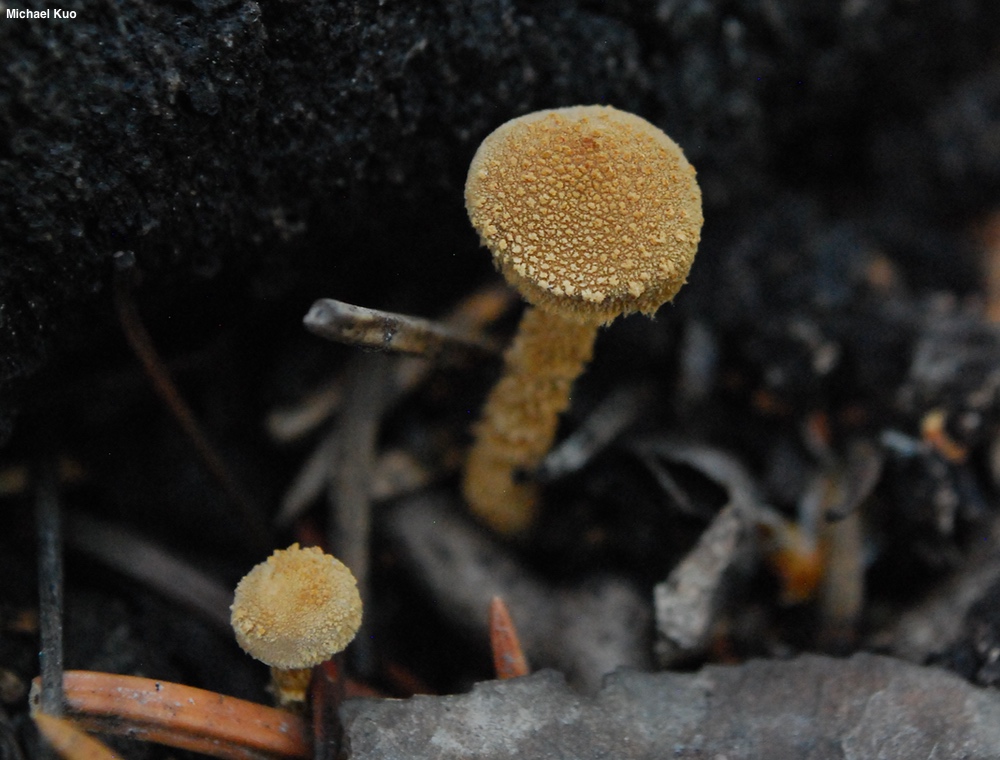
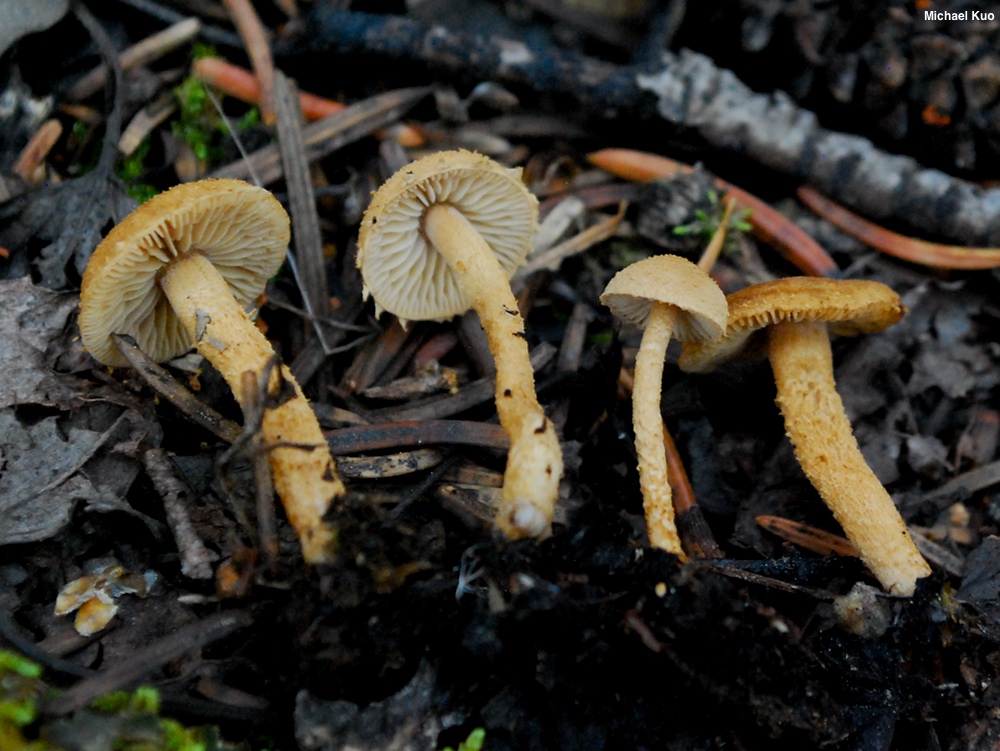
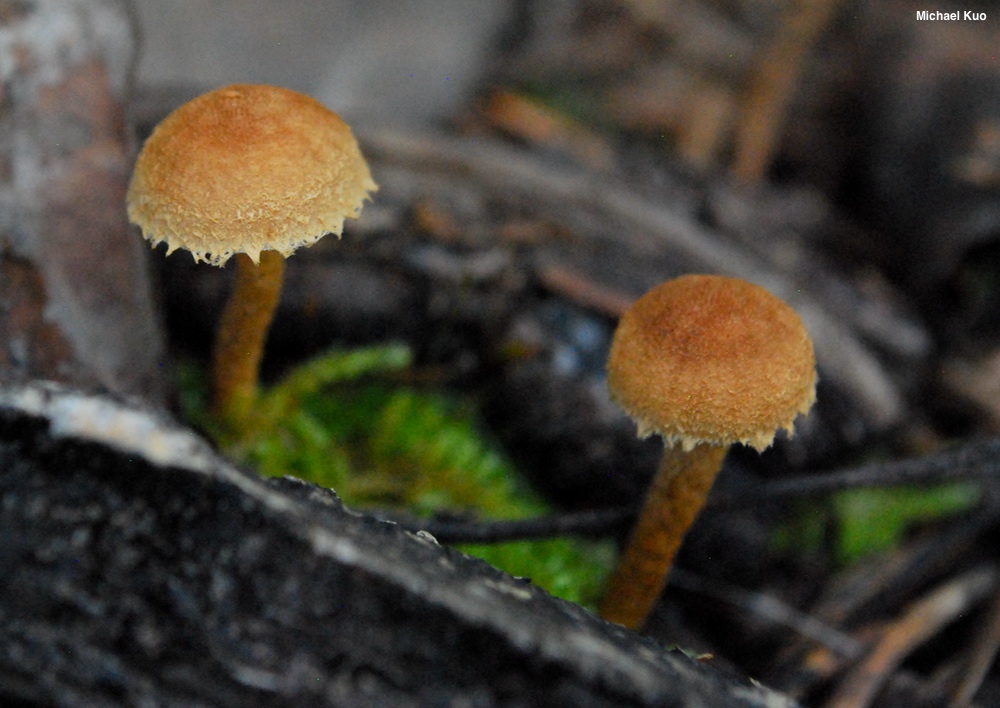
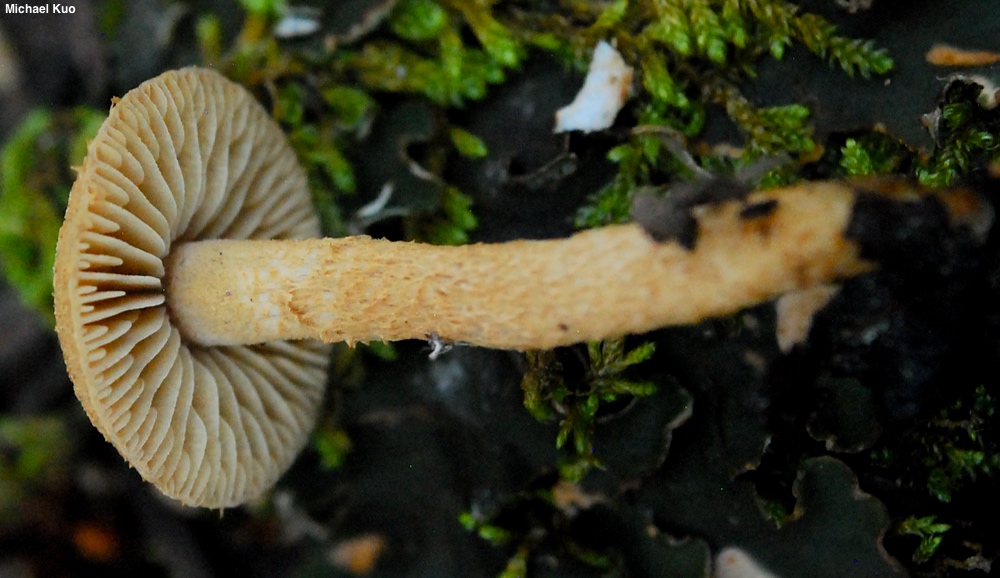
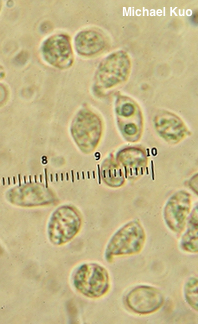
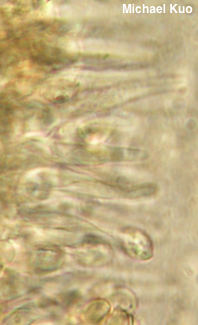
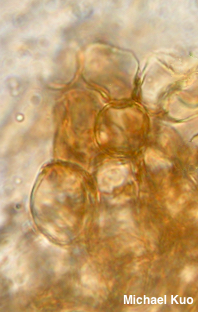
[ Basidiomycota > Agaricales > Tubariaceae > Flammulaster . . . ] Flammulaster carpophilus by Michael Kuo, 29 January, 2026 This little guy has caused an awful lot of confusion over the years. Flammulaster carpophilus is a tiny, fibrillose-scaly mushroom found in Europe and North America, usually arising from leaf litter in hardwood or mixed forests. Its cap and stem are granular- to fibrillose-scaly, and its gills are well spaced, and attached to the stem. It is similar to Flammulaster erinaceellus, but smaller and paler—and it does not grow on wood like the latter species. Flammulaster carpophilus is often mistaken for a Cystoderma since its cap and stem are granular-scaly; in fact it was treated as Cystoderma rhombosporum by North American authors until at least the late 1970s. It has also been placed in the genus Phaeomarasmius, as well as other genera. Further complicating things, several versions of Flammulaster carpophilus have been, and sometimes continue to be, treated as separate species. The version with papillate spores is sometimes treated as Flammulaster rhombosporus; a pale, pinkish version with capitate cheilocystidia is sometimes called Flammulaster subincarnata. Here I follow Vellinga (1986) and treat carpophilus as a broadly defined species encompassing the others as forms or varieties. Description: Ecology: Saprobic; growing alone or gregariously in leaf litter or conifer duff in hardwood forests or in mixed woods; spring through fall; originally described from Scandinavia (Fries 1815); fairly widespread in Europe, especially in beech forests; North American distribution uncertain, but usually reported from northern and montane regions. The illustrated and described collection is from Colorado. Cap: 5–12 mm; convex becoming broadly convex; dry; densely covered with granular to fibrillose scales; yellow-brown; the margin hung with triangular toothlike remnants of the fibrillose partial veil. Gills: Narrowly attached to the stem; nearly distant; short-gills frequent near the margin; whitish to pale yellow at first, becoming faintly brownish. Stem: 10–23 mm long; 1–4 mm mm thick; equal; smooth and yellowish at the apex, but elsewhere covered with fibrillose scales like the cap; basal mycelium white. Flesh: Yellowish to brownish; unchanging when sliced. Odor: Not distinctive. Spore Print: Not documented. Microscopic Features: Spores 8–11 x 4–6 µm; amygdaliform, or exceptionally subpapillate; smooth; hyaline in KOH; inamyloid. Basidia 25–28 x 4–6 µm; clavate; 4-sterigmate. Cheilocystidia 25–40 x 2–5 µm; fusiform to nearly aciculate; smooth; thin-walled; hyaline in KOH. Pleurocystidia not found. Pileipellis composed of chained subglobose to globose elements 6–20 µm wide, smooth or roughened, orange-brown in KOH. Clamp connections present. REFERENCES: (E. M. Fries, 1815) F. S. Earle ex E. C. Vellinga, 1986. (Singer & Smith, 1945; Smith, Smith & Weber, 1979; Vellinga, 1986; McNeil, 2006; Boccardo et al., 2008; Buczacki et al., 2012; Gmnider & Böhning, 2017; Vesterholt & Rald, 2018; Læssøe & Petersen, 2019.) Herb. Kuo 07252102. This site contains no information about the edibility or toxicity of mushrooms. |
© MushroomExpert.Com |
|
Cite this page as: Kuo, M. (2026, January). Flammulaster carpophilus. Retrieved from the MushroomExpert.Com Web site: http://www.mushroomexpert.com/flammulaster_carpophilus.html |