| Major Groups > Gilled Mushrooms > Dark-Spored > Coprinoid Mushrooms > Coprinellus flocculosus |

|
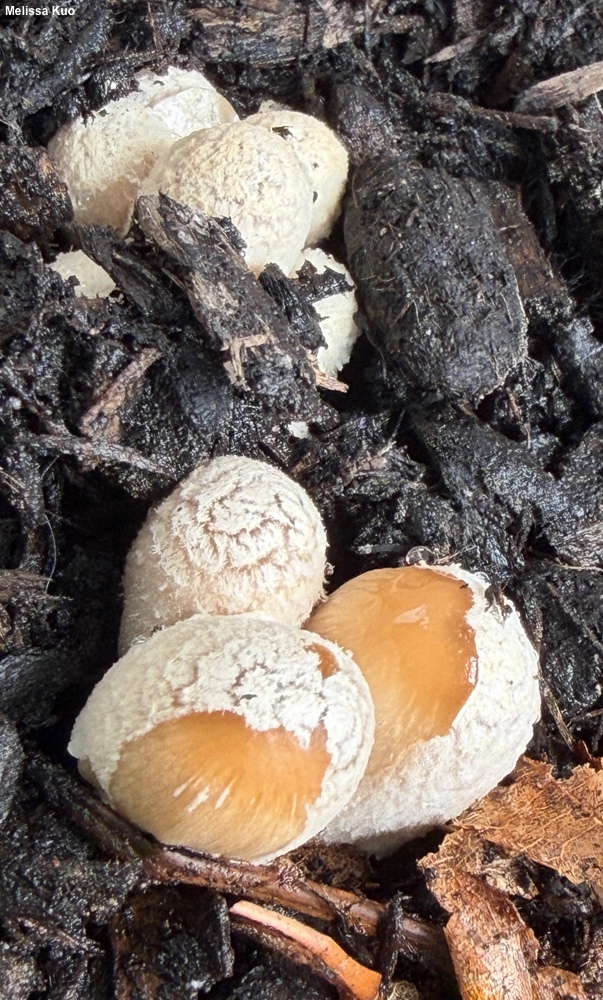
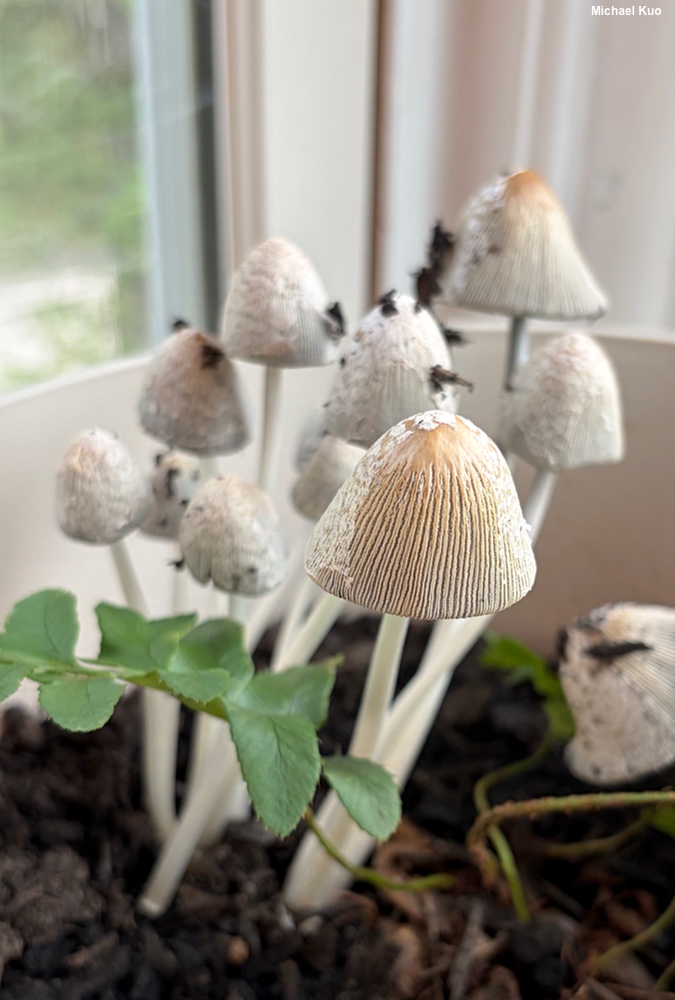
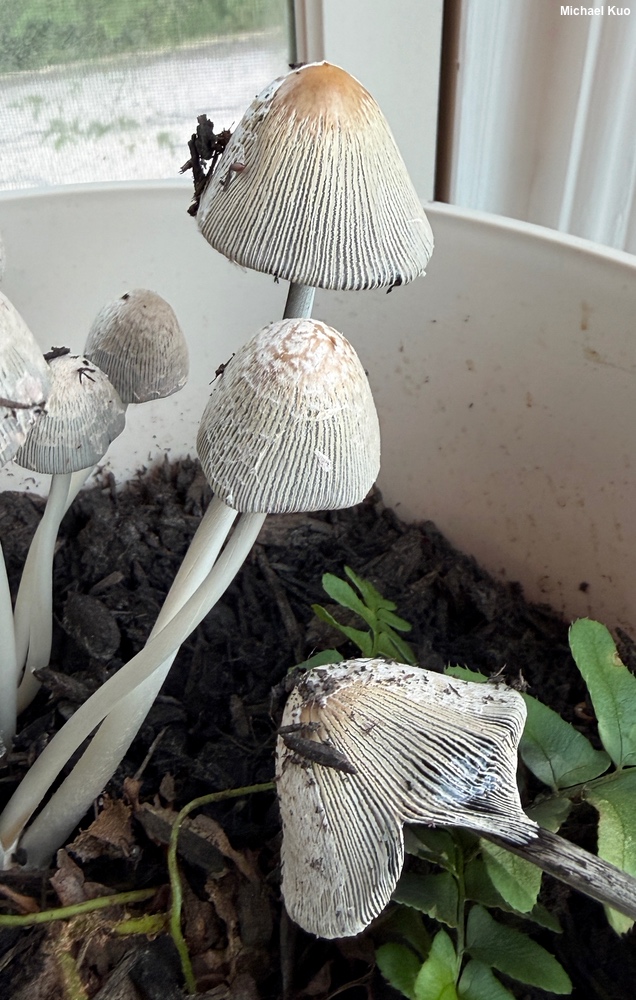
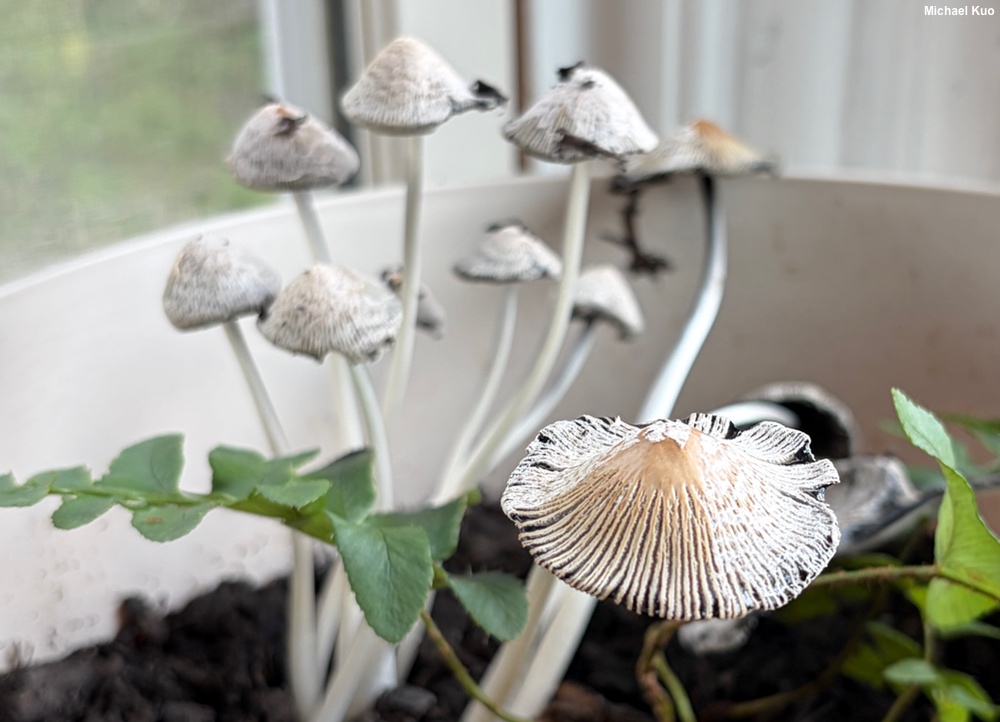
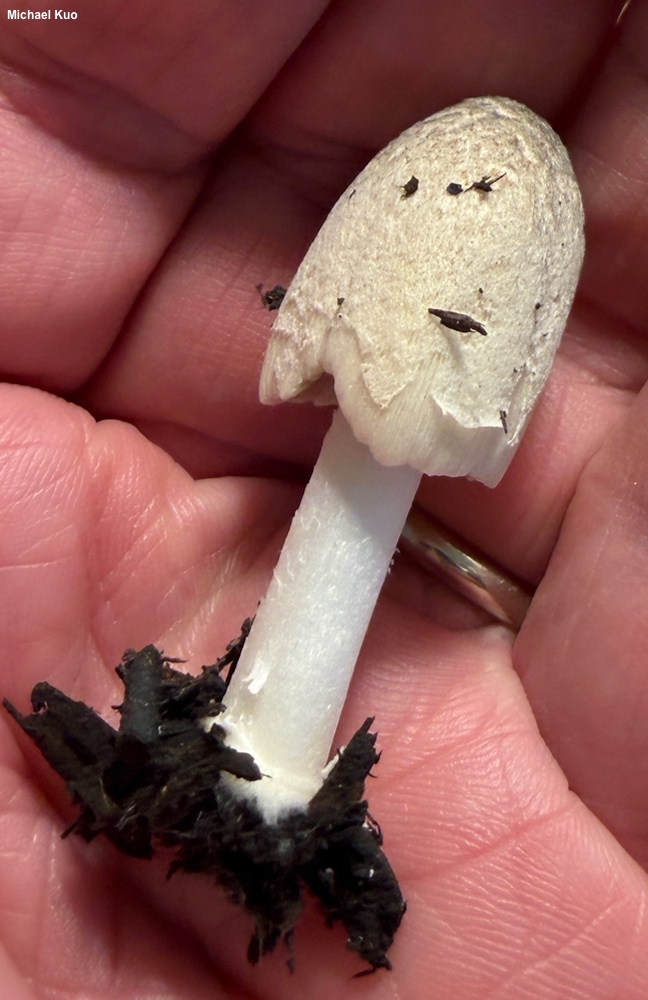
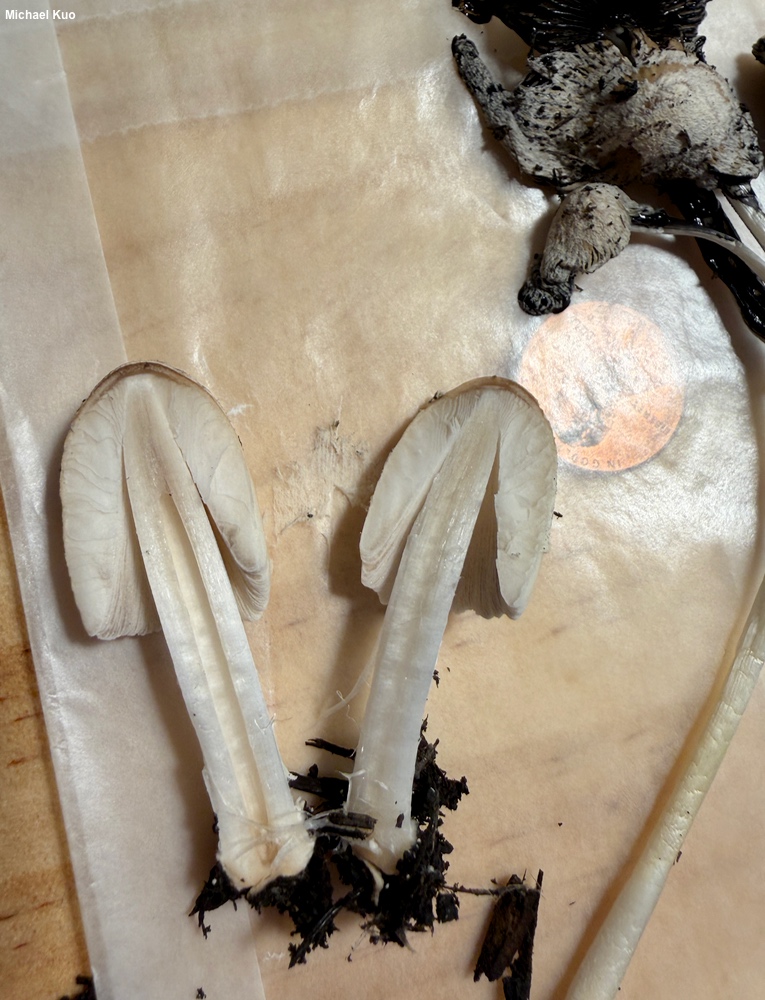
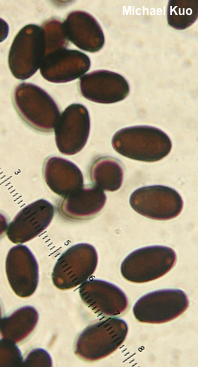
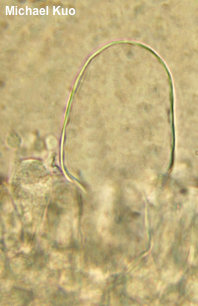
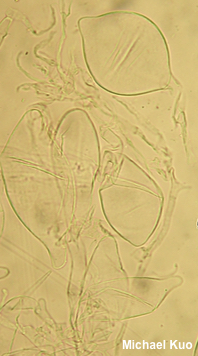
[ Basidiomycota > Agaricales > Psathyrellaceae > Coprinopsis . . . ] Coprinellus flocculosus by Michael Kuo, 1 July 2026 I call it "Agrocybe season." That time of year when there aren't many mushrooms coming up in the Midwestern woods, no matter how much rain you get. The spring mushrooms (morels, false morels, jelly fungi, and others) are long gone, and the summer explosion of charismatic mycorrhizal mushrooms (amanitas, boletes, russulas, milky caps, and so on) is weeks away. Only Agrocybe species, and a few other boring fungi, flourish at this time of year. This year it was especially bad. Plenty of rain, agrocybes everywhere . . . but nothing in the woods for weeks. And then, out of nowhere, a little magic: in a potted plant by the windows in my laboratory, coprinoid mushrooms suddenly appeared, thrusting themselves up from commercial potting mulch! The mushrooms were shaggy, medium-sized coprinoids with brownish yellow caps that soon became gray, and gills that dissolved into black goo within a few hours. But these features are shared by a host of bewilderingly similar species. In the end microscopic analysis was required (fortunately, the mushrooms appeared just a few feet from my microscopes), and the large spores with eccentric pores, along with the distinctive veil elements, matched Coprinellus flocculosus. . . . and within a few days, mushrooms started coming up in the woods; I didn't have to collect a single Agrocybe this year. Coprinus flocculosus is a synonym. Description: Ecology: Saprobic; growing alone, gregariously, or in clusters in fertilized soil, woodchips, old straw, sawdust, and so on—or in woods, especially from woody debris; spring through fall, or year-round in warm climates or indoors; originally described from France (de Candolle 1805); widespread in Europe, Oceania, and North America. The illustrated and described collection is from Ohio. Cap: 2–4 cm across; egg-shaped when young, expanding to broadly conic or bell-shaped; at first completely covered with shaggy whitish veil, then with a bald and brownish yellow surface underneath whitish veil patches, then gray to whitish, with the veil breaking up into small fragments; becoming grooved and finally splitting apart or dissolving with the gills. Gills: Attached to the stem; very crowded; short-gills frequent; white at first, becoming gray, then black; eventually liquefying. Stem: 4–13 cm long; 3–6 mm thick; more or less equal; bald; becoming hollow (without an interior "string"); white; base staining and discoloring brown; basal mycelium white. Flesh: White; not changing when sliced. Odor: Not distinctive, or, when the gills are liquefying, somewhat foul. Chemical Reactions: KOH on cap surface negative. Spore Print: Black. Microscopic Features: Spores 11–14 x 6–8 µm; ellipsoid, with a large, eccentric pore 1–2 µm across; smooth; dark reddish brown in KOH. Basidia 25–28 x 11–13 µm; clavate; 4-sterigmate; surrounded by brachybasidioles. Pleurocystidia 60–80 x 32–40 µm; utriform to ellipsoid or subsaccate; smooth; walls 1–2 µm thick; hyaline in KOH. Cheilocystidia similar to pleurocystidia. Pileipellis an epithelium. Veil elements 40–125 x 10–150 µm; cylindric to ellipsoid, subglobose, fusiform, lageniform, or irregular; smooth; hyaline in KOH. REFERENCES: (A. P. de Candolle, 1805) R. J. Vilgalys, J. S. Hopple & J. Johnson, 2001. (Orton & Watling, 1979; Breitenbach & Kränzlin, 1995; Hopple & Vilgalys, 1999; Uljé, 2003; Uljé, 2005; McNeil, 2006; Bougher, 2009; Nagy et al., 2012; Desjardin, Wood & Stevens, 2015; Siegel & Schwarz, 2016; Vesterholt, 2018; Læssøe & Petersen, 2019; Kibby, 2021.) Herb. Kuo 06292601. This site contains no information about the edibility or toxicity of mushrooms. |
© MushroomExpert.Com |
|
Cite this page as: Kuo, M. (2026, July). Coprinellus flocculosus. Retrieved from the MushroomExpert.Com Web site: http://www.mushroomexpert.com/coprinellus_flocculosus.html |