| Major Groups > Gilled Mushrooms > Dark-Spored > Psathyrella > Psathyrella candolleana |

|
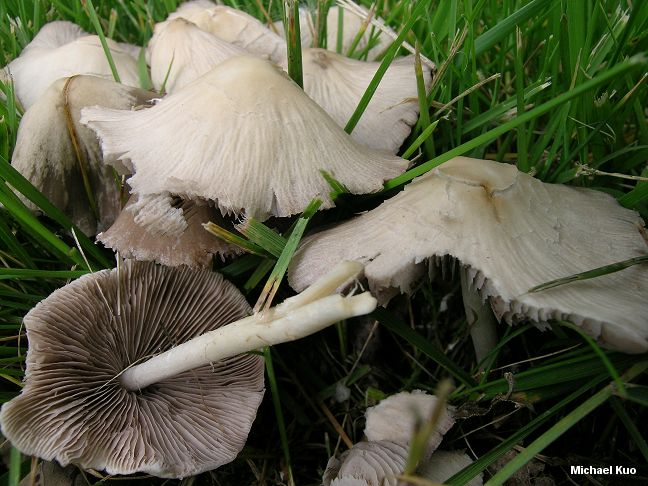
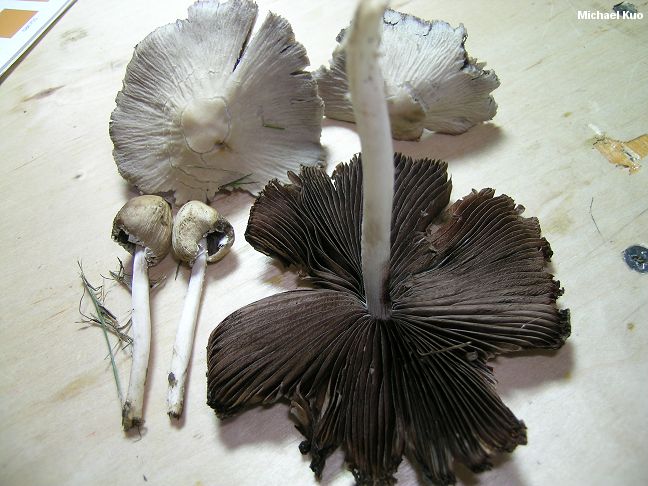
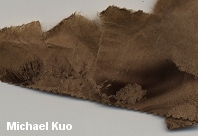
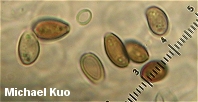
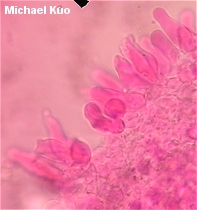
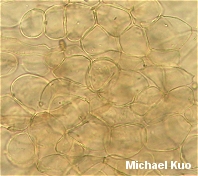
Psathyrella candolleana [ Basidiomycetes > Agaricales > Coprinaceae > Psathyrella . . . ] by Michael Kuo Widespread and common, Psathyrella candolleana is often chosen by field guide authors to represent the genus Psathyrella. The cap of this species is honey brown when young, but it soon fades to nearly white--especially when it grows in open places. The spore print is dark brown, as are the mature gills. The young caps have hanging partial veil remnants on the margins, but there is typically not a persisting ring on the stem. The stem is very fragile, and snaps easily--in fact, the whole mushroom is so fragile that you will be lucky to get it home in one piece. Psathyrella candolleana is a saprobe, usually found in the vicinity of recently dead hardwood trees--often in urban areas, but also in the woods. In a stricter, more technical sense, a microscope should probably be used to separate Psathyrella candolleana from a number of species that will more or less meet the description above. Psathyrella candolleana should have spores measuring 6.5-9.5 x 4-5 µ, along with saccate to clavate or subcylindric cheilocystidia; pleurocystidia should be absent. Psathyrella incerta has a pale yellow cap when young, and spores measuring 6-7.5 x 3.5-4 µ. Psathyrella hymenocephala has a cinnamon-colored cap when young, and spores measuring 6-9 x 3.5-5 µ. Description: Ecology: Saprobic; growing alone or gregariously in lawns, pastures, and cultivated areas--also in woods; typically near recently dead hardwood trees, their roots, stumps, and so on; usually appearing in spring and early summer, but sometimes appearing in fall (or year-round in warmer climates); widely distributed and common in North America. Cap: 3-11 cm; rounded-conical or convex when young, expanding to broadly convex, broadly bell-shaped, or nearly flat; bald; often developing shallow radial wrinkles; dry; honey yellow when young, changing color markedly to pale brownish or nearly white as it dries out; the young margin adorned with hanging partial veil remnants; mature margin often splitting radially in places. Gills: Attached to the stem or nearly free from it; whitish at first, becoming grayish and finally dark brown; close or crowded. Stem: 4-13 cm long; 3-8 mm thick; equal; fragile; white; hollowing; bald or slightly lined and/or silky; almost always lacking a ring, but sometimes with loosely clinging partial veil remnants in a ring-like zone. Flesh: Very thin; fragile; brownish to whitish. Odor and Taste: Not distinctive. Chemical Reactions: KOH on cap surface pinkish (sometimes fleetingly) to lilac gray or brownish gray. Spore Print: Dark purplish brown. Microscopic Features: Spores 6.5-9.5 x 4-5 µ; ellipsoid with a truncated end; smooth; dark brown in KOH. Pleurocystidia absent. Cheilocystidia abundant; hyaline in KOH; thin-walled; subcylindric to subutriform, clavate, subclavate, or saccate; to about 50 x 15 µ. Pileipellis hymeniform-cellular. REFERENCES: (Fries, 1818) Maire, 1913. (Smith, 1949; Smith, 1972; Smith, Smith & Weber, 1979; Arora, 1986; Phillips, 1991/2005; Hansen & Knudsen, 1992; Lincoff, 1992; Evenson, 1997; Barron, 1999; Roody, 2003; McNeil, 2006; Miller & Miller, 2006; Trudell & Ammirati, 2009.) Herb. Kuo 07020803, 05211001, 08041005. This site contains no information about the edibility or toxicity of mushrooms. |
© MushroomExpert.Com |

|
Cite this page as: Kuo, M. (2011, January). Psathyrella candolleana. Retrieved from the MushroomExpert.Com Web site: http://www.mushroomexpert.com/psathyrella_candolleana.html |