| Major Groups > Gilled Mushrooms > Pale-Spored > Mycenoid Mushrooms > Mycena luteopallens |

|
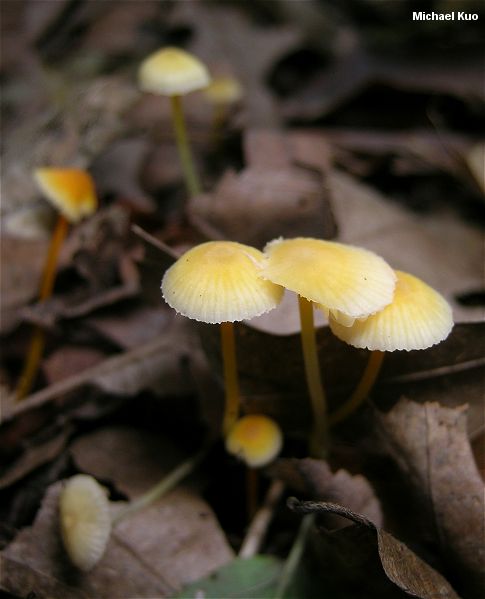
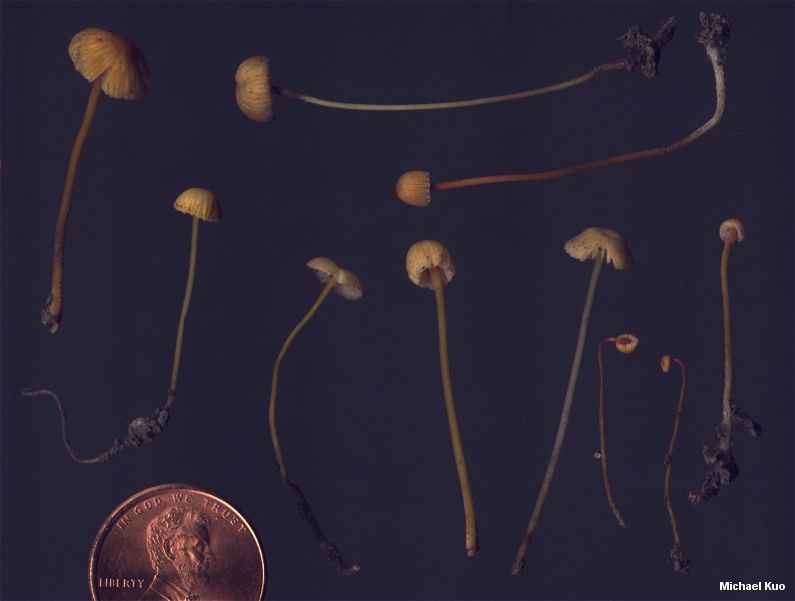
Mycena luteopallens [ Basidiomycetes > Agaricales > Tricholomataceae > Mycena . . . ] by Michael Kuo This tiny mushroom is usually found decomposing the remains of walnut or hickory shells--though the shells may be buried, or decayed beyond recognition. When young and fresh, Mycena luteopallens has a beautiful bright orange-yellow cap (representing the "luteo" in luteopallens), but the color soon fades to a dirty buff (the "pallens"). If you are not sure of the specialized habitat on walnut, hickory, or other nutty debris, definitively distinguishing Mycena luteopallens from other yellow Mycena species is a task requiring microscopic analysis (see details below). Description: Ecology: Saprobic on walnut and hickory shells, or from associated debris; occasionally found on the nut debris of other hardwoods, including black locust; typically growing gregariously in clusters of two or four but occasionally found growing alone; fall; fairly widely distributed in eastern North America. Cap: 8-15 mm across; oval, becoming broadly bell-shaped or conic; the margin sometimes becoming wavy; bald; dry; sometimes shallowly lined or grooved; rich yellow to orange yellow when young; changing color markedly as it dries out; soon whitish to buff. Gills: Attached to the stem; nearly distant; pale to yellowish or tinged pinkish. Stem: 5-9 cm long; 1-2 mm thick; equal; hollow; smooth or with tiny hairs; colored like the cap above, paler below. Flesh: Insubstantial; pallid or yellowish. Odor and Taste: Odor not distinctive; taste mild. Spore Print: White. Microscopic Features: Spores 7-9 x 4-5.5 µ; elliptical; smooth; weakly to moderately amyloid when young; inamyloid when mature. Pleurocystidia and cheilocystidia abundant; fusoid-ventricose; up to 80 µ long. REFERENCES: Peck, 1887. (Saccardo, 1891; Smith, 1947; Phillips, 1991/2005; Lincoff, 1992; Horn, Kay & Abel, 1993; Barron, 1999.) Herb. Kuo 08270202, 10290702. This site contains no information about the edibility or toxicity of mushrooms. |
© MushroomExpert.Com |



|
Cite this page as: Kuo, M. (2010, December). Mycena luteopallens. Retrieved from the MushroomExpert.Com Web site: http://www.mushroomexpert.com/mycena_luteopallens.html |