| Major Groups > True Morels & Verpas > Morchella angusticeps |

|
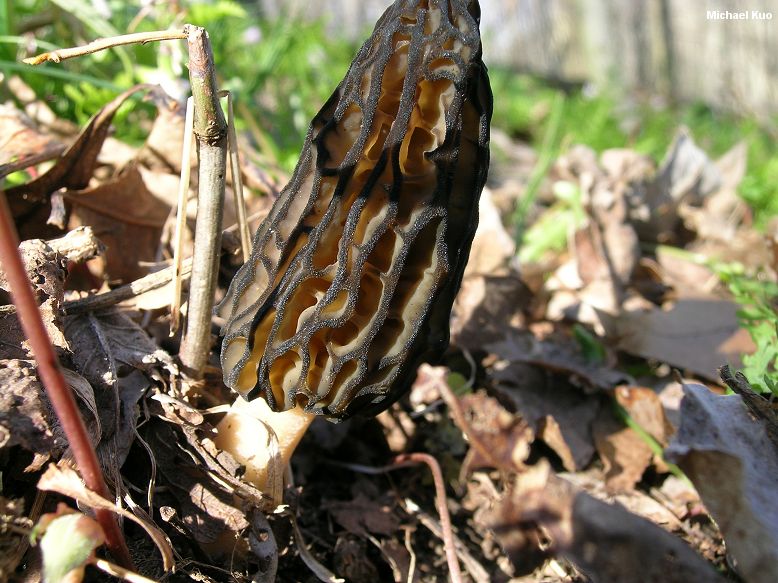
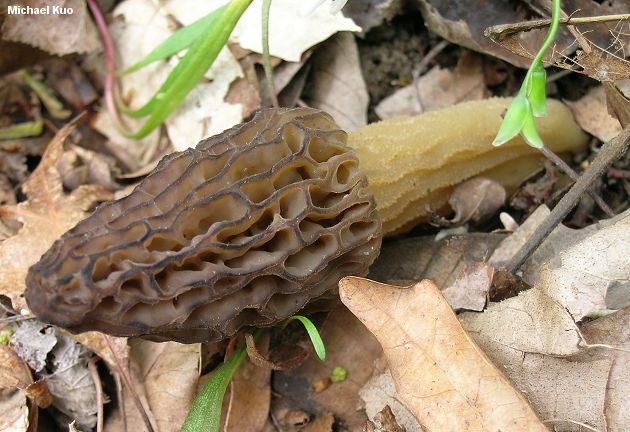
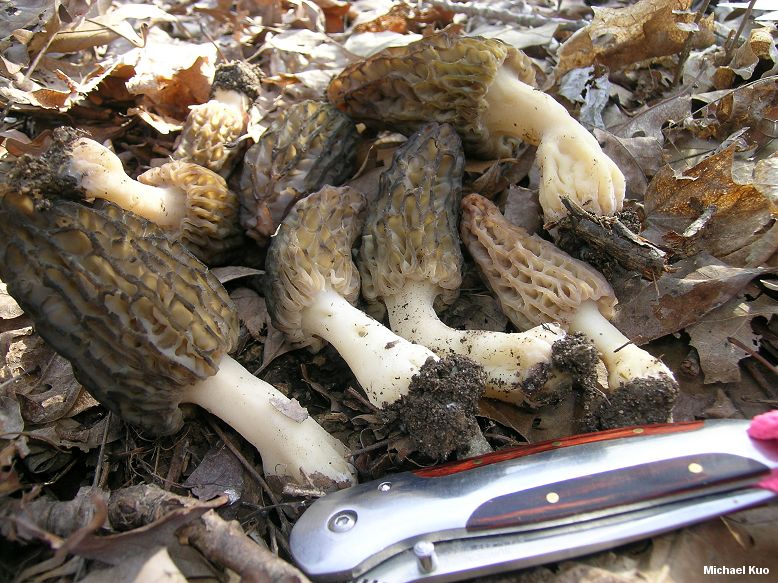
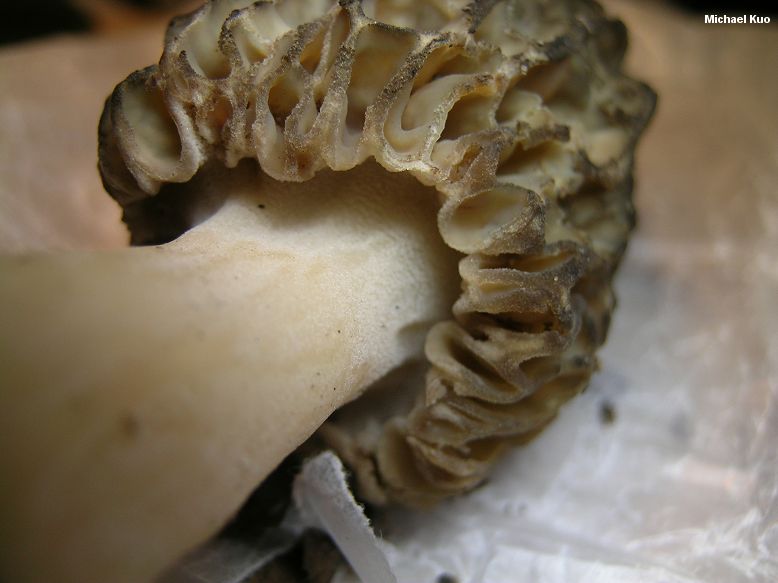
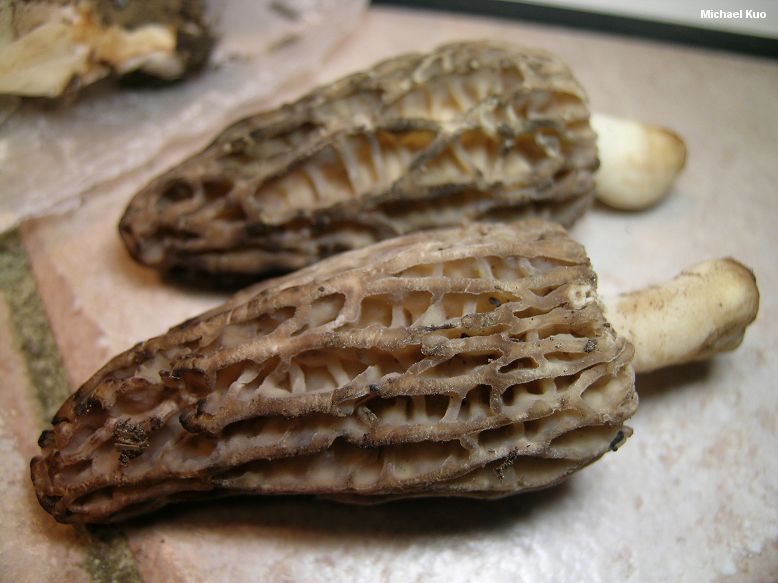
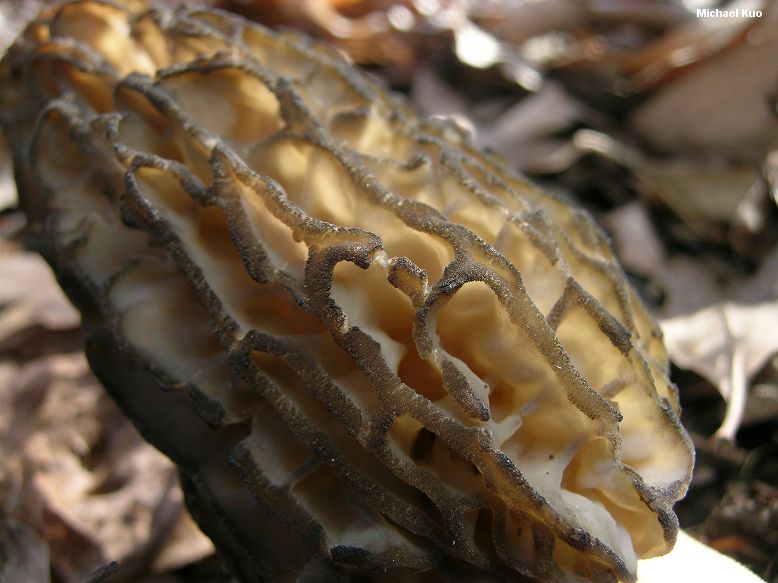
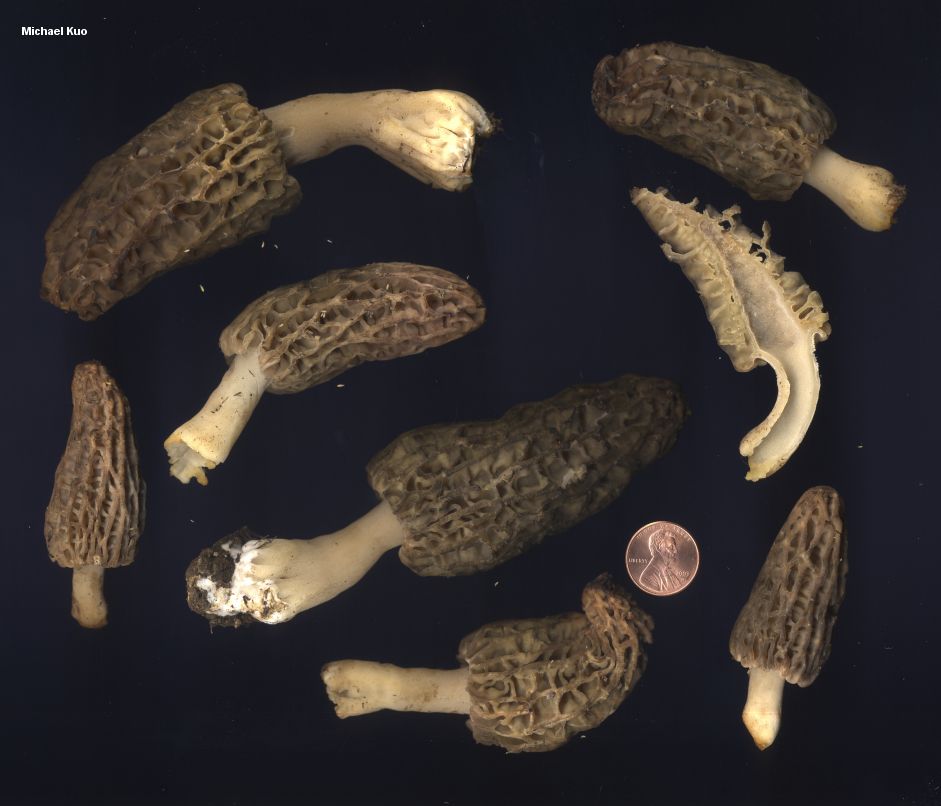
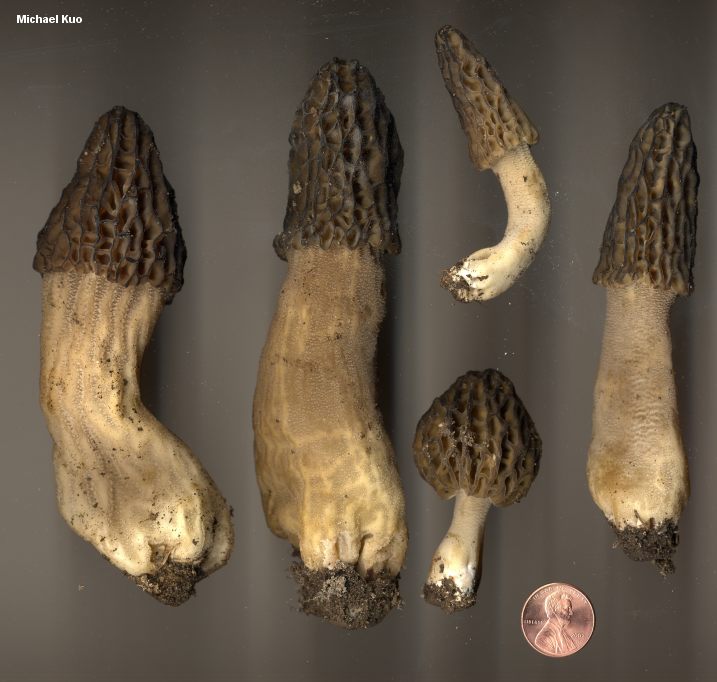
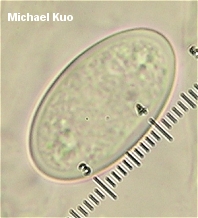
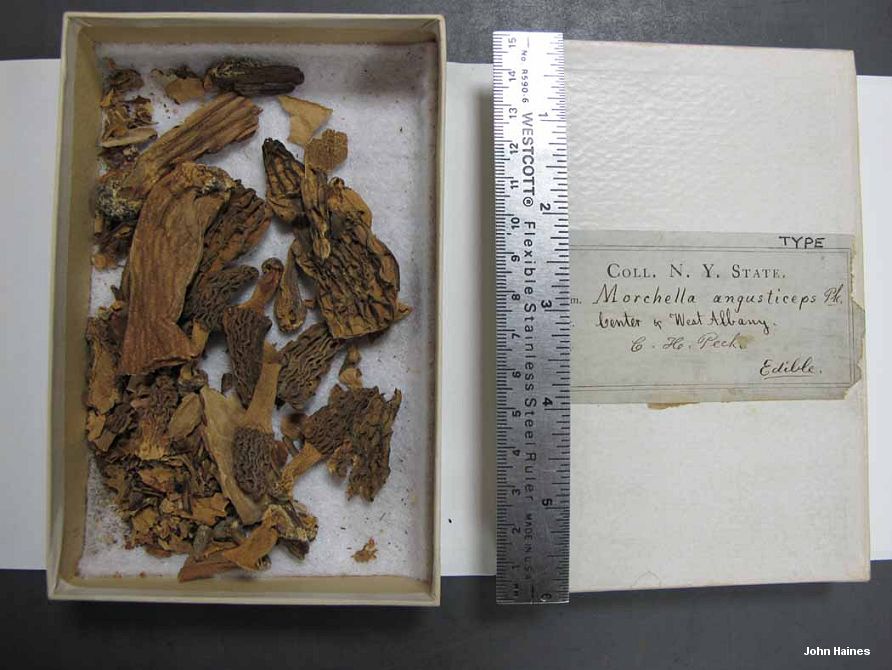
Morchella angusticeps [ Ascomycetes > Pezizales > Morchellaceae > Morchella . . . ] by Michael Kuo This is the classic, widespread, black morel of eastern North America. Like other black morels, it has ridges that darken with maturity, pits and ridges that are primarily vertically oriented, and a cap that is attached to the stem with a small but noticeable groove--kind of like a little raceway for ants (see the fourth illustration). Morchella angusticeps is widely distributed east of the Rocky Mountains. Throughout most of its range, it is the only occurring black morel and is thus easily identified. Only in the northern part of its range is there a look-alike species; north of roughly the 44th parallel Morchella angusticeps should be compared with Morchella septentrionalis, which is somewhat smaller, has smaller spores, and often grows near or from rotting wood. Description: Ecology: Possibly saprobic and mycorrhizal at different points in its life cycle; growing alone, scattered, or gregariously under hardwoods, including white ash, green ash, and tulip tree; March through May; widely distributed east of the Rocky Mountains. Cap: 3-8 cm tall and 2-5 cm wide; usually conical or bluntly conical, with a sharp or bluntly rounded apex--but occasionally egg-shaped; pitted and ridged, with the pits primarily arranged vertically; when young with nearly bald or finely velvety, flattened, tan to brown ridges and dull brownish yellow pits; when mature with flattened to sharpened or eroded, dark brown to black ridges and brownish to yellowish (or occasionally olive) pits; attached to the stem with a small groove (2-5 mm deep); hollow. Stem: 2-8 cm high and 1-3 cm wide; equal, or with a slightly swollen base; whitish to pale brownish; finely mealy with granules, or nearly bald; sometimes developing folds and channels, especially near the base; in warm, wet conditions sometimes becoming prominently ridged and/or swollen to reach the width of the cap; hollow. Microscopic Features: Spores 22-27 x 11-15 µ; smooth; long-elliptical; without oil droplets; contents homogeneous. Asci 8-spored. Paraphyses cylindric with variable apices; septate; hyaline in KOH. Elements on sterile ridges 100-200 x 7.5-35 µ; septate; hyaline to brownish or brown in KOH; terminal cell cylindric, clavate, subcapitate, or occasionally irregular. REFERENCES: C. H. Peck, 1887. (Kuo, 2005; O'Donnell et al., 2011; Kuo et al., 2012.) SPECIMENS EXAMINED: Herb. NYS 268 (holotype). Herb. F. 04089501, 04189502, 05249501, 04010301, 04040301, 04110301, 04120301, 04150301, 04170301, 04220303, 04220304, 04220305, 04220307, 04240303, 04270302, 05010306, 05080303, 05110302, 05120302, 04020401, 04040401, 04160404, 04250403, 04270502, 04020602 , 04090601 (epitype). Study of the Holotype Morchella angusticeps Peck, 1879: Annual Report of the New York State Museum 32: 44-45. Original description (Peck 1879): "Pileus oblong-conical and subobtuse or narrowly conical and acute, adnate to the stem, one or two inches high, and about half as broad at the base; ribs longitudinal, here and there anastamosing or connected by transverse veins; stem subequal, hollow, whitish, furfuraceous without and within, even or rarely rough with irregular longitudinal furrows; asci cylindrical; ascospores elliptical, whitish tinged with ochre, .0008'-.001' long, .0005'-.0007' broad; paraphyses short, clavate, with one or two septa near the base. Sandy soil in the borders of woods and in open places. West Albany and Center. April and May. Two forms occur, one with the pileus oblong-conical, rather obtuse, often tipped with a slight umbo or papilla, and with a diameter a little surpassing that of the stem from which the base is separated by a slight groove; the other with the pileus narrowly conical, rather acute, scarcely exceeding the stem in diameter, and without any separating groove. The stem and fruit are alike in both forms. The stem is usually about equal in length to the pileus. The species is related to M. conica and M. elata, but may be separated from both by the size of the ascospores and the character of the paraphyses. In our plant I have never seen these as long as the asci. Large forms appear also to approach M. rimosipes, but that species has the margin of the pileus more free, the stem proportionately longer, and the paraphyses as long as the asci, if we may rely upon the figure of it. Our plant is edible." The holotype of Morchella angusticeps is held in the Mycological Collections Herbarium of the New York State Museum (NYS). A small portion was made available to O'Donnell et al. (2011) for molecular study, but after the specimens were returned the herbarium lost funding and staff. A moratorium was placed on loans, and the holotype could not be fully studied for morphological data. Through the kind efforts of Dr. John Haines we were able to provide the microscopic data presented here, as well as provide a preliminary assessment of the collection. The collection consists of many ascomata of various sizes that appear to the naked eye to be well preserved, in two boxes--one of which contains five individually packaged and numbered ascomata, the other of which contains approximately 13-18 ascomata, many of which are fragmented. The former box was segregated by L. R. Batra with the notation that the subdivided specimens represent "M. canaliculata ined. lectotype." We were unable to locate a corresponding publication among Batra's works. Reference is made to "M. canaliculata" in a field guide by McKnight & McKnight (1987), who say it can be separated from M. angusticeps "only by using microscopic characters." However, McKnight and McKnight do not specify what microscopic characters should be examined, and they provide no references for their use of the epithet canaliculata. For the present work the collection of microscopic data from the holotype of M. angusticeps was inhibited by the fact that asci, paraphyses, and elements on sterile ridges were conglomerated and indistinguishable in 2% KOH squash mounts; Dr. Haines suspects that the collection may have been treated with a preservative or pesticide that has rendered the micromorphology unfit for assessment, although he was able to separate a few ascospores for measurement. Data from study of the holotype. Dried ascomata approximately 32-100 mm high. Hymenophore 18-52 mm high x 5-23 mm wide, with 12-22 primary vertical ridges and occasional shorter, secondary vertical ridges, with occasional or frequent sunken, transecting horizontal ridges; attached to the stipe with a sinus 1-2 mm deep, or in larger specimens attached without a notable sinus. Ridges glabrous; flattened, or in more mature specimens becoming somewhat sharpened or eroded. Pits nearly glabrous. Stipe 14-57 x 3-17 mm; punctate with granules; in older specimens sometimes ridged in places. Ascospores 19.5-25 x 13.5-15 µ; elliptical; smooth; contents homogeneous. Asci not measurable. Paraphyses not distinguishable. Elements on sterile ridges not distinguishable. DNA was successfully extracted from one ascoma in the holotype following the methods of O'Donnell et al. (2011), but informative sequences could not be generated. Discussion. Potential problems arise from the fact that data from O'Donnell et al. (2011) indicate there may be two phylogenetic species of elata-like morels in the Albany area, either of which could plausibly match at least some of the ascomata described and preserved by Peck. One of these species (M. septentrionalis) is somewhat smaller, has smaller ascospores, and has a limited northern distribution (from about the 44th parallel northward) in eastern North America; we have cited one collection of this species (05060602) from Clinton, also in upstate New York. The specimens in the holotype collection of M. angusticeps vary in size from small to large, and several of the ascomata qualify for the dimensions of M. septentrionalis. The ascospores measured by Dr. Haines overlap the size ranges for both phylogenetic species, and the two reported type localities for M. angusticeps (Center, which is now known as Colonie, and West Albany, which are approximately four miles apart) fall within the distribution range for both phylogenetic species. We have retained Peck's M. angusticeps as the name for the larger, more widely distributed eastern North American phylogenetic species and we have selected a robust, contemporary collection as representative of our concept of the phylogenetic species we are labeling M. angusticeps. However, further, more rigorous study of the holotype of M. angusticeps is clearly in order. Additionally, while Batra's concept of "M. canaliculata" was apparently never published, his reasoning and intent should be determined if at all possible, perhaps through his notes or those of McKnight. (Adapted from Kuo and collaborators, 2012.) This site contains no information about the edibility or toxicity of mushrooms. |
© MushroomExpert.Com |
|
Cite this page as: Kuo, M. (2012, November). Morchella angusticeps. Retrieved from the MushroomExpert.Com Web site: http://www.mushroomexpert.com/morchella_angusticeps.html. |