| Major Groups > Gilled Mushrooms > Pale-Spored > Marasmioid > Marasmius oreades |

|
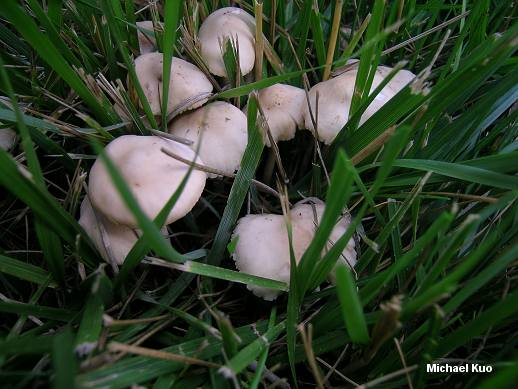
Marasmius oreades [ Basidiomycetes > Agaricales > Marasmiaceae > Marasmius . . . ] by Michael Kuo This mushroom is often called the "fairy ring mushroom," since it frequently fruits in rings on lawns, in meadows, and in other grassy places. Many other mushrooms create fairy rings, however, and if the e-mails I often receive are any indication, the use of the common name "fairy ring mushroom" for Marasmius oreades leads to substantial confusion, causing Chlorophyllum molybdites, Agaricus campestris, and other mushrooms to be mislabeled. Besides, the ring created by Marasmius oreades is often indistinct, and can't always serve as a way to identify the mushroom. It is best recognized with a combination of features:
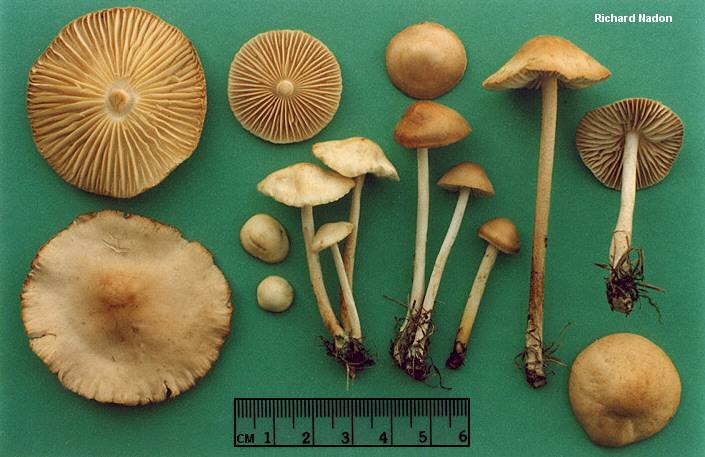
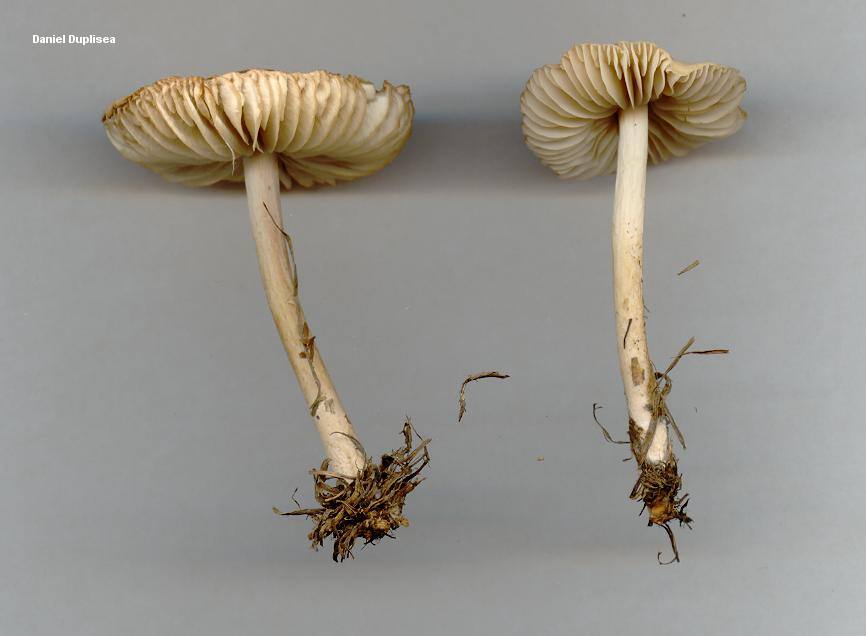
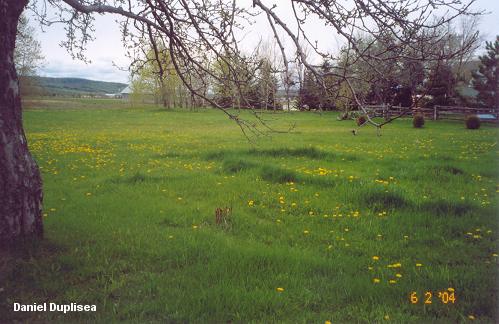
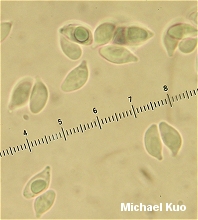
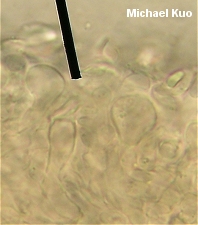
Description: Ecology: Saprobic on grass in lawns, meadows, and other grassy areas; frequently growing among coastal grasses in dunes; growing gregariously in troops, arcs, or rings; summer and fall--or year-round in warmer climates; widely distributed in North America. Cap: 1-5 cm across; bell-shaped with a somewhat inrolled margin at first, becoming broadly convex with an even or uplifted margin, but often retaining a slight central bump; dry; bald; pale tan or buff--occasionally white, or reddish tan; usually changing color markedly as it dries out; the margin sometimes faintly lined. Gills: Attached to the stem or free from it; nearly distant; white or pale tan. Stem: 2-8 cm long; 1.5-6 mm thick; equal; dry; tough and pliant; whitish or colored like the cap. Flesh: Tough; whitish. Odor and Taste: Not distinctive. Spore Print: White. Microscopic Features: Spores 7-10 x 4-6 µ; smooth; fusoid-ellipsoid; inamyloid. Cystidia absent. Pileipellis hymeniform; terminal elements clavate, pyriform, cylindric or somewhat irregular, hyaline to yellowish. REFERENCES: (Bolton, 1792) Fries, 1836. (Fries, 1821; Saccardo, 1887; Kauffman, 1918; Smith, 1975; Gilliam, 1976; Smith, Smith & Weber, 1979; Weber & Smith, 1985; Arora, 1986; Phillips, 1991/2005; Lincoff, 1992; Horn, Kay & Abel, 1993; Evenson, 1997; Barron, 1999; Roody, 2003; McNeil, 2006; Miller & Miller, 2006; Kuo, 2007; Trudell & Ammirati, 2009.) Herb. Kuo 08170309, 08080501. This site contains no information about the edibility or toxicity of mushrooms. |
© MushroomExpert.Com |

|
Cite this page as: Kuo, M. (2013, January). Marasmius oreades. Retrieved from the MushroomExpert.Com Web site: http://www.mushroomexpert.com/marasmius_oreades.html |