| Major Groups > Gilled Mushrooms > Dark-Spored > Hebeloma > Hebeloma crustuliniforme |

|
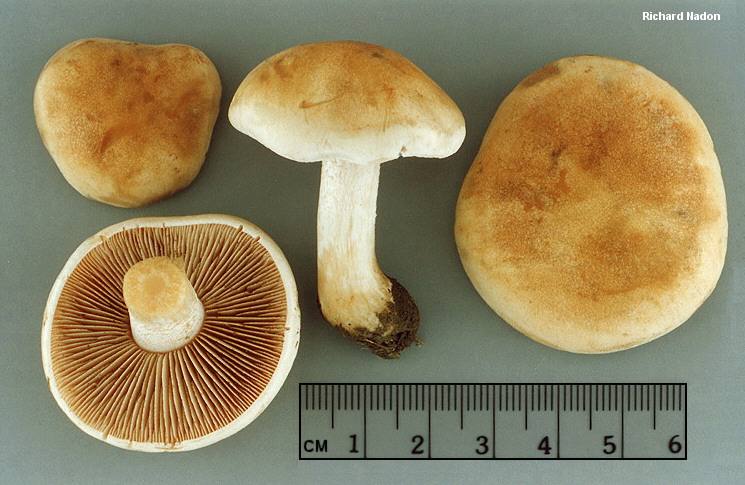
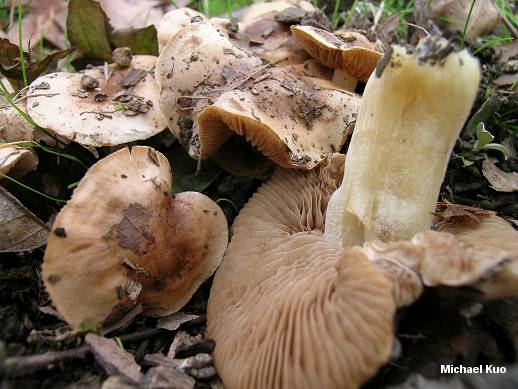
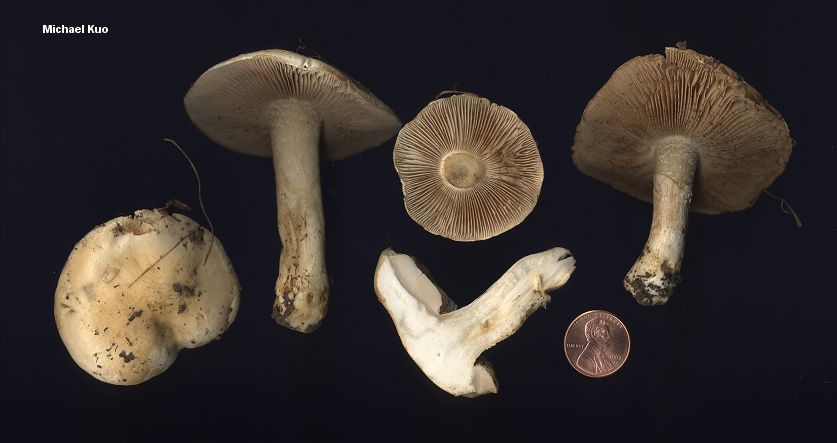
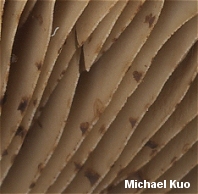
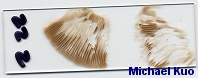
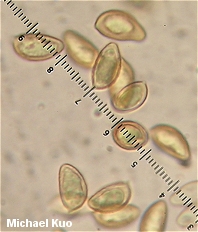
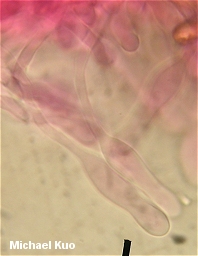
Hebeloma crustuliniforme [ Basidiomycetes > Agaricales > Bolbitiaceae > Hebeloma . . . ] by Michael Kuo In the wide sense, "Hebeloma crustuliniforme" is a mycorrhizal associate of both hardwoods and conifers, recognized by its drab, slimy cap and its radishlike odor. It has gills that are attached to the stem (usually by a "notch") and a brown spore print. The stem does not develop the scales that typify Hebeloma sinapizans, but the apex of the stem is often adorned with little flakes of tissue. There is no cortina, even in the button stage. However, this description matches a number of Hebeloma species that have been separated on the basis of fine distinctions in some of the macroscopic features (for example an indistinct, rather than radishlike, odor) and on microscopic details. Recent DNA research has shown that a few of these species are probably not genetically valid, and has demonstrated that ecological factors may help us to separate some of the remaining species in the cluster with greater confidence; see the comments below for more information. Description: Ecology: Mycorrhizal with hardwoods or conifers; growing gregariously or in loose clusters, sometimes in arcs or fairy rings, in grassy areas at woods' edges or in woods; late summer and fall (winter and spring in California); widely distributed in North America. Cap: 3-11 cm; convex, becoming broadly convex, broadly bell-shaped, or flat; slimy when fresh; smooth; whitish, dirty buff, or pale tan--often with a somewhat darker central area; the margin inrolled when young. Gills: Attached to the stem, often by a notch; crowded; pale when young, becoming brownish; sometimes with beads of liquid when young and fresh--and, later, with brownish spots where the beads occurred; with whitish edges. Stem: 4-13 cm long; 0.5-1.5 cm thick; more or less equal above a slightly swollen base; finely hairy or smooth; with little flakes of tissue near the apex; without a cortina or ring zone; the base sometimes with white rhizomorphs. Flesh: Whitish; thick. Odor and Taste: Odor radishlike; taste radishlike or bitter. Spore Print: Brown. Microscopic Features: Spores 9-13 x 5-7.5 µ; amygdaliform to limoniform; finely verrucose; not dextrinoid. Cheilocystidia abundant; apices subclavate to clavate; rarely basally inflated; 50-95 x 7-9 µ. Pileipellis an ixocutis. REFERENCES: (Bulliard, 1787) Quélet, 1872. (Saccardo, 1887; Kauffman, 1918; Smith, 1975; Smith, Smith & Weber, 1979; Arora, 1986; States, 1990; Phillips, 1991/2005; Lincoff, 1992; Barron, 1999; Roody, 2003; Vesterholt, 2005; McNeil, 2006; Miller & Miller, 2006.) Herb. Kuo 11220402, 11230403. Among the species traditionally separated in the Hebeloma crustuliniforme complex are Hebeloma hiemale, Hebeloma helodes, Hebeloma sacchariolens, and Hebeloma pusillum. However, a study by D. K. Aanen and others (2000) found that some of these morphologically defined species were not clearly differentiated genetically. Specimens identified as Hebeloma helodes and Hebeloma pusillum, for example, did not necessarily line up with other putatively identical specimens. The researchers were able to define two well supported groups, however--one corresponding to mushrooms that are mycorrhizal with willows and poplars, and another corresponding to mushrooms that are less picky about mycorrhizal partners. Given the wide distribution and diverse mycorrhizal hosts of North American versions of "Hebeloma crustuliniforme," it seems likely that we have several species waiting to be studied in a contemporary setting. Further Online Information: Hebeloma crustuliniforme at MykoWeb |
© MushroomExpert.Com |
|
Cite this page as: Kuo, M. (2012, March). Hebeloma crustuliniforme. Retrieved from the MushroomExpert.Com Web site: http://www.mushroomexpert.com/hebeloma_crustuliniforme.html |