| Major Groups > Gilled Mushrooms > Dark-Spored > Cortinarius > Cortinarius trivialis |

|
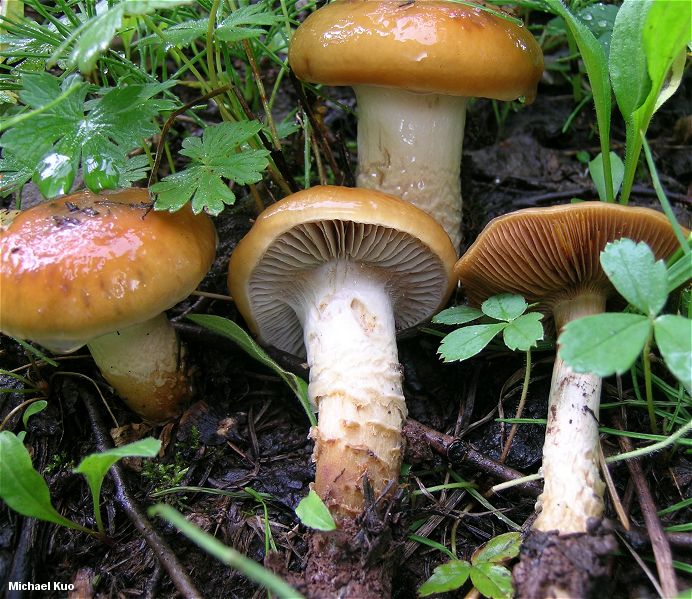
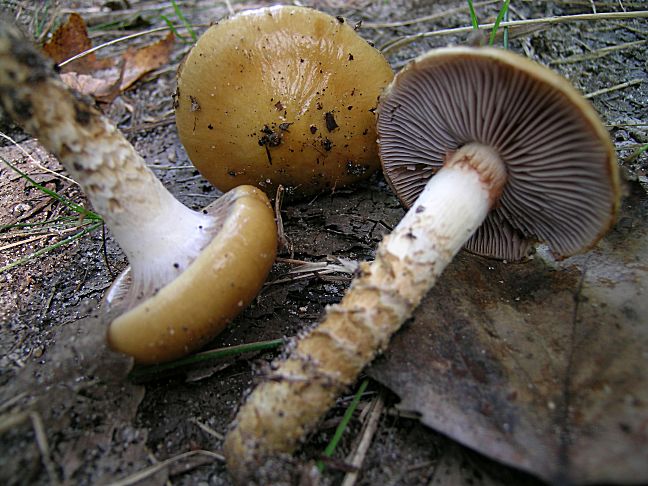
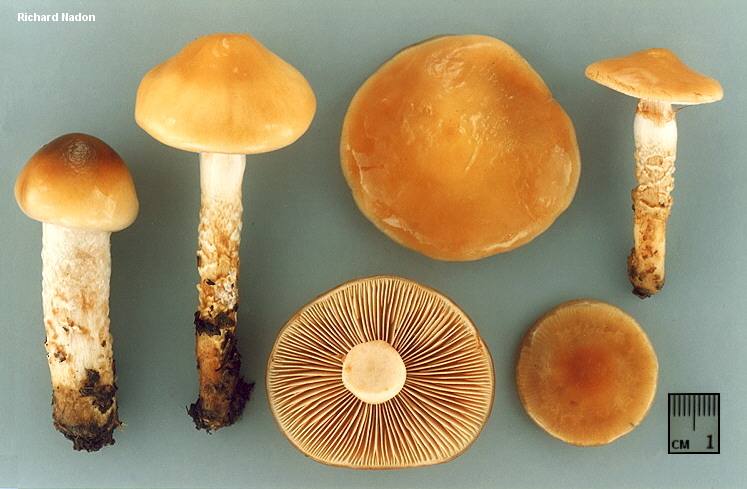
Cortinarius trivialis [Basidiomycetes > Agaricales > Cortinariaceae > Cortinarius ... ] by Michael Kuo The most widely distributed North American version of this slimy European Cortinarius is primarily associated with aspen, probably throughout the range of the tree (see the map on the linked page). It has a thick, gooey slime veil, and a long, tapering stem that is sheathed in slimy whitish shagginess that begins to break up into concentric "belts" as the mushroom matures. Under the microscope it features large, flask-shaped spores, as well as clamp connections. At least one other version of the species occurs in North America, however, under coast live oak in California. It is a bit more orange, and its young gills are more strongly lilac to clay colored. Whether or not any of our continent's Cortinarius trivialis versions is the same as the original European species (which, by the way, is now regarded as "a collective species" [Knudsen & Vesterholt, 2008]) is a matter for Cortinariologists. Some mycologists--notably Alexander Smith, for North American readers--consider Cortinarius trivialis to be a variety of Cortinarius collinitus that lacks purple shades in the slime veil. Description: Ecology: Mycorrhizal with quaking aspen and other hardwoods; growing scattered or gregariously; summer and fall (or over winter in coastal California); northern and western North America. Cap: 3-11 cm; bell-shaped or convex, becoming broadly bell-shaped; thickly slimy; bald; orangish brown to yellowish brown. Gills: Attached to the stem; close; pale clay or faintly lilac colored at first, becoming brownish or rusty brown. Stem: 5-12 cm long; 1-2 cm thick; equal or tapering a little to the base; covered with clear or whitish slime when fresh; shaggy and "belted" or obscurely zoned with whitish to brownish scales, especially over the lower half; whitish above, orange-brown to brownish below; sometimes with a rusty ring zone. Flesh: White, or brownish in base of stem; sometimes bruising brownish. Odor and Taste: Not distinctive. Chemical Reactions: KOH negative to slightly grayish on cap surface. Spore Print: Rusty brown. Microscopic Features: Spores 10-15 x 5-8 µ; amygdaliform or subellipsoid; moderately to weakly verrucose. Pleurocystidia absent. Cheilocystidia basidiole-like. Marginal cells present. Pileipellis an ixocutis with conspicuously clamped elements. REFERENCES: J. E. Lange, 1940. (Moser, 1983; Phillips, 1991/2005; Hansen & Knudsen, 1992; Breitenbach & Kränzlin, 2000; McNeil, 2006; Miller & Miller, 2006.) Herb. Kuo 09110506, 01160602, 01121107. This site contains no information about the edibility or toxicity of mushrooms. |
© MushroomExpert.Com |


|
Cite this page as: Kuo, M. (2011, December). Cortinarius trivialis. Retrieved from the MushroomExpert.Com Web site: http://www.mushroomexpert.com/cortinarius_trivialis.html |