| Major Groups > Boletes > Boletellus > Boletellus pseudochrysenteroides |

|
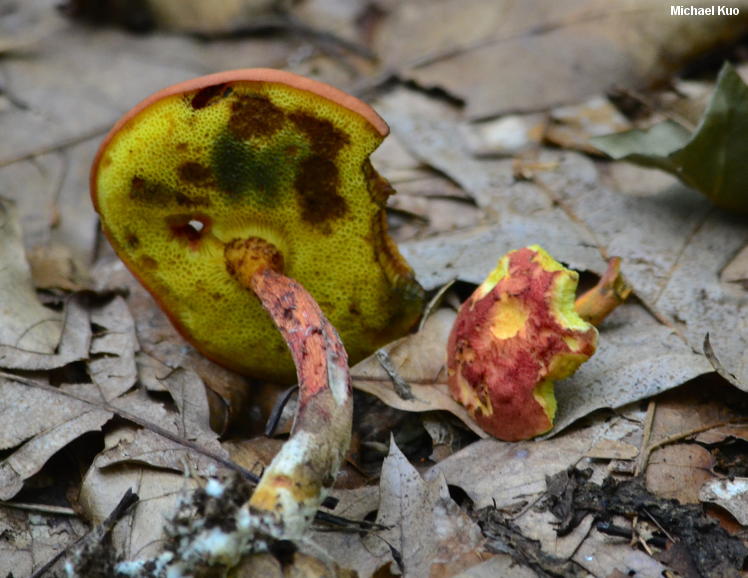
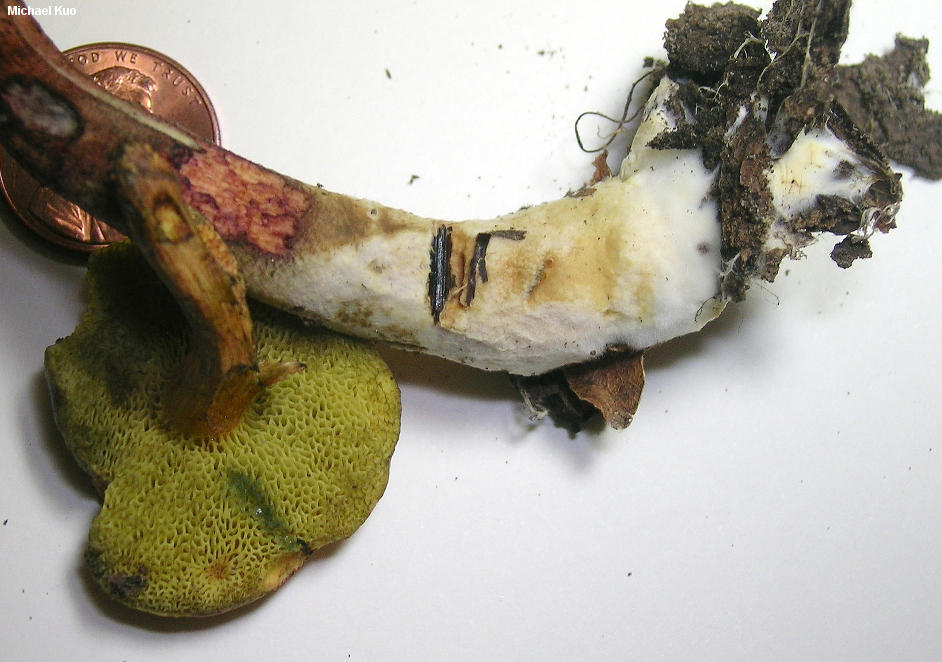
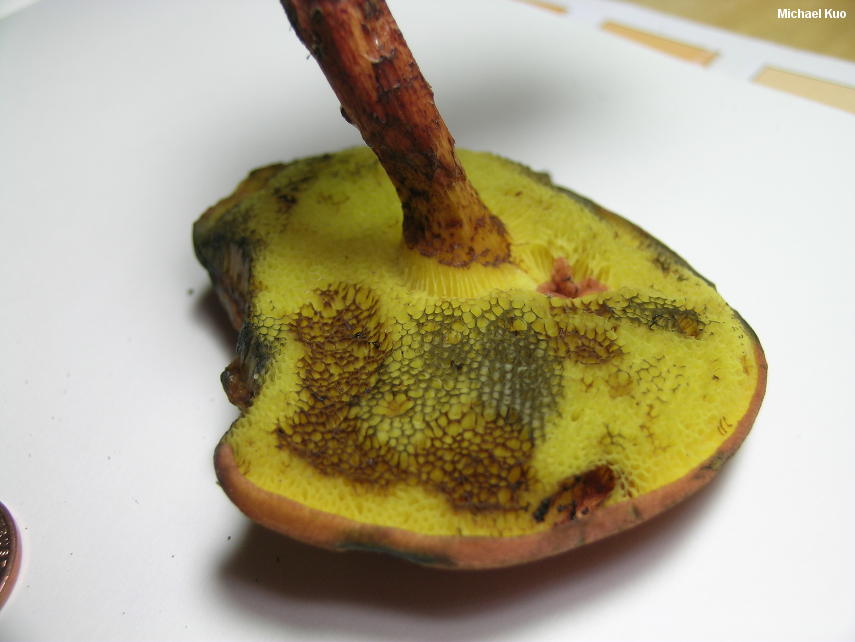
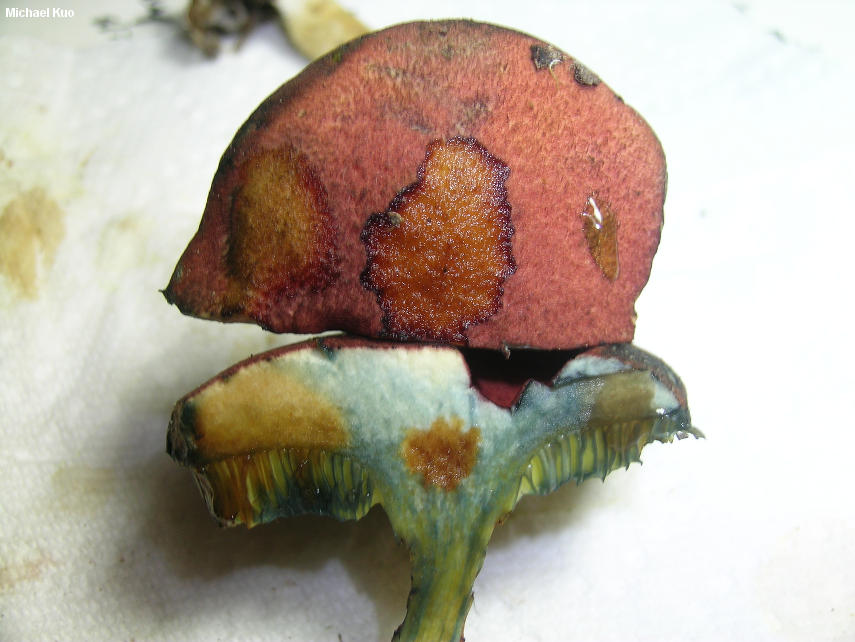
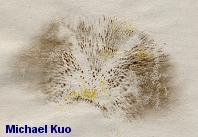
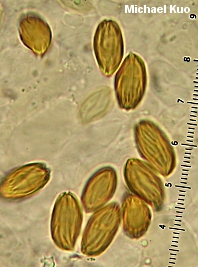
Boletellus pseudochrysenteroides [ Basidiomycetes > Boletales > Boletaceae > Boletellus . . . ] by Michael Kuo This rarely collected species demonstrates striking color contrasts when sliced open: the flesh is dark red in the stem and pale yellow in the cap, where it discolors indigo blue. The distinctive cap is brick red and soon prominently cracked up, with whitish to pinkish flesh revealed in the cracks. The spores are ribbed or lined, which is why the species is placed in Boletellus. Similar mushrooms include reddish forms of Xerocomellus chrysenteron (usually brown to olive brown, spores smooth) and Xerocomellus rubellus (cap usually a bit less cracked, spores smooth, red dots in flesh in the stem base). Boletus chrysenteron has a brownish, cracked cap with pinkish flesh showing in the cracks, and smooth spores; Boletellus chrysenteroides has a brown cap, a distinctively punctate-hairy stem surface, and often grows from decaying oak stumps; Boletellus intermedius has a cap that develops olive shades, and has smaller spores (9-12 x 4-5 µ). Description: Ecology: Probably Mycorrhizal with hardwoods, especially beech or oaks--but often found growing from deadwood; growing alone, scattered, or gregariously; summer and fall; originally described from Michigan, and documented in Arizona. The illustrated and described collections are from Illinois. Cap: 3-9 cm; convex, becoming broadly convex or nearly flat in age; dry; soft; felty to velvety, soon becoming prominently cracked, with whitish to pinkish flesh showing in the cracks; dark brick red, fading to pinkish brick red; with an incurved margin when young; sometimes bruising blue when fresh and young. Pore Surface: Yellow at first, becoming olive and eventually dark reddish brown; bruising blue, then brown; pores angular, 1-1.5 mm wide; tubes to 1 cm deep. Stem: 3-10 cm long; 0.5-1 cm thick; more or less equal; dry; solid; finely hairy; colored like the cap or paler, yellow at the apex; basal mycelium dense and whitish to yellowish. Flesh: Pale to bright yellow in the cap, quickly staining blue on exposure; pale to dark red in the stem and bluing somewhat, especially in the base. Odor and Taste: Taste mild or acidic; odor not distinctive. Chemical Reactions: Ammonia dull orange, or yellowish, with a gray ring, on cap; orangish on flesh. KOH dull orange, with a black ring, or merely grayish on cap; orange on flesh. Iron salts olive gray to blackish on cap; yellowish to gray or olive on flesh. Spore Print: Brown to dark olive brown. Microscopic Features: Spores 11-15 x 5-7 µ; longitudinally striate, with 9-22 ridges; ellipsoid or nearly so; golden brown in KOH. Pileipellis a trichoderm; terminal elements cylindric with rounded to clavate apices. REFERENCES: Smith & Thiers, 1971. (Smith, Smith & Weber, 1981; Both, 1993.) Herb. Kuo 08300206, 09010207. This site contains no information about the edibility or toxicity of mushrooms. |
© MushroomExpert.Com |


|
Cite this page as: Kuo, M. (2013, November). Boletellus pseudochrysenteroides. Retrieved from the MushroomExpert.Com Web site: http://www.mushroomexpert.com/boletellus_pseudochrysenteroides.html |