| Major Groups > Gilled Mushrooms > Pale-Spored > Amanita > Amanita vaginata |

|
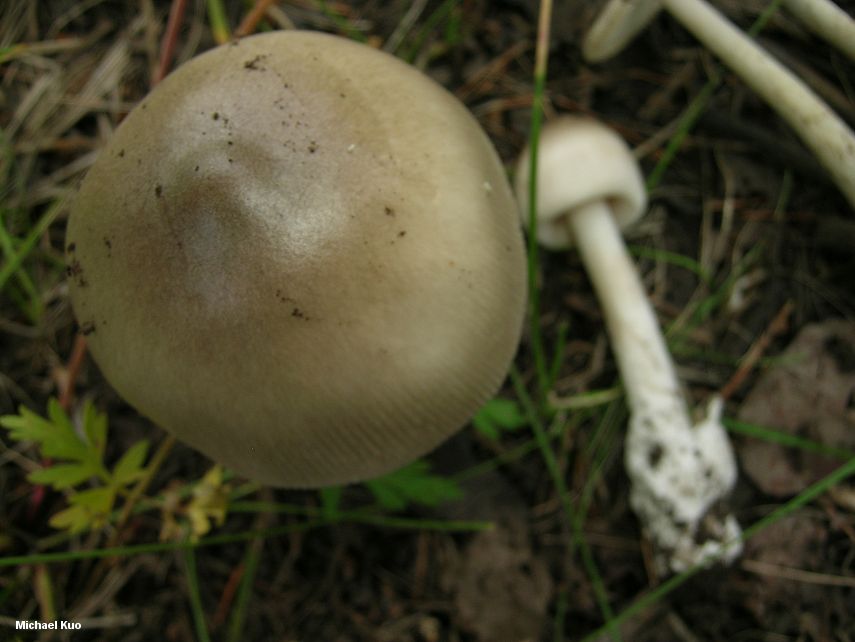
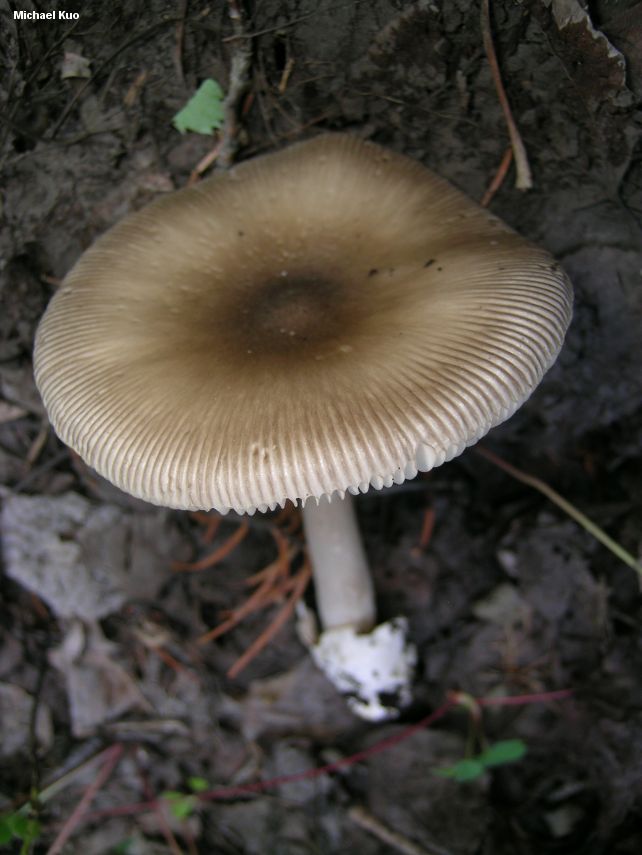
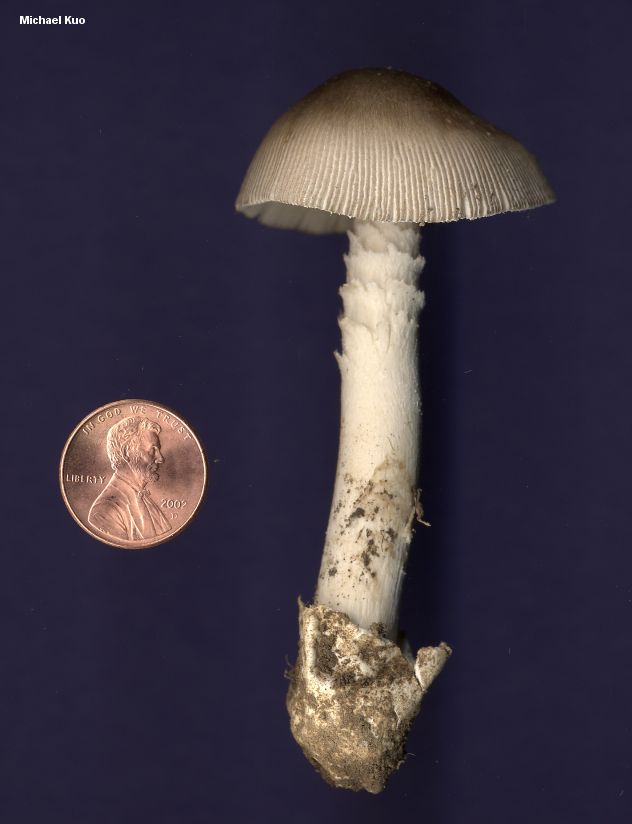
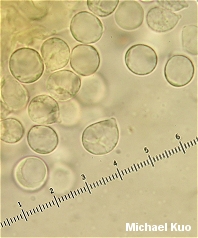
Amanita vaginata [ Basidiomycetes > Agaricales > Amanitaceae > Amanita . . . ] by Michael Kuo Amanita vaginata, sometimes called the "grisette" in field guides, is a gray to grayish brown species with a sacklike volva, a lined cap margin, and no ring on its stem. That's the theory, anyway. The reality is that you might as well call a mushroom that meets this description "Steve," if you want to be scientific. Perhaps there are a few highly variable species, and perhaps things like cap color, the "constrictedness" of the volva, and spore dimensions can accurately predict phylogenetically distinct species--but I doubt it. More likely, there are many North American species going under the classic European name "Amanita vaginata." Amanita expert Rod Tulloss treats literally dozens of unnamed, vaginata-like, numbered taxa ("species 46," and so on) in his keys to North American amanitas (2003, 2008)--all separated on putative morphological differences. In short, a comprehensive DNA and morphological study of well documented "Amanita vaginata" collections from across the continent will be required before there are "good names" for our North American species. "Amanita vaginata" is often found in urban settings or in public parks where the earth has been disturbed at some point in the relatively recent past. I find it in grassy areas at the edges of woods--or in lawns that are not meticulously manicured--more frequently than I find it in the woods. Description: Ecology: Mycorrhizal with oaks and other hardwoods, and with conifers; often found in disturbed ground settings in urban areas, state parks, and so on; late spring, summer and fall; widely distributed in North America. Cap: 3-10 cm; oval at first, becoming convex or nearly flat, with a central bump; sticky at first or when wet; gray to grayish brown; sometimes with a few scattered white to grayish patches; margin prominently lined or grooved for up to 1 cm or more. Gills: Free from the stem or slightly attached to it; white; close or crowded; short-gills present. Stem: 7-15 cm long; 0.5-2 cm thick; slightly tapering to apex; bald, or with a few grayish scales; lacking a ring; the base enclosed in a sacklike, white volva that fits loosely and sometimes discolors grayish or reddish brown. Flesh: White throughout; unchanging when sliced. Odor: Not distinctive. Chemical Reactions: KOH negative to yellowish on cap surface. Spore Print: White. Microscopic Features: Spores 8-12 µ; subglobose; smooth; inamyloid. Basidia 4-spored; unclamped. Pileipellis an ixocutis of hyphae 2-7 µ wide. Lamellar trama bilateral; subhymenium subcellular to cellular. REFERENCES: (Bulliard, 1783) Fries, 1821. (Saccardo, 1887; Kauffman, 1918; Smith, Smith & Weber, 1979; Thiers, 1982; Weber & Smith, 1985; Arora, 1986; Jenkins, 1986; States, 1990; Phillips, 1991/2005; Lincoff, 1992; Evenson, 1997; Barron, 1999; McNeil, 2006; Miller & Miller, 2006.) Herb. Kuo 09019516, 07200206, 08010205, 08290505, 07210704, 08150715, 08160713. This site contains no information about the edibility or toxicity of mushrooms. |
© MushroomExpert.Com |



|
Cite this page as: Kuo, M. (2013, May). Amanita vaginata. Retrieved from the MushroomExpert.Com Web site: http://www.mushroomexpert.com/amanita_vaginata.html |