| Major Groups > Gilled Mushrooms > Pale-Spored > Amanita > Amanita gemmata |

|
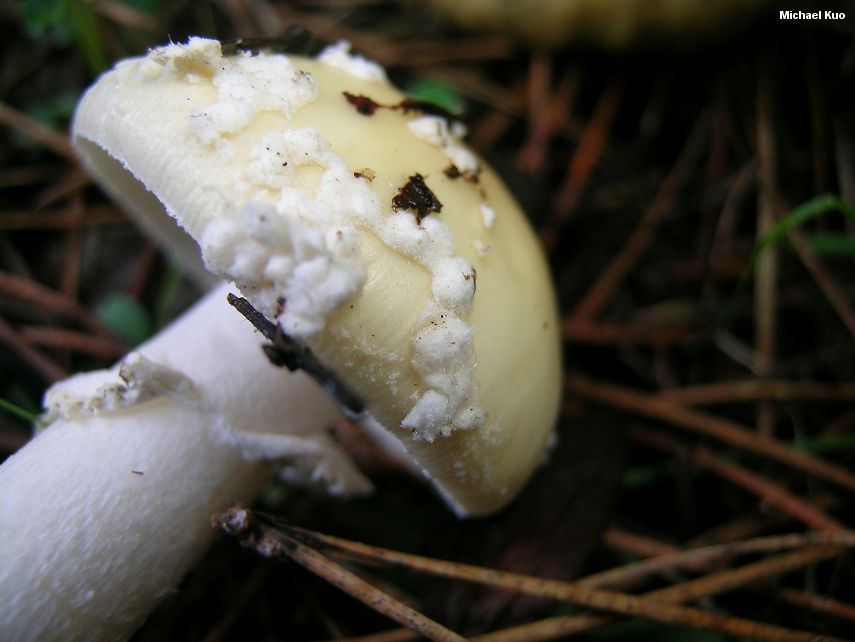
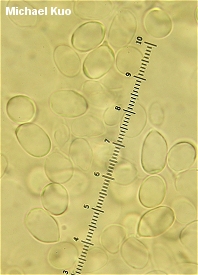
Amanita gemmata [ Basidiomycetes > Agaricales > Amanitaceae > Amanita . . . ] by Michael Kuo A lot of North American mushrooms are labeled "Amanita gemmata" by mushroom identifiers, and it is probable that none of them actually matches the European species first described by Swedish mycologist Elias Fries in 1838. Most North American Amanita experts treat our versions of the species as a group in need of further study. Despite being so taxonomically confusing, however, "Amanita gemmata" makes for a fairly easily recognized mushroom. The fresh cap is a dull but attractive shade of yellow, and is usually moist or sticky. White warts adorn the cap surface, but they are usually flimsy and easily washed away by rain; they often seem as though they might easily slide off the wet cap surface with no more than gravity to encourage them. The stem features a flimsy, easily-lost ring and, at its base, a flimsy white volva that often forms a small, free rim. I have found what I would call "Amanita gemmata" only in California; my eastern North American gemmata-like collections differ on several characters, and appear to match Amanita russuloides (see the linked page for a discussion of differences)--while my gemmata-like collections from the Rocky Mountains appear to match an unnamed species (see Amanita species 03). The illustrations to the right, along with the description below, represent the West Coast version of Amanita gemmata. Description: Ecology: Mycorrhizal with various hardwoods and conifers (Largent & collaborators [1980] document mycorrhizal association of Amanita gemmata with manzanita and lodgepole pine, while others report it under various hardwoods and conifers); growing alone, scattered, or gregariously; summer, fall, and winter; California and the Pacific Northwest. Cap: 3-11 cm; convex to planoconvex or flat; dull yellow, fading to nearly whitish; sticky when fresh; when young covered with white warts that are easily lost as the mushroom matures; bald; the margin often lined by maturity. Gills: Free from the stem; close or nearly distant; whitish; with frequent short-gills. Stem: 4-14 cm long; 1-2 cm thick; tapering slightly to the apex; with a small basal bulb; bald or finely hairy; white; with a fragile white ring that is easily lost; with a white volva that typically clings tightly to the bulb and extends to form a free rim on the upper edge of the bulb, but may fragment into soft patches or warts at the top of the bulb. Flesh: White; unchanging when sliced. Odor: Not distinctive. Chemical Reactions: KOH negative on cap surface. Spore Print: White. Microscopic Features: Spores 8-13 x 6.5-9 µ; broadly elliptical; smooth; inamyloid. Basidia 4-spored; without clamps. Pileipellis an ixocutis of hyphae 2-8 µ wide. Lamellar trama bilateral; subhymenium ramose or with slightly inflated cells. REFERENCES: (Fries, 1838) Bertillon, 1866. (Saccardo, 1887; Largent et al., 1980; Thiers, 1982; Weber & Smith, 1985; Arora, 1986; Jenkins, 1986; States, 1990; Lincoff, 1992; Barron, 1999; Miller & Miller, 2006; Trudell & Ammirati, 2009.) Herb. Kuo 01150601. This site contains no information about the edibility or toxicity of mushrooms. |
© MushroomExpert.Com |

|
Cite this page as: Kuo, M. (2013, April). Amanita gemmata. Retrieved from the MushroomExpert.Com Web site: http://www.mushroomexpert.com/amanita_gemmata.html |