| Major Groups > Gilled Mushrooms > Pale-Spored > Amanita > Amanita cokeri |

|
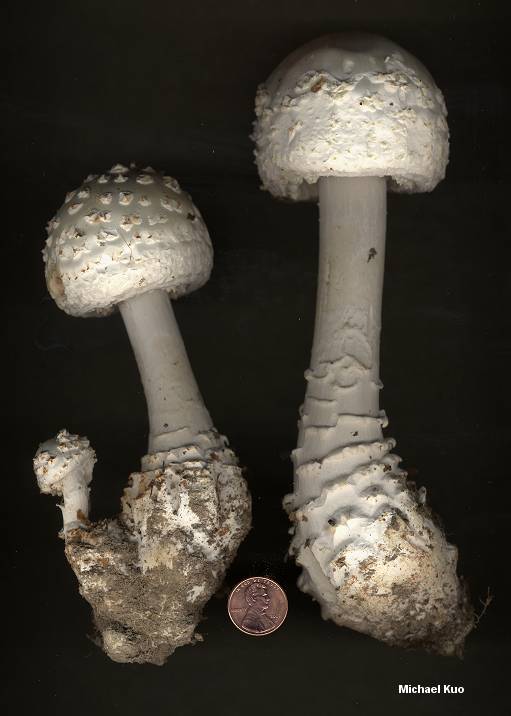
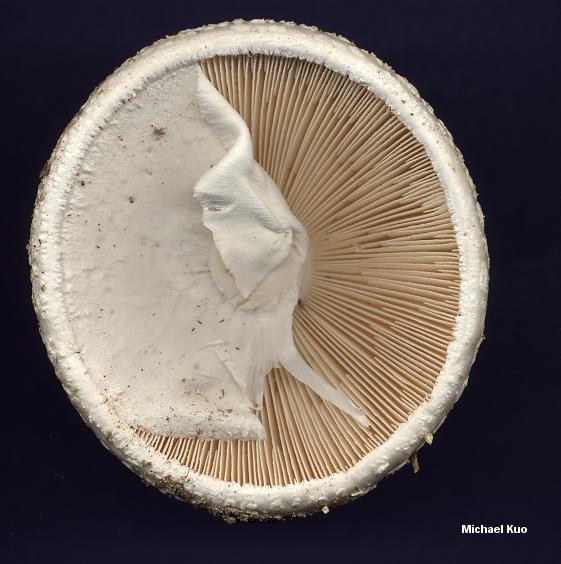
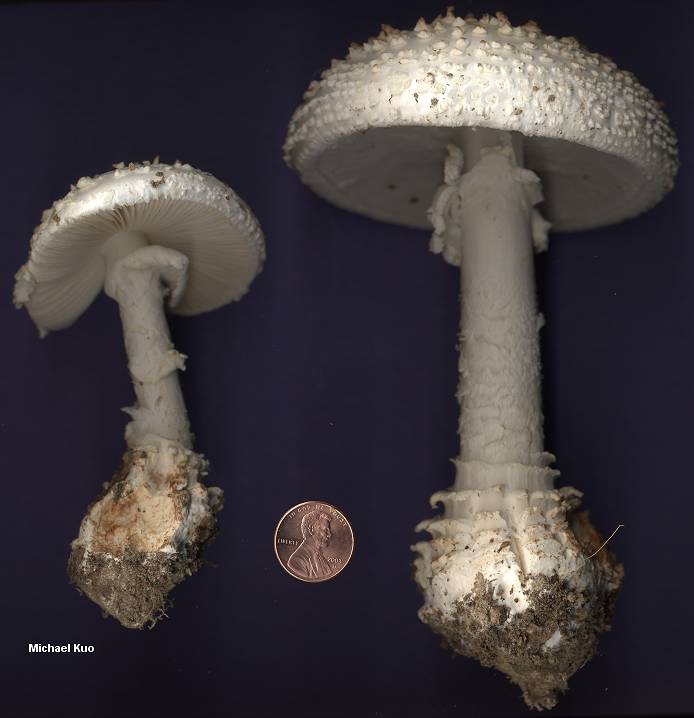
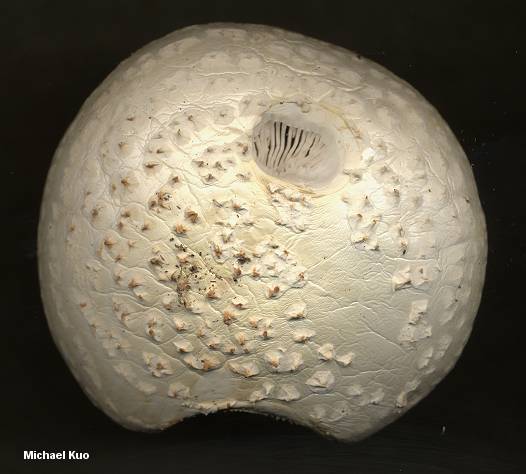
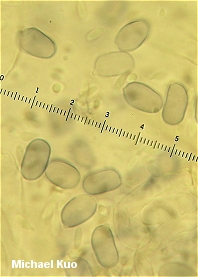
Amanita cokeri [ Basidiomycetes > Agaricales > Amanitaceae > Amanita . . . ] by Michael Kuo I doubt I have collected a more beautiful mushroom than this one. Amanita cokeri takes my breath away every time I find it--which, unfortunately, is not often. Field guides feature Amanita cokeri fairly regularly, but always warn the reader that many look-alikes exist, and that positive identification is therefore unlikely. While this is true in a general sense (there are over 40 white Amanita species, most of which have white warts), I don't think the endeavor is impossible or futile; in fact, with careful observation of macrofeatures one can narrow the possibilities down pretty substantially--and with the simplest of microscopic analyses (viewing spores), one can reach a fair level of identification confidence with many of these mushrooms. Amanita cokeri is actually pretty distinctive among the "Lepidellas" and other white amanitas. As is usually the case with Amanita species, a close look at the stem base is the starting point. Amanita cokeri has a fairly thick basal bulb that extends a shallow "root" into the ground (if the root is very long, however, you have found something else). At the top of the bulb and on the lower portion of the stem, there are more or less concentric bands of large, peeled-back scales. Aside from the stem base, distinctive features of Amanita cokeri include the cap scales, which are large and pointy and become brownish; the ellipsoid, amyloid spores; and the very thick ring, which is often double-edged, lined on the top, and shaggy below (note that the right-hand specimen in the fourth illustration is obviously going to produce a double ring, since one ring is already hanging on the stem while the partial veil still covers the gills). Description: Ecology: Mycorrhizal with hardwoods or conifers; growing alone, scattered, or gregariously; summer and fall; distribution centered in the southeastern United States, but ranging throughout much of eastern North America. Cap: 6-20 cm; oval or convex, expanding to convex or planoconvex; dry or sticky when wet; white; bald; covered with fairly large, pointed, white to brownish or reddish brown warts; the margin not lined. Gills: Free from the stem or slightly attached to it; nearly distant; white or creamy; with frequent short-gills. Stem: 10-15 cm long; 1-2 cm thick; tapering slightly to apex; white; bald above or somewhat shaggy; with a fairly large basal bulb that is shallowly "rooted"; with more or less concentric zones of distinctive, down-turned scales on the upper bulb and lower stem; with a thick, persisting, skirtlike ring that is often double or double-edged (or often lined on the upper side and shaggy beneath); sometimes bruising and staining reddish or rusty, especially on the bulb. Flesh: White; not staining on exposure. Odor: Not distinctive. Chemical Reactions: KOH on cap surface negative. Spore Print: White. Microscopic Features: Spores 10-13 x 6-7.5 µ; elliptical; smooth; amyloid. Basidia 4-spored; clamped. Pileipellis an ixocutis of hyphae 2-7 µ wide. Lamellar trama bilateral. REFERENCES: (Gilbert & Kühner, 1928) Gilbert, 1941. (Smith, Smith & Weber, 1979; Weber & Smith, 1985; Jenkins, 1986; Phillips, 1991/2005; Lincoff, 1992; Metzler & Metzler, 1992; Roody, 2003; Miller & Miller, 2006; Binion et al., 2008.) Herb. Kuo 07129701, 07280301, 06290706. This site contains no information about the edibility or toxicity of mushrooms. |
© MushroomExpert.Com |

|
Cite this page as: Kuo, M. (2013, March). Amanita cokeri. Retrieved from the MushroomExpert.Com Web site: http://www.mushroomexpert.com/amanita_cokeri.html |