| Major Groups > Gilled Mushrooms > Pale-Spored > Amanita > Amanita brunnescens |

|
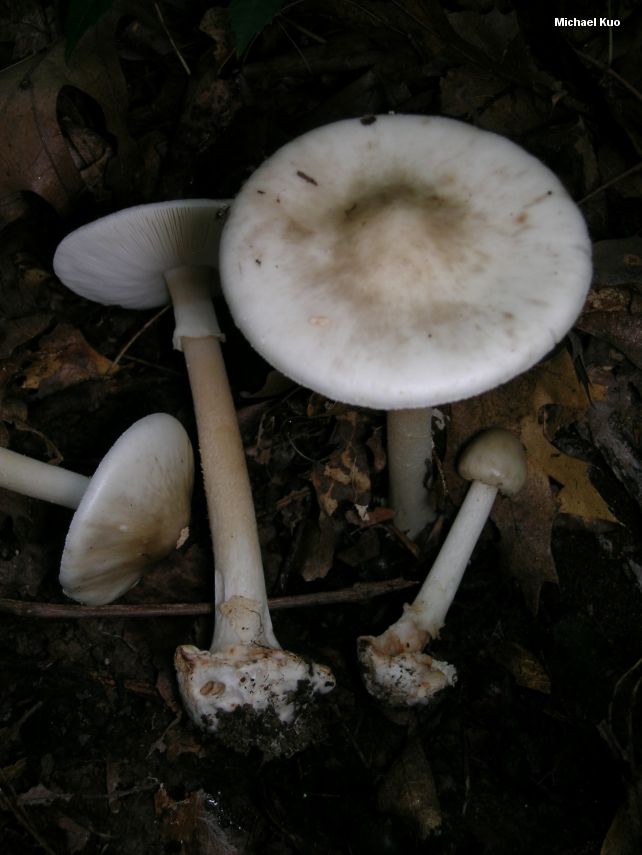
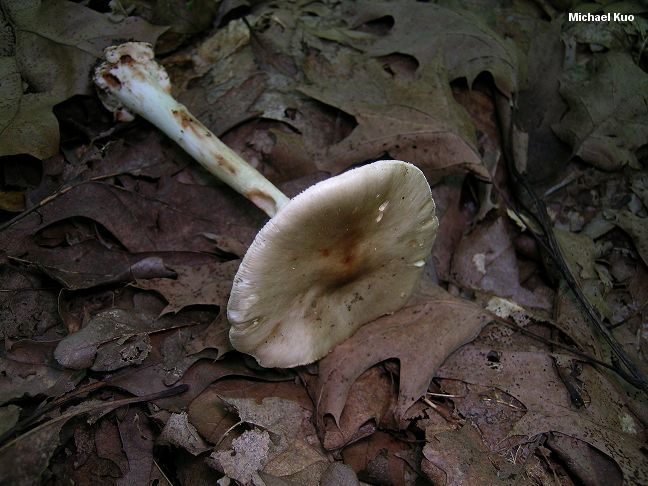
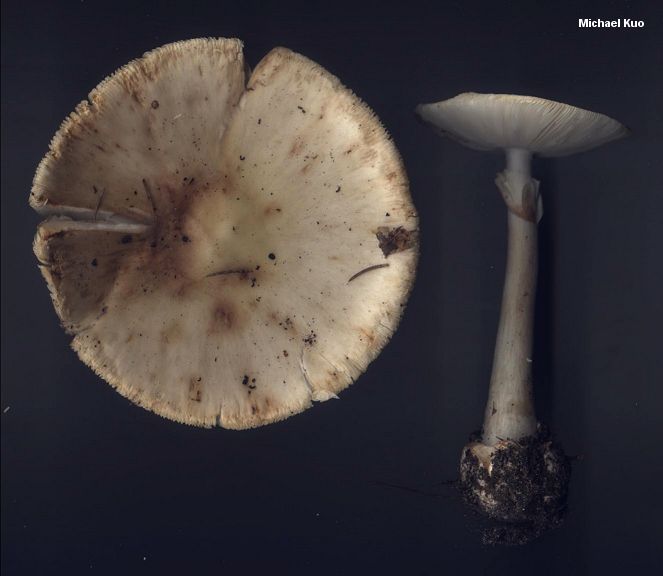
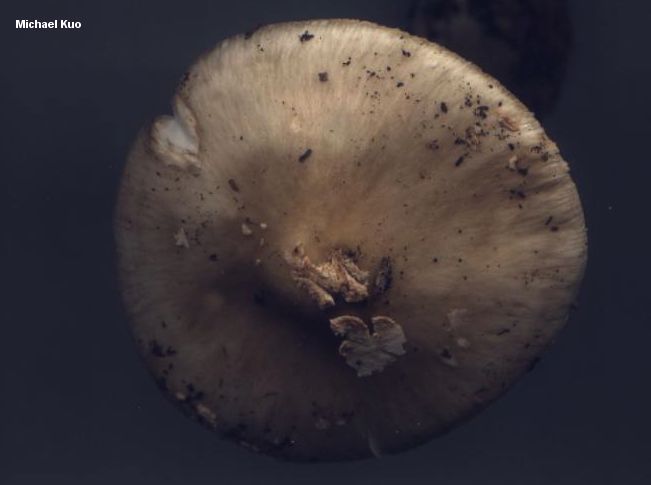
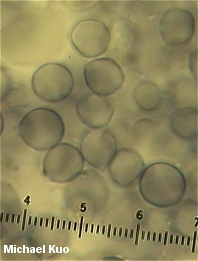
Amanita brunnescens [ Basidiomycetes > Agaricales > Amanitaceae > Amanita . . . ] by Michael Kuo Sometimes called the "cleft-foot Amanita," this eastern North American species features a variable, brown to whitish cap. The distinguishing feature of this relatively easily recognized mushroom is its stem, which, when acting the way it's supposed to, ends in an abrupt basal bulb that is split or "chiseled" in one or more places, and discolors reddish brown. Unfortunately for would-be Amanita identifiers, however, Amanita brunnescens hasn't read much Amanita literature and does not always manifest a perfectly bulbous, chiseled stem base; collections with wimpy, non-chiseled bases can be difficult to identify. Amanita brunnescens var. pallida, recognized by some authors, is virtually identical, but has a nearly white cap. I have collected it growing alongside the typical, brown variety, and I have seen specimens that seemed to "intergrade" between the colors of the putative varieties; for this reason I am treating var. pallida as a synonym of the type variety. Description: Ecology: Mycorrhizal with various hardwoods and conifers; growing alone, scattered, or gregariously; summer and fall; widely distributed and common east of the Rocky Mountains. Cap: 3-11 cm, convex, becoming broadly convex with a shallow central bump, or nearly flat; tacky at first or when wet; varying in color from grayish brown to whitish, often with a darker center; sometimes developing reddish brown stains; often somewhat streaked or mottled in appearance; usually featuring a few scattered, randomly distributed white to grayish or tan warts; the margin often becoming faintly lined for a few mm. Gills: Free from the stem; white; close or crowded; not discoloring, or sometimes discoloring brownish. Stem: 6-12 cm long; 0.5-1.5 cm thick above the bulb; tapering to apex; bald or silky; with a relatively persistent, skirtlike, white ring that sometimes develops a reddish brown edge and often collapses against the stem; usually ending in an abrupt, rimmed basal bulb that is "chiseled" or split vertically in one or more places; discoloring and bruising reddish brown, especially near the base; volval remnants usually absent but occasionally present as a few patches along the upper rim of the bulb. Flesh: White throughout; firm; not discoloring, or sometimes discoloring or bruising reddish brown, especially around worm channels. Odor: Not distinctive. Chemical Reactions: KOH on cap surface negative; on flesh in stem base slowly slightly yellowish. Spore Print: White. Microscopic Features: Spores 6.5-10 µ; smooth; globose or subglobose; amyloid. Basidia without basal clamps; 4-spored. Pileipellis a cutis or ixocutis of hyphae 2-6 µ wide. Lamellar trama bilateral; subhymenium ramose or with inflated cells. REFERENCES: Atkinson, 1918. (Smith, 1949; Smith, Smith & Weber, 1979; Arora, 1986; Jenkins, 1986; Phillips, 1991/2005; Lincoff, 1992; Metzler & Metzler, 1992; Barron, 1999; Roody, 2003; McNeil, 2006; Miller & Miller, 2006; Binion et al., 2008; Tulloss, cont. upd.) Herb. Kuo 06229501, 07200203, 07200204, 07200205, 06120301, 07160703, 07100802, 10170904, 06221010. This site contains no information about the edibility or toxicity of mushrooms. |
© MushroomExpert.Com |

|
Cite this page as: Kuo, M. (2013, March). Amanita brunnescens. Retrieved from the MushroomExpert.Com Web site: http://www.mushroomexpert.com/amanita_brunnescens.html |