| Major Groups > Gilled Mushrooms > Pale-Spored > Amanita > Amanita aprica |

|
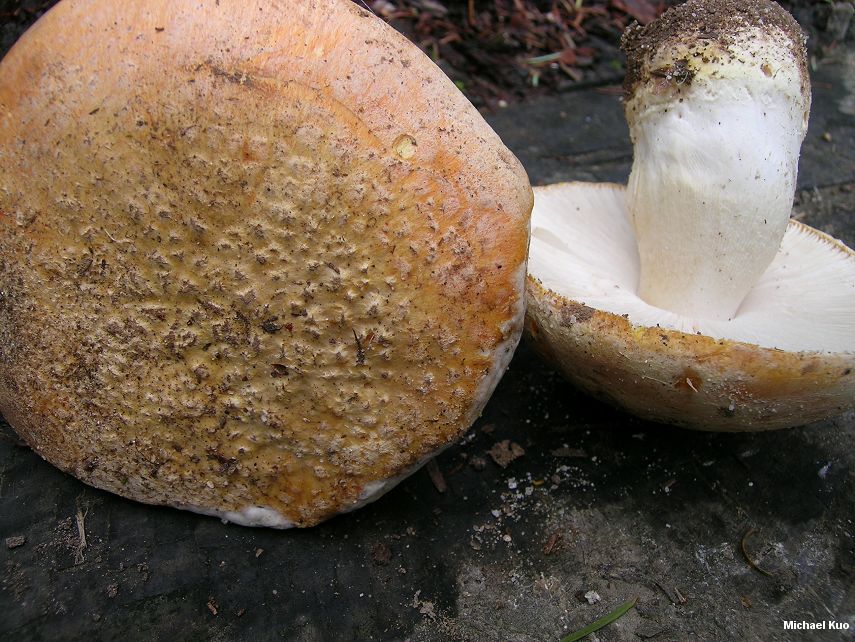
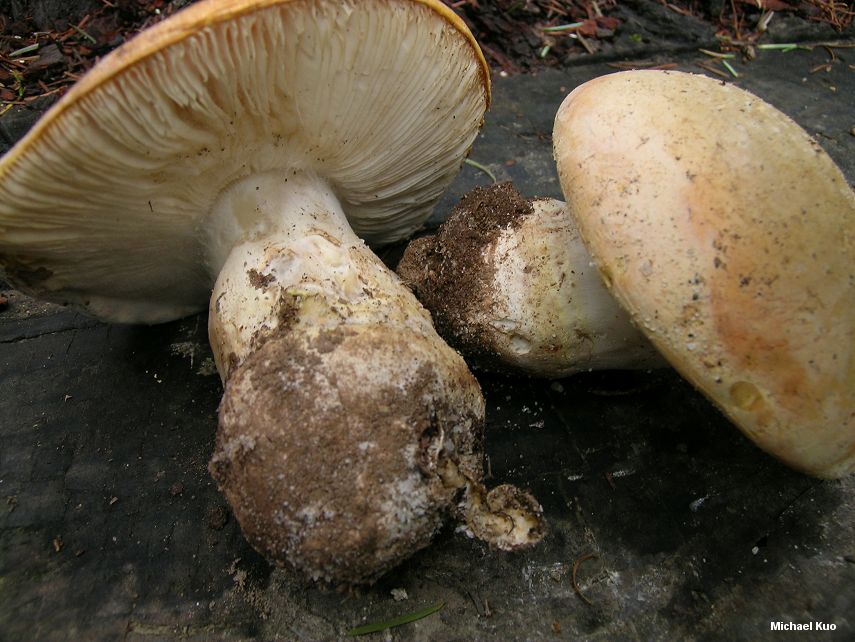
Amanita aprica [ Basidiomycetes > Agaricales > Amanitaceae > Amanita . . . ] by Michael Kuo This stocky but beautiful species of Amanita is one of the few amanitas I have seen that might easily be mistaken for a member of some other genus; its proportions and oddly disposed veil remnants are not "typical" of amanitas. Amanita aprica is found in northern California and the Pacific Northwest, under Douglas-fir and pines. The orange-yellow cap, when young, features a frosty coating of whitish universal veil material that is tightly adherent, and doesn't quite qualify as warts or patches. The stem base displays a volva that typically has a small, freely extending portion (a "limb," in Mycologese) but can become stretched out and poorly defined, or even appear like basal "rings" of tissue. The true ring of Amanita aprica sits higher on the stem, but can collapse against the stem surface or disappear altogether. Thanks to University of California Herbarium for facilitating my study of the collection cited and described below. Description: Ecology: Mycorrhizal with Douglas-fir and pines (species of Pinus); growing alone or gregariously; often appearing in sun-lit patches (windfall breaks in the canopy, paths, and so on); winter and spring; distribution limited to the Pacific Northwest. Cap: 5-15 cm; convex, expanding to planoconvex or flat; bright orange-yellow but often fading with age; when young usually covered with tightly adherent, frost-like, whitish universal veil material; the margin faintly lined or not. Gills: Free from the stem; close or nearly distant; creamy; with frequent short-gills. Stem: 3.5-9 cm long; up to 3.5 cm thick; equal; whitish; sometimes bruising and discoloring brownish; bald or finely hairy; with a fragile whitish ring that often collapses or may disappear; without a prominently swollen base; with a whitish volva that usually has a free upper edge but may appear as "rings" near the base of the stem or as indistinct, appressed material. Flesh: White; unchanging when sliced. Odor: Not distinctive. Spore Print: White. Microscopic Features: Spores 8-13 x 6-8.5 µ; ellipsoid; smooth; inamyloid. Basidia 4-spored; infrequently clamped. Pileipellis a cutis of elements 2-7 µ wide. Lamellar trama bilateral; subhymenium with inflated cells. REFERENCES: Tulloss & Lindgren, 2005. (Trudell & Ammirati, 2009; Tulloss, 2013.) Herb. UC 1999116 (EP Blanchard 31). This site contains no information about the edibility or toxicity of mushrooms. |
© MushroomExpert.Com |

|
Cite this page as: Kuo, M. (2013, July). Amanita aprica. Retrieved from the MushroomExpert.Com Web site: http://www.mushroomexpert.com/amanita_aprica.html |