| Major Groups > Clubs & Corals > Trichoglossum hirstutum |

|
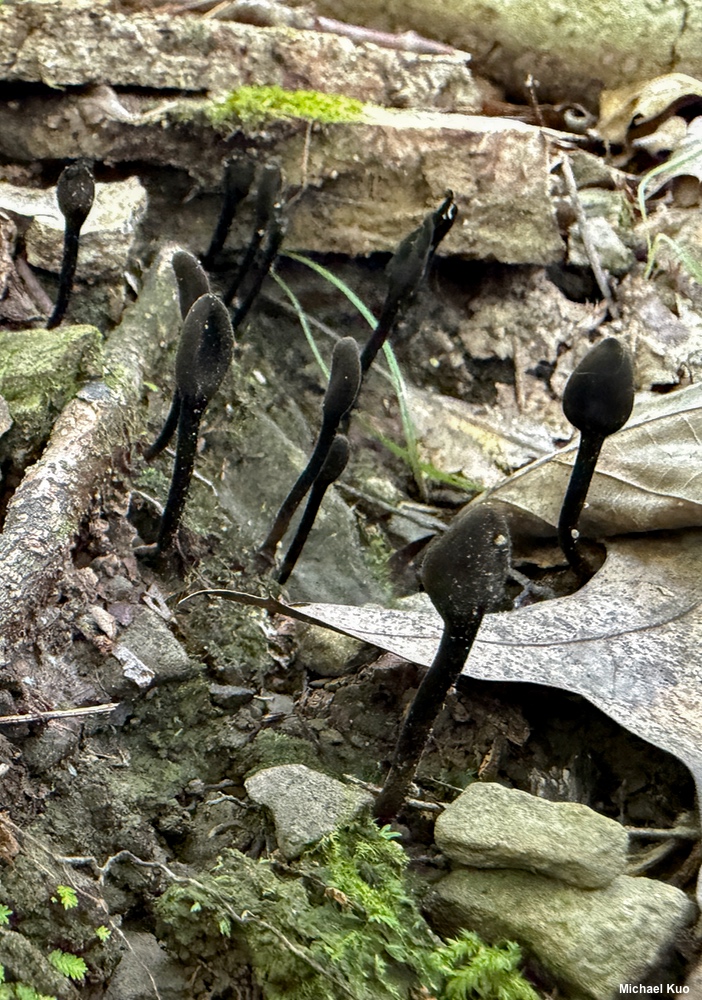
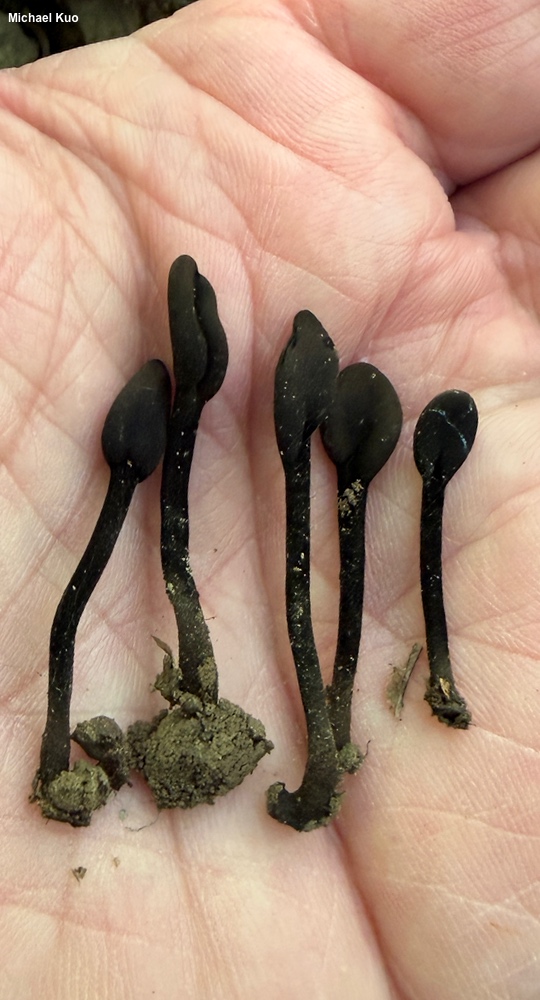
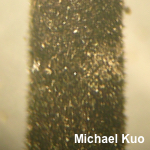
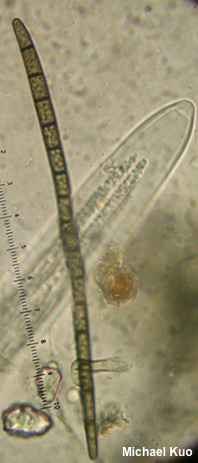
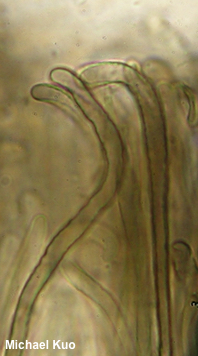
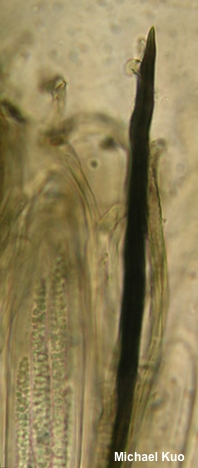
[ Ascomycota > Geoglossales > Geoglossaceae > Trichoglossum ... ] Trichoglossum hirstutum by Michael Kuo, 3 August 2026 Yet another tiny, black "earth tongue" in the Geoglossaceae family (should we call them the Glossums?), Trichoglossum hirsutum is covered with tiny bristles—so tiny that you may need a hand lens to see them. The bristles narrow down the identification choices somewhat, but microscopic features will have to be assessed, as well: the asci pack eight (rather than four) spores together, and the spores themselves are quite long, featuring 15 septa. According to Hustad et al. (2013), "[a] preliminary phylogeographic analysis using ITS nrDNA indicates that T. hirsutum is not monophyletic and cryptic speciation is likely to have occurred in this morphological species complex." Translation: somebody's prolly gonna come along and split "Trichoglossum hirsutum" into 27 ½ different species that can't be separated without DNA analysis, and all this golly-glossum fun we're having will come to a crashing halt. Sigh . . . Description: Ecology: Saprobic; growing alone, scattered, or gregariously, often in moss, but also on bare soil or from rotted wood in hardwood and conifer forests; summer and fall, or over winter in warm climates; originally described from Europe (Persoon 1797); widely distributed in Europe and North America; also reported from the Caribbean, Central America, South America, Oceania, and western Asia. The described and illustrated collection is from Ohio. Fruiting Body: Club-shaped, with a well defined head that is clearly separate from the stem; 35–50 mm high. Head: 6–11 mm high; 4–8 mm wide; flattened and somewhat two-dimensional; elliptic to spear-shaped, or somewhat irregular; usually developing a broad longitudinal groove; black; very finely velvety (best seen with a lens); dry. Stem: 20–40 mm high; 2–3 mm wide; finely velvety to finely hairy (best seen with a lens); black; dry; basal mycelium black. Flesh: Thin; whitish; not changing when sliced. Odor: Not distinctive. Microscopic Features: Spores 128–170 x 5–6 µm; narrowly fusiform; smooth; with 15–16 septa; with brown walls and ochraceous, granular contents in KOH, with darker brown septa. Asci 8-spored; to 225 x 22 µm. Paraphyses 2–3 µm wide; filiform, with rounded, "hooked," or slightly bent apices; septate; smooth; brown in KOH. Setae scattered throughout hymenium; 170–250 x 4–9 µm; narrowly fusiform; sometimes flexuous; smooth; black in KOH. Setae on stem surface densely packed, similar to hymenial setae but generally longer. REFERENCES: (C. H. Persoon, 1797) J. L. E. Boudier, 1907. (Fries, 1821; Seaver, 1951; Mains, 1954; Dennis, 1968; Phillips, 1981; Smith, Smith & Weber, 1981; Breitenbach & Kränzlin, 1984; Lincoff, 1992; Mraz, 1997; Barron, 1999; Roody, 2003; McNeil, 2006; Ridge, 2006; Kučera et al., 2008; Hladki & Romero, 2009; Trudell & Ammirati, 2009; Trierveiler-Pereira & Bezerra, 2011; Hustad et al., 2013; Beug et al., 2014; Desjardin, Wood & Stevens, 2016; Siegel & Schwarz, 2016; Elliott & Stephenson, 2018; Ekanayaka et al., 2017; Gminder & Böhning, 2017; MacKinnon & Luther, 2021; McKnight et al., 2012; Læssøe & Petersen, 2019; Dasgupta et al., 2022; de la Fuente et al., 2022.) Herb. Kuo 07232601. This website contains no information about the edibility or toxicity of mushrooms. |
© MushroomExpert.Com |
|
Cite this page as: Kuo, M. (2026, July). Trichoglossum hirstutum. Retrieved from the MushroomExpert.Com Web site: http://www.mushroomexpert.com/trichoglossum_hirstutum.html |