| Major Groups > Gilled Mushrooms > Pink-Spored > Pluteus > Pluteus brunneidiscus |

|
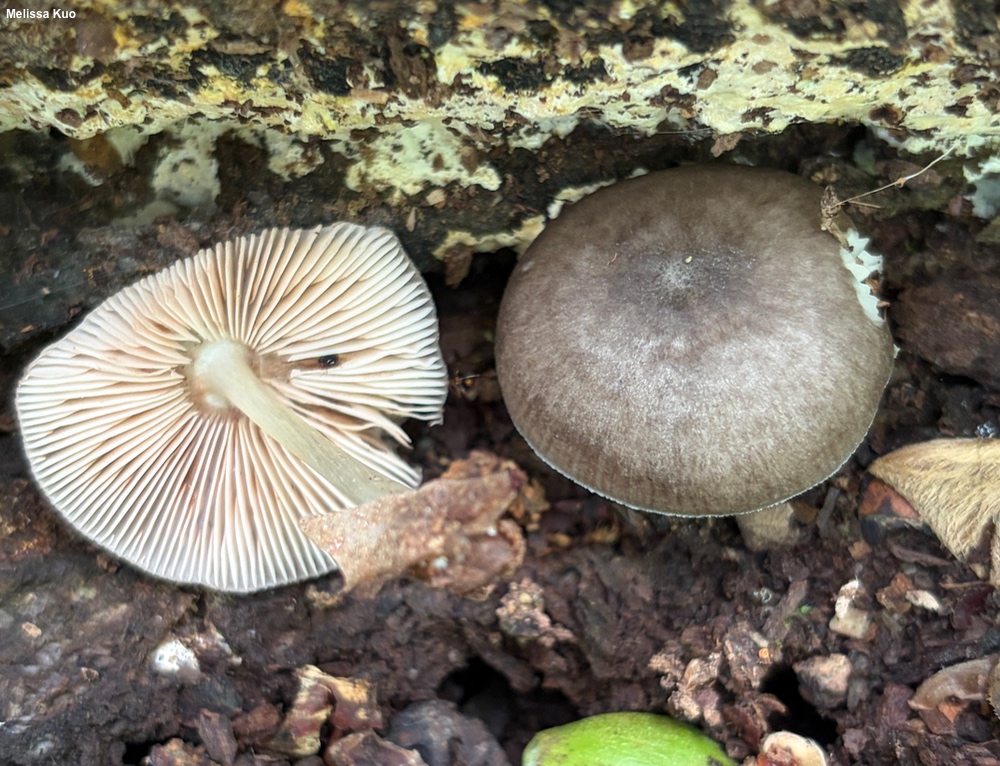
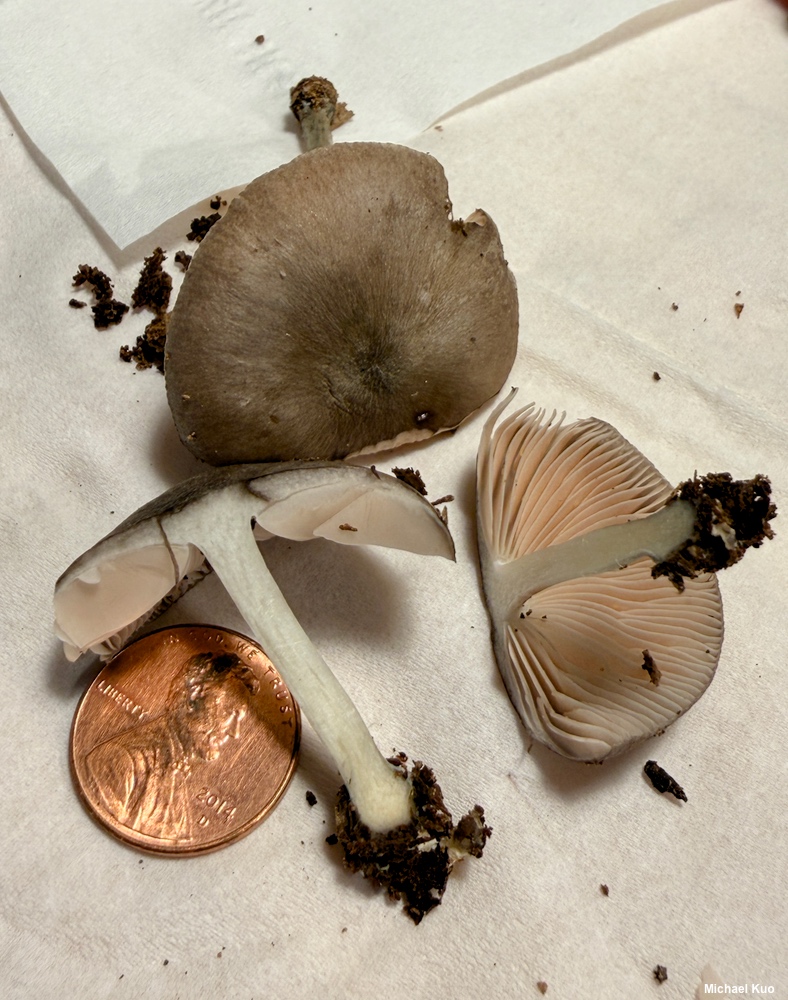
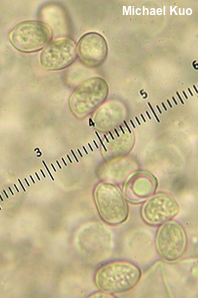
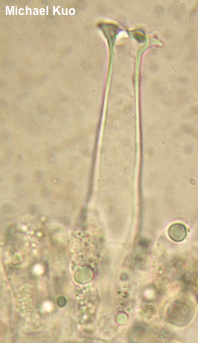
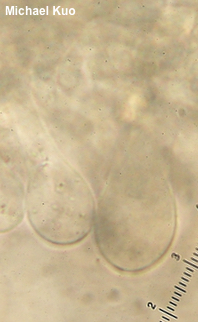
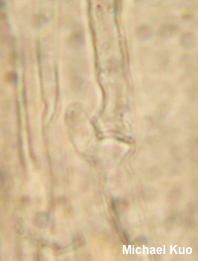
[ Basidiomycota > Agaricales > Pluteaceae > Pluteus . . . ] Pluteus brunneidiscus by Michael Kuo, 1 July 2026 This is a small to medium-sized, rare Pluteus requiring microscopic examination for confident identification. Like other species in the genus it grows on wood and features gills that are free from the stem and become pink at maturity. Crucial identification features include its "antlered" and thick-walled pleurocystidia, its club-shaped cheilocystidia, the presence of clamp connections, and the fact that it appears on the deadwood of hardwoods, rather than conifers. There are many similar Pluteus species; I will call to your attention only Pluteus saupei, with prong-less or short-pronged pleurocystidia—and Pluteus hibbettii, Pluteus arizonicus, and Pluteus methvenii, which favor the wood of conifers. Pluteus washingtonensis is a synonym. Description: Ecology: Saprobic on decaying hardwood logs; growing alone or gregariously; summer and fall in temperate climates, or over winter in California; originally described from Connecticut (Murrill 1917); rare, but widely distributed in North America, with precise distribution limits yet to be established; also present in northwestern Russia and Siberia. The illustrated and described collection is from Ohio. Cap: 3–4.5 cm; convex, becoming broadly convex or nearly flat; fragile; dry; bald; gray-brown to dark brownish gray; the margin becoming finely lined. Gills: Free from the stem; close; short-gills frequent; whitish at first, becoming pinkish. Stem: 3–5 cm long; 2–4 mm thick; equal; bald; whitish; not bruising; basal mycelium white. Flesh: Insubstantial; white; not changing when sliced. Odor: Radishlike. Chemical Reactions: KOH on cap surface negative. Spore Print: Brownish pink. Microscopic Features: Spores 6–8 x 4–5 µm; broadly ellipsoid to subglobose; smooth; hyaline in KOH; inamyloid. Basidia 28–30 x 5–7 µm; clavate; 4-sterigmate. Cheilocystidia 30–45 x 12–15 µm; clavate; smooth; thin-walled; hyaline in KOH. Pleurocystidia 45–80 x 9–15 µm; sublageniform to subutriform, with a flared apex bearing 3–4 entire hooks; smooth; walls 1–2 µm thick; hyaline in KOH. Pileipellis a cutis; elements 7–20 µm wide, smooth, brown in KOH; terminal cells cylindric with rounded apices; clamp connections present. REFERENCES: W. A. Murrill, 1917. (Singer, 1956; Banerjee & Sundberg, 1995; Justo et al., 2011; Justo et al., 2014; Justo & Clements, 2024.) Herb. Kuo 06202601. This site contains no information about the edibility or toxicity of mushrooms. |
© MushroomExpert.Com |
|
Cite this page as: Kuo, M. (2026, July). Pluteus brunneidiscus. Retrieved from the MushroomExpert.Com Web site: http://www.mushroomexpert.com/pluteus_brunneidiscus.html |